Eruzioni cutanee
Revisione paritaria di Dr Colin Tidy, MRCGPUltimo aggiornamento di Dr Hayley Willacy, FRCGP Ultimo aggiornamento 14 Feb 2024
Rispetta le linee guida editoriali
- ScaricaScarica
- Condividi
- Language
- Discussione
- Versione audio
- Add to preferred sources on Google
There are many different types of skin rashes and many different causes of skin rashes. Although most skin rashes are harmless, some do need treatment (which may be tablets, creams or ointments) from your doctor or pharmacist.
Some rashes (especially dark red or purple rashes that don't fade when you press them) may even need urgent medical treatment as they can be associated with meningitis and blood infection (septicaemia).
At a glance
Rashes can be described by their appearance, such as redness or flat spots.
Macules are flat, abnormally coloured skin areas, while papules and nodules are solid raised areas.
Blisters are fluid-filled swellings, with vesicles being small and bullae larger.
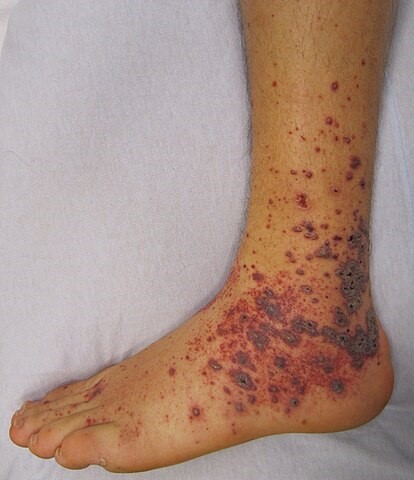
Purpura are reddish-purple lesions that do not fade with pressure.
Common causes of rashes include infections, allergic reactions, and skin conditions like eczema or psoriasis.
See a doctor urgently if a rash doesn't fade with pressure, you feel unwell, or are concerned.
In questo articolo:
Video picks for Eruzioni cutanee
This leaflet is a guide but if you have any concerns, you must seek urgent clinical assessment if:
The rash doesn't quickly disappear.
You feel unwell.
The rash does not fade with pressure (the best way to test this is to press a glass gently against the rash to see if it fades).
Continua a leggere sotto
How are skin rashes described?
Skin rashes can be described in the following way:
Redness of the skin (called eritema).
Flat abnormally coloured areas of skin (called macules). Macules are often either red, dark red or purple, brown or white.
Solid raised areas which are up to half a centimetre across (called papules).
Solid raised areas which are more than half a centimetre across (called nodules).
Areas of red raised skin (called plaques) e scales, which have a flaky silvery-white appearance.
Reddish-purple lesions which do not fade with pressure (called porpora):
If less than one centimetre across then these are called petechiae.
If more than one centimetre across then they are called ecchymoses.
Blisters: these are swellings of the skin containing fluid:
If a blister is less than half a centimetre across then it is called a vesicle. If filled with yellow fluid (pus) then it is called a pustule.
If a blister is larger than half a centimetre across it is called a bulla (plural is bullae).
What skin conditions cause itching?
Torna ai contenutiSkin disorders that can cause itching include (please click the links to separate leaflets which provide further information):
Pelle secca.
Continua a leggere sotto
What causes skin rashes?
Torna ai contenutiPlease click the links to separate leaflets which provide further information:
Red (erythema) but not scaly skin rash
A skin infection called cellulite.
An allergic reaction called orticaria.
Reaction to a medicine you are taking.
Eruzioni virali - eg, morbillo oppure rubella (German measles).
Vasculitis. This is a condition involving inflammation of blood vessels, which may occur with various illnesses, including artrite reumatoide.
Eritema nodoso. This is a condition which causes red rounded lumps (nodules), most commonly on the shins.
Redness on the palms of your hands may be caused by liver disease, pregnancy or an ghiandola tiroidea iperattiva (ipertiroidismo).
A red rash may occasionally be due to an inflammatory condition called lupus eritematoso sistemico, especially if it is on the cheeks.
Red (erythema) and scaly skin rash
Psoriasi. This is a condition where there is inflammation of the skin.
Eczema. This is sometimes called dermatitis and also involves inflammation of the skin. It may be caused by an allergy and is then called atopic dermatitis/eczema. This may happen in response to some plants - eg, poison oak or ivy.
Dermatite seborroica (in adults). This is a type of skin rash sometimes called seborrhoeic eczema. In babies it is known as cradle cap.
Fungal (or 'yeast') skin infection, such as il piede d'atleta, groin infection (tinea cruris), ringworm, scalp ringworm or infection with candida.
Pitiriasi rosea. This condition is described as 'self-limiting' and the rash will clear itself naturally.
Pitiriasi versicolor. This is a rash which is caused by a yeast-like germ.
Lichen planus. This condition mainly affects the skin and causes an itchy rash.
Macules
Red macules may be due to a reaction to a medicine or a eruzione cutanea virale - such as morbillo oppure rosolia - as well as other causes.
A brown macule may be a mole but check with your doctor if a mole changes or you are concerned it might be a melanoma.
A white macule may be due to a condition which causes pale patches of skin (called vitiligine) or a skin complaint with flaky discoloured areas (called pityriasis versicolor).
If a macule is dark red or purple and does not fade when you put pressure on it then it is a purpura (see below) and you need to see a doctor urgently. This is because it could be a sign of meningite or blood infection (setticemia).
Papules
Common causes of papules include cicatrici da acne, viral wart, seborrhoeic wart, mollusco contagioso, scabbia, morsi di insetto and skin tags.
Other causes include psoriasi.
Purpura and petechiae
These are dark red or purple and don't fade when you press them. You need to see a doctor urgently because there may be a serious cause that needs urgent treatment, such as meningococcal infection.
However, common causes include injury to the skin or repeated coughing. More serious common causes include liver disease such as cirrosi.
Less common causes include vasculitis (eg, Porpora di Henoch-Schönlein) or a low level of platelets in your blood (eg, porpora trombotica trombocitopenica).
Vasculite
© James Heilman, MD, CC BY-SA 3.0, via Wikimedia Commons
Nodules
Common causes of a nodule include a cisti sebacea, lipoma, cancro della pelle, or a wart.
Other causes include rheumatoid nodules (associated with artrite reumatoide) and Heberden's nodes (associated with osteoartrite).
Blisters
Skin inflammation, including reactions to medicines, dermatite da contatto, eczema. Eczema on your legs may be caused by varicose veins (eczema varicoso).
Diseases of your immune system - eg, bullous pemphigoid.
Viral infections - eg, varicella, malattia mani-piedi-bocca.
Skin infection: a germ (bacterial) infection with impetigine or viral infection with herpes simplex (herpes labiale oppure herpes genitale) or with herpes zoster (shingles).
Rarer causes include pemfigo e pemfigoide.
Pustules
Skin infection by a virus (eg, herpes labiale due to herpes simplex virus) or bacterial germs (impetigine).
Inflammation - eg psoriasi.
Pustular skin reaction to medicine you are taking.
Pustules on your face may be acne or rosacea.
Ulcere
Ulcers may be due to venous leg ulcers, ulcere da pressione, diabetes skin ulcers oppure cancerous (malignant) skin ulcers.
This leaflet is a guide but if you have any concerns, you must telephone or see your GP, especially if:
The rash doesn't quickly disappear.
You feel unwell.
The rash does not fade with pressure (the best way to test this is to press a glass gently against the rash to see if it fades).
You are not sure what has caused the rash or have any other concerns.
Patient picks for Eruzioni cutanee

Salute della pelle, delle unghie e dei capelli
Pitiriasi rosea
La pitiriasi rosea è un'eruzione cutanea autolimitante, in altre parole scompare da sola senza alcun trattamento. Sebbene l'eruzione possa essere piuttosto evidente, la malattia è molto lieve. Colpisce più comunemente i giovani adulti ma può interessare tutte le età.
by Dr Hayley Willacy, FRCGP

Salute della pelle, delle unghie e dei capelli
Rosacea
La rosacea è una condizione della pelle che colpisce alcune parti del viso. I sintomi possono includere arrossamento del viso, rossore, foruncoli, ispessimento della pelle e problemi agli occhi come occhi secchi e palpebre infiammate. Non tutti i sintomi si presentano in ogni caso. La rosacea colpisce circa 1 persona su 20 nel Regno Unito, di solito in età adulta. Molti casi sono lievi. I foruncoli possono di solito essere trattati con antibiotici. Altri trattamenti possono essere usati per altri sintomi. Una complicanza che interessa la parte anteriore dell'occhio (la cornea) è rara ma grave. Consultare urgentemente un medico se si ha la rosacea e si sviluppano dolore agli occhi o problemi visivi.
di Dott.ssa Rosalyn Adleman, MRCGP
Domande frequenti
What does it mean if a rash doesn't fade when I press on it?
If a rash, particularly if it's dark red or purple, does not fade when you apply pressure (e.g., with a glass), it's called purpura. This needs urgent medical attention as it can be a sign of serious conditions like meningitis or a blood infection. Common causes also include injury or repeated coughing, but less commonly it could be due to vasculitis or a low level of platelets.
Can certain medications cause a skin rash?
Yes, a skin rash can be a reaction to a medicine you are taking. This can manifest as red (erythema) but not scaly skin, or even lead to blisters or pustules as a reaction.
What are some common reasons for red, scaly skin rashes?
Red and scaly skin rashes can be caused by conditions such as psoriasis, eczema (sometimes called dermatitis), seborrhoeic dermatitis (known as cradle cap in babies), fungal skin infections (like athlete's foot or ringworm), pityriasis rosea, pityriasis versicolor, lupus erythematosus, and lichen planus.
Are all moles considered a type of macule?
A brown macule may indeed be a mole. However, it's important to check with your doctor if a mole changes in appearance or if you are concerned it might be a melanoma, which is a type of skin cancer.
What causes blisters on the skin?
Blisters can be caused by skin inflammation, including reactions to medicines, contact dermatitis, or eczema (like varicose eczema on the legs). They can also result from diseases of your immune system, viral infections such as chickenpox, hand, foot and mouth disease, or skin infections like impetigo or herpes simplex (cold sores/genital herpes) or herpes zoster (shingles). Rarer causes include pemphigus and pemphigoid.
Ulteriori letture e riferimenti
- Meningococcal infection rash images; DermNet NZ
- DermIS - Dermatology Information System
- Dermatite da pannolino; NICE CKS, ottobre 2023 (accesso solo Regno Unito)
Continua a leggere sotto
About the authorView full bio

Dr Hayley Willacy, FRCGP
Medico di base, Autore medico
MBChB (1992), DRCOG, DFFP, MRCOG (Part 1) MRCGP (2007), DFSRH (2013), MSc - medical education (2020)
Dr Hayley Willacy was an NHS GP working in northwest England, who retired from clinical practice in 2022 after 30 years.
About the reviewerView full bio

Dr Colin Tidy, MRCGP
Medico di base, Autore medico
MBBS, MRCGP, MRCP (Paediatrics), DCH
Dr Colin Tidy is an NHS Doctor, based in Oxfordshire.
Storia dell'articolo
Le informazioni su questa pagina sono scritte e revisionate da clinici qualificati.
Prossima revisione prevista: 12 Feb 2029
14 Feb 2024 | Ultima versione

Chiedi, condividi, connettiti.
Esplora le discussioni, fai domande e condividi esperienze su centinaia di argomenti di salute.

Non ti senti bene?
Valuta i tuoi sintomi online gratuitamente
Iscriviti alla newsletter di Patient
La tua dose settimanale di consigli sulla salute chiari e affidabili - scritti per aiutarti a sentirti informato, sicuro e in controllo.
By subscribing you accept our Informativa sulla Privacy. Puoi annullare l'iscrizione in qualsiasi momento. Non vendiamo mai i tuoi dati.