Infezione fungina dell'inguine
Tinea cruris
Revisione paritaria di Dr Toni Hazell, FRCGPUltimo aggiornamento di Dr Philippa Vincent, MRCGPUltimo aggiornamento 9 Jan 2025
Rispetta le linee guida editoriali
- ScaricaScarica
- Condividi
- Language
- Discussione
- Versione audio
- Aggiungi alle fonti preferite su Google
In questa serie:Infezioni fungineFarmaci antifunginiCandidosi negli uominiPiede d'atletaInfezione da lievitoTigna
L'infezione fungina dell'inguine (tinea cruris) è un'infezione della pelle dell'inguine causata da un fungo. È un problema comune, particolarmente negli atleti e negli anziani. Il trattamento con una crema antifungina di solito funziona bene. I consigli forniti di seguito possono aiutare a prevenire le recidive.
A colpo d'occhio
Tinea cruris is a fungal skin infection in the groin area.
Symptoms include itchiness, redness, and a scaly rash with a definite border.
It is sometimes called "jock itch" and is common in athletes.
Self-care includes keeping the area dry and wearing loose clothing.
Antifungal creams are often used for treatment.
See a doctor if the rash is painful, causes a fever, or does not improve after a week of treatment.
What is tinea cruris?
Tinea cruris is a fungal skin infection of the groin. Some types of fungal germs (fungi) are commonly found on human skin. These fungi usually cause no problems. However, under certain circumstances, they can multiply and cause an infection. The most common fungus causing a fungal groin infection is trichophyton rubrum.
The conditions that fungi like best are warm, moist and airless areas of skin. This includes the groin, the armpits and the area under the breasts.
Fungal skin infection is also known as intertrigo. This is a word that means "between" and "rubbing". The fungal infection is more likely to take hold because there is so much skin-to-skin contact in these areas - in the groin this is where the scrotum rubs on the skin of the thighs or the thighs rub together.
Tinea cruris in the groin is sometimes called "jock itch" because it is common in athletes. This is because the groin tends to become warm and moist during sports activities.
What does tinea cruris look like?
Fungal groin infection (tinea cruris)
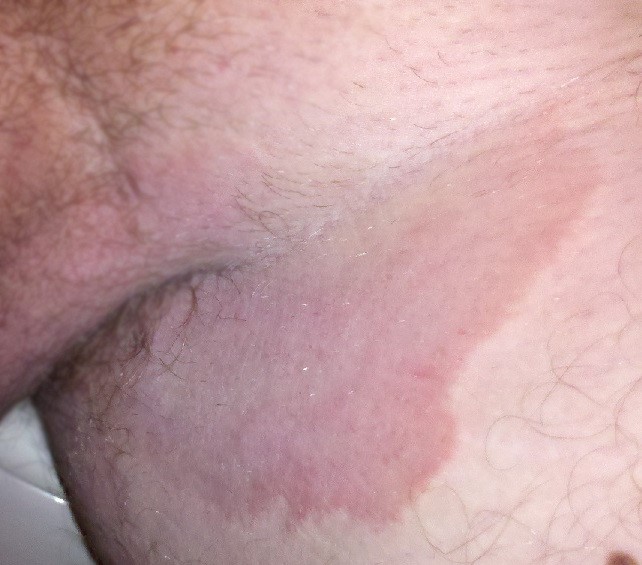
© ByRobertgascoin,via Wikimedia Commons
Jock itch
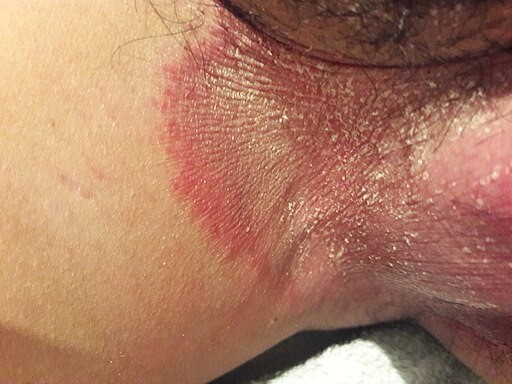
© Gerardolagunes, CC BY-SA 3.0, via Wikimedia Commons
Tinea cruris symptoms
Symptoms of tinea cruris include:
Itchiness. The groin becomes itchy and can be sore, mainly in the crease between the top of the leg and the genitals.
Scrotum. In men the scrotum may also be itchy or sore.
Redness. The skin in the groin area becomes red and slightly scaly. There is usually a definite edge or border. Both sides are commonly affected.
Spreading away from the groin. The rash often spreads a short way down the inside of both thighs.
Odore. Sometimes a musty yeasty smell is noticeable.
Sometimes the infection spreads to the skin on other parts of the body (or may have first started in another area, such as tinea pedis (fungo del atleta)). Fungal infections usually remain on the skin and do not usually go deeper into the body; they are not usually serious.
Fungal groin infections are more common in men than women.
When to see a doctor about tinea cruris
Medical advice should be sought if:
The rash is painful or a fever develops.
The rash has not improved after a week or two of using a topical antifungal medicine as recommended by a pharmacist.
The rash hasn't cleared up fully after three weeks of treatment.
People with a weakened body defence (immune system), eg, diabetes or having chemotherapy, may need more treatment so should seek medical advice sooner if the rash is not improving.
Risk factors for fungal groin infection
Diabete.
Obesità.
A weakened immune system.
Tinea cruris diagnosis
Aspetto. The diagnosis can usually be made by the features of the rash which is usually obvious.
Raschiature cutanee. Occasionally, if there is doubt about the diagnosis, skin scrapings can be sent to the laboratory to identify features that would indicate a fungal infection.
Biopsia cutanea. If there is any concern about the diagnosis then a specialist (dermatologist) referral may be made. This would be unusual. Occasionally a skin biopsy may be required.
Tinea cruris treatment
Cura di sé.
Wear loose-fitting clothes made of cotton or material designed to keep moisture away from the skin.
Avoid tight-fitting clothes such as leggings.
Maintain good hygiene by washing the affected skin areas daily.
Dry thoroughly after washing, especially in the skin folds.
Avoid scratching which may spread the infection to other sites.
Do not share towels, and wash them frequently, to reduce the risk of passing on the infection to someone else.
Wash clothes and bed linen frequently to get rid of any fungal spores.
If a child is affected, it is not necessary to exclude them from school or nursery.
Topical antifungal creams. A topical antifungal cream can be used if there is mild, non-extensive disease. Options include:
Treatment with a topical antifungal cream may be repeated in the future if there are recurrent episodes of mild, non-extensive disease. An antifungal powder can be used (eg, miconazole) but creams are recommended as being more effective.
Steroid cream. A mildly-potent topical corticosteroid can be used in addition to a topical antifungal cream if there is associated marked inflammation, eg, hydrocortisone 1% cream, applied once daily for a maximum of 7 days. A topical corticosteroid preparation should not be used alone as it can make the fungal infection worse.
Oral antifungal treatment. For severe or extensive disease, adults can be prescribed oral antifungal treatment, such as:
Oral itraconazole oppure oral griseofulvin can be used if terbinafine cannot be used or causes any side effects.
A child with severe or extensive disease would be referred to a specialist (paediatric dermatologist).
Tinea cruris outcome
Tinea cruris usually clears up in 1 to 3 weeks with treatment, including antifungal creams. However, for people who are particularly susceptible, such as athletes and those who sweat a lot, recurrences are common and the problem may become long term (chronic).
Preventing recurrent tinea cruris
To prevent any recurring tinea cruris (fungal groin infection) self-care should be used, as outlined in the treatment above:
Wash the groin daily; then dry thoroughly. Drying is the most important part of this. It is very important to delay putting on underwear until the groin is fully dry. The damp groin is then an ideal site for fungi to multiply. A hairdryer is very useful to dry the area if the groin is more hairy or difficult to dry. However, ensure that the hairdryer is not too hot.
Change underwear daily. Fungi may multiply in flakes of skin in unwashed underwear.
Check for tinea pedis (fungo del atleta) and treat it if present. Athlete's foot is a common fungal infection of the toes. In a typical case of athlete's foot, the skin between the toes is itchy and flaky - especially between the outer two toes. The fungi from athlete's foot may spread to the groin. The same creams are used to treat athlete's foot and tinea cruris.
Do not share towels with people in communal changing rooms. Wash towels frequently.
Do not share towels if suffering from tinea cruris.
Scelte del paziente per Infezioni fungine

Infezioni
Infezioni fungine polmonari
Un fungo è un tipo di germe minuscolo che di solito non causa problemi. Sono ovunque intorno a noi: puoi vederli solo con un microscopio. Ma in alcune situazioni, in particolare se hai altre malattie gravi, i funghi (il plurale di fungo) possono infettare i tuoi polmoni. Questo può essere molto serio e richiede cure specialistiche.
di Dr Colin Tidy, MRCGP

Infezioni
Candidosi negli uomini
Thrush is a common infection, caused by a fungus called Candida. Candida normally lives on our skin in small amounts without causing any problems. Sometimes, though, it can cause infections. Candidal infections can affect many body systems, but most commonly cause problems in the genital area, in the mouth (oral thrush), or on the skin. Thrush in men is quite common, although women are more likely to get thrush than men. Thrush is usually a mild infection that clears up quickly with treatment.
di Dr Hayley Willacy, FRCGP
Domande frequenti
Can I use hydrocortisone cream alone to treat tinea cruris?
No, a topical corticosteroid preparation like hydrocortisone 1% cream should not be used alone to treat tinea cruris, as it can worsen the fungal infection. It should only be used in addition to a topical antifungal cream, and for a maximum of 7 days, if there is significant inflammation.
How long does it typically take for tinea cruris to clear up with treatment?
With appropriate treatment, including antifungal creams, tinea cruris usually clears up within 1 to 3 weeks. However, for individuals who are particularly prone to it, such as athletes or those who sweat a lot, recurrences are common.
Is tinea cruris more common in men or women?
Fungal groin infections, or tinea cruris, are more common in men than in women.
What should I do if the infection keeps coming back?
If you experience recurrent tinea cruris, it's important to consistently follow self-care measures. This includes washing the groin daily and drying thoroughly, changing underwear daily, checking for and treating athlete's foot, and avoiding sharing towels. If recurrences are persistent, medical advice may be helpful.
Should children with tinea cruris be kept home from school or nursery?
No, if a child is affected by tinea cruris, it is not necessary to exclude them from school or nursery.
Ulteriori letture e riferimenti
- Infezioni fungine della pelle; DermNet NZ
- Infezione fungina della pelle - corpo e inguine; NICE CKS, luglio 2023 (accesso solo Regno Unito)
- Tinea corporis (body), cruris (groin) and incognito (steroid exacerbated); Società di Dermatologia delle Cure Primarie.
Informazioni sull'autoreVisualizza il profilo completo

Dr Philippa Vincent, MRCGP
Medico di base, Autore medico
MB BS, Bsc, MRCGP (2000), DCH, DFSRH, DRCOG
Dr Philippa Vincent è un medico di base del NHS che lavora nel nord di Londra.
Informazioni sul recensoreVisualizza il profilo completo

Dr Toni Hazell, FRCGP
MBBS, BSc, FRCGP, DFSRH, Dip GU med, DRCOG, DCH (London, UK, 2000)
La Dott.ssa Toni Hazell si è laureata presso la St. Mary’s Hospital Medical School e ha completato il suo VTS al Northwick Park Hospital.
Storia dell'articolo
Le informazioni su questa pagina sono scritte e revisionate da clinici qualificati.
Articolo disponibile anche in Inglese, Tedesco, Spagnolo, Francese, Italiano, Portoghese, Hindi, Ebraico, Arabo, and Svedese.
Next review due: 8 Jan 2028
9 Jan 2025 | Ultima versione

Chiedi, condividi, connettiti.
Esplora le discussioni, fai domande e condividi esperienze su centinaia di argomenti di salute.

Non ti senti bene?
Valuta i tuoi sintomi online gratuitamente
Iscriviti alla newsletter di Patient
La tua dose settimanale di consigli sulla salute chiari e affidabili - scritti per aiutarti a sentirti informato, sicuro e in controllo.
Abbonandoti accetti i nostri Informativa sulla Privacy. Puoi annullare l'iscrizione in qualsiasi momento. Non vendiamo mai i tuoi dati.