Dermatite seborroica nei neonati
Crosta lattea
Revisione paritaria di Dr Colin Tidy, MRCGPUltimo aggiornamento di Dr Hayley Willacy, FRCGP Ultimo aggiornamento 14 Apr 2025
Rispetta le linee guida editoriali
- ScaricaScarica
- Condividi
- Language
- Discussione
- Versione audio
- Aggiungi alle fonti preferite su Google
In questa serie:Dermatite seborroica
La dermatite seborroica nei neonati causa una forte forfora (crosta lattea). A volte provoca un'eruzione cutanea in altre aree della pelle. Di solito non è necessario alcun trattamento, poiché normalmente non causa alcun disagio e di solito si risolve da sola.
A colpo d'occhio
Seborrhoeic dermatitis in babies is a skin inflammation often called cradle cap.
It typically starts between 2 and 6 weeks of age, affecting the scalp and face.
Symptoms include greasy, yellow, scaly patches on the scalp.
It is usually not itchy or painful and often clears up by itself.
Treatment is not usually needed, but daily washing may help remove scales.
See a doctor if scales become thick or inflamed.
What is seborrhoeic dermatitis (cradle cap)?
Seborrhoeic dermatitis in babies is a type of skin inflammation which mainly affects the scalp and face. Cradle cap affects many newborns, typically starting between the ages of 2 and 6 weeks. It is most common in babies under 1 year of age, though it can sometimes persist beyond the first year.
The exact cause of seborrhoeic dermatitis is not known. It is thought that babies who develop seborrhoeic dermatitis may produce more oil (sebum) from the sebaceous glands in their skin. Yeast germs from the Malassezia species may also be involved. However, seborrhoeic dermatitis is not just a simple skin infection and you cannot catch this condition from others (it is not contagious). The fungal germ lives in the sebum of human skin and some babies may react to the germ in some way which causes the skin inflammation.
Many babies have a mild form of seborrhoeic dermatitis within the first six months of life but it usually goes away on its own after a few months. In most children, cradle cap has cleared by the age of 6 months. It does not usually occur in older children. Some teenagers and adults have a related condition which causes bad dandruff and a rash. See the separate leaflet called Seborrhoeic dermatitis (Dandruff) for more details.
What are the symptoms of seborrhoeic dermatitis in babies?
I sintomi includono:
Crosta lattea. This is areas of greasy, yellow, scaly patches on the scalp. In some cases a thick scaly layer covers the whole scalp. Over time the scales may become flaky and rub off easily. Cradle cap is not usually itchy and, in most cases, the baby is not aware of any problem or discomfort.
Crosta lattea
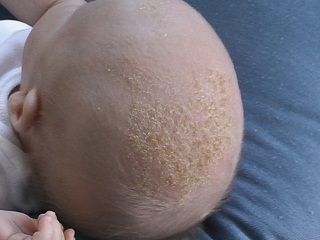
© Immagine tramite Wikimedia Commons
Eruzione cutanea. In addition to cradle cap, some affected babies develop a mild red rash. This can appear on the eyebrows, on the skin next to their nose, or in the creases of the skin such as around the neck, behind the ears or in the armpits. Sometimes it can cause a kind of nappy rash in the groin creases.
Is cradle cap painful?
Cradle cap is generally not painful or itchy, though some babies may experience mild irritation. It does not cause discomfort, but in some cases, the scales can become thicker or inflamed, requiring treatment.
What is the treatment for seborrhoeic dermatitis in babies?
Treatment for seborrhoeic dermatitis is not usually needed, as the condition is usually mild, is not serious and does not usually cause any discomfort to the baby. Seborrhoeic dermatitis will usually clear up by itself eventually.
However, the appearance of the scalp can be improved by daily washing with a baby shampoo followed by gentle brushing with a soft brush to loosen scales.
Alternatively, soften the scales with baby oil first, followed by gentle brushing and then washing off with baby shampoo.
If this does not work, it may be helpful to soften the scales by rubbing in olive oil, vegetable oil or white petroleum jelly. Leave this in overnight to allow it time to work. Wash it off with baby shampoo in the morning.
Another option is to try a greasy moisturising lotion (emollient) such as emulsifying ointment.
If other areas are affected by seborrhoeic dermatitis, regular washing helps. Use an emollient cream instead of soap on the affected skin.
If needed, a medicated crema antifungina may be prescribed by your doctor. Creams which may be used are clotrimazolo, econazolo oppure miconazole. This will usually clear the rash. Rarely, if inflammation is more severe, a mild steroid cream may be prescribed by your doctor.
How to prevent cradle cap
There is no guaranteed way to prevent cradle cap, but you can help reduce the risk by:
Gently washing your baby's scalp with mild soap or shampoo.
Avoiding harsh chemicals or products that could irritate the skin.
Using soft brushes to keep the scalp clean and free from excessive buildup.
Scelte del paziente per Neonati e bambini piccoli

Salute dei bambini
Dermatite da pannolino
La maggior parte dei bambini sviluppa un'eruzione da pannolino a un certo punto. Di solito è lieve e non disturba il tuo bambino. Tuttavia, in alcuni casi può essere più grave e dolorosa. Di solito può essere gestita con i suggerimenti seguenti.
di Dr Rachel Hudson, MRCGP
Salute dei bambini
Stenosi pilorica
La stenosi pilorica colpisce tra 2 e 5 neonati su 1.000. Provoca un blocco del cibo all'uscita dello stomaco (piloro). Il sintomo principale è il vomito a getto dopo ogni pasto, causando perdita di peso e disidratazione. È necessaria una piccola operazione che risolve il problema.
di Dr Philippa Vincent, MRCGP
Domande frequenti
What is the difference between cradle cap and nappy rash caused by seborrhoeic dermatitis?
Cradle cap specifically refers to greasy, yellow, scaly patches on the scalp. However, seborrhoeic dermatitis can also manifest as a type of nappy rash in the groin creases, which is a rash in a different location but related to the same underlying condition.
If my baby has seborrhoeic dermatitis on other parts of their body, how should I care for their skin?
For areas affected by seborrhoeic dermatitis other than the scalp, regular washing is helpful. You should use an emollient cream instead of soap on the affected skin to keep it moisturised and reduce irritation.
When might a doctor prescribe a medicated cream for cradle cap or other seborrhoeic dermatitis symptoms?
A doctor may prescribe a medicated antifungal cream if the usual methods of loosening scales and washing don't clear the rash. Examples of such creams include clotrimazole, econazole, or miconazole. In rare cases, if inflammation is severe, a mild steroid cream might also be prescribed.
Ulteriori letture e riferimenti
- Nobles T, Harberger S, Krishnamurthy K; Cradle Cap.
- Dermatite seborroica; NICE CKS, novembre 2024 (accesso solo Regno Unito)
- Seborrhoeic dermatitis - infants (Simple advice); NICE CKS, novembre 2024 (accesso solo Regno Unito)
- Crosta lattea (dermatite seborroica infantile); DermNet NZ
Informazioni sull'autoreVisualizza il profilo completo

Dr Hayley Willacy, FRCGP
Medico di base, Autore medico
MBChB (1992), DRCOG, DFFP, MRCOG (Part 1) MRCGP (2007), DFSRH (2013), MSc - medical education (2020)
La Dott.ssa Hayley Willacy era un medico di base del NHS che lavorava nel nord-ovest dell'Inghilterra, e si è ritirata dalla pratica clinica nel 2022 dopo 30 anni.
Informazioni sul recensoreVisualizza il profilo completo

Dr Colin Tidy, MRCGP
Medico di base, Autore medico
MBBS, MRCGP, MRCP (Paediatrics), DCH
Il Dr Colin Tidy è un medico del NHS, con sede nell'Oxfordshire.
Storia dell'articolo
Le informazioni su questa pagina sono scritte e revisionate da clinici qualificati.
Articolo disponibile anche in Inglese, Tedesco, Spagnolo, Francese, Italiano, Portoghese, Hindi, Ebraico, Arabo, and Svedese.
Next review due: 3 Apr 2028
14 Apr 2025 | Ultima versione

Chiedi, condividi, connettiti.
Esplora le discussioni, fai domande e condividi esperienze su centinaia di argomenti di salute.

Non ti senti bene?
Valuta i tuoi sintomi online gratuitamente
Iscriviti alla newsletter di Patient
La tua dose settimanale di consigli sulla salute chiari e affidabili - scritti per aiutarti a sentirti informato, sicuro e in controllo.
Abbonandoti accetti i nostri Informativa sulla Privacy. Puoi annullare l'iscrizione in qualsiasi momento. Non vendiamo mai i tuoi dati.
Di più sulla salute dei bambini
- Medicina per l'enuresi notturna - desmopressina
- Allattamento con biberon
- Allattare il tuo bambino
- Bronchiolite
- Bullismo
- Piede torto
- Tosse e raffreddori nei bambini
- Diabete nei bambini
- distrofia muscolare di Duchenne
- Dislessia
- Alimentazione dei neonati prematuri
- Nutrire il tuo bambino
- Pidocchi e lendini
- Vaccino HPV
- Emorragia intraventricolare nei neonati
- Sindrome di Klinefelter
- Mughetto orale nei neonati
- Polio e vaccino antipolio
- Strabismo nei bambini
- Sopravvivere all'adolescenza