Heat rash and prickly heat
Miliaria
Peer reviewed by Dr Hayley Willacy, FRCGP Last updated by Dr Rosalyn Adleman, MRCGPLast updated 15 Aug 2023
Meets Patient’s editorial guidelines
- DownloadDownload
- Share
- Language
- Discussion
- Audio Version
- Add to preferred sources on Google
Heat rash is one of the most common types of the skin rash, and it's also known as miliaria, prickly heat, or a sweat rash. Heat rash occurs in some people when they sweat a lot. It can be very itchy. It is due to a blockage of the sweat ducts which causes sweat to seep into the skin cells. The main treatment is to keep cool as much as possible.
At a glance
Heat rash, also called prickly heat, happens when you sweat more than usual.
Symptoms include tiny red, raised spots or blisters, an itchy or prickly feeling, and redness.
It is commonly found in skin folds and is not contagious.
Keeping cool and avoiding sweat can help prevent heat rash.
See a doctor if you feel unwell, as this could be heat exhaustion or heatstroke.
What is heat rash?
Prickly heat
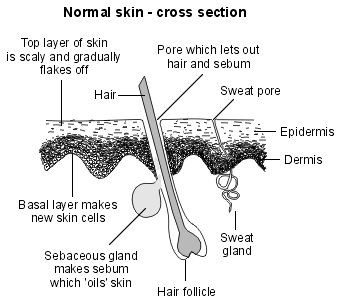
Heat rash (miliaria) is a skin problem that develops in some people when they sweat more than usual. The rash is also sometimes called prickly heat, or a heat rash, or a sweat rash. It is not usually serious but it can be itchy and uncomfortable.
What does heat rash look like?
Chest showing prickly heat rash
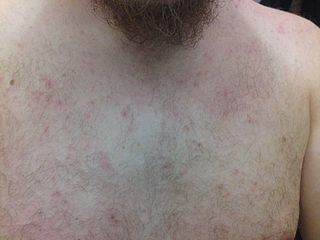
Heat rash symptoms
Common symptoms of heat rash (prickly heat) are:
Tiny red, raised spots or blisters.
An itchy, prickly feeling.
Redness and mild swelling.
Symptoms can appear anywhere on the body but is common in the skin folds. A heat rash can spread but it cannot be passed on to other people.
Types of heat rash
There are several types of heat rash (miliaria), these are:
Miliaria crystallina
This type of heat rash can also be known as miliaria sudamina. This is caused when the blockage of the sweat ducts is close to the surface of the skin. The rash is like tiny clear spots that appear in crops. They may look like beads of sweat. The spots tend to disappear within a few hours or days. This is the least itchy form of prickly heat and there may not be any itch at all. The rash may simply be a curious event that you notice on your skin.
Miliaria rubra
This type of heat rash is the common type and the one most people would identify as prickly heat. It is caused when the blockage of the sweat ducts occurs at a deeper part of the outer layer of the skin (the epidermis).
Crops of tiny red bumpy spots (tiny papules) develop. The spots are just a few millimetres in size and may look like tiny blisters. Several crops of spots usually appear in different parts of the body. They occur mostly where there is friction with clothes. They can be very itchy - although it may be more of an intense prickling sensation. Some areas of skin become red.
The heat rash may occur within days of coming into a hot climate. However, often the rash does not appear until weeks or months have passed in the hot climate. The rash tends to go within a few days if you get out of the hot environment and stop sweating.
On the affected areas of skin there is a reduced amount of sweat, or no sweat at all. You may feel tired and become intolerant of heat. If you continue to sweat and the rash covers a large part of your body then you have a small risk of developing a high temperature (fever) and/or heat exhaustion. This is because you are not able to sweat properly to get rid of body heat.
Miliaria profunda
This type of heat rash is uncommon. It is caused when the blockage of the sweat ducts occurs at the level of the middle layer of the skin (the dermis). This typically occurs in people who live in a hot climate who have had repeated episodes of miliaria rubra.
Bigger lumps develop on the skin when you sweat. These tend to be flesh-coloured as they are deeper than the miliaria rubra form. There is little itch with this type of miliaria but there is a greater risk of developing a fever and heat exhaustion if much of the skin surface is affected.
Miliaria pustulosa
In this type of heat rash, the bumps on the skin become infected with the bacteria living on the skin surface. The fluid inside the bumps contains pus.
What causes heat rash?
Heat rash or prickly heat (miliaria) is due to blockage of sweat ducts. You have thousands of sweat glands that lie just under the skin surface. These glands make sweat which travels down the sweat duct to the skin surface. If the sweat duct is blocked, the sweat seeps into the nearby skin. This causes tiny pockets of swelling (inflammation) which cause the heat rash.
What blocks the sweat ducts?
Some people are more prone to heat rash (miliaria) than others. It seems that a germ (bacterium) called Staphylococcus epidermidis may play a role. This bacterium lives harmlessly on the skin and miliaria is not an infection. However, this bacterium makes a sticky substance. This substance combined with excess sweat and dead skin cells may cause the blockage, and therefore prickly heat.
One study reports that people who develop miliaria when they sweat have, on average, three times as many bacteria per unit area of skin compared with those who do not develop miliaria when they sweat.
Anything else that blocks the sweat ducts can also cause miliaria. For example, if you place polythene tightly on your skin for 3-4 days, you are likely to develop a miliarial rash on the covered skin.
How common is heat rash?
Skin conditions like heat rash or prickly heat (miliaria) can develop in anyone at any age. However, it is most common in children and babies, as their immature sweat glands are more prone to becoming blocked. It is particularly common in newborn babies but soon clears.
Another common time for the rash to occur is when people travel to a warmer climate and sweat more than usual - typically, on going to a hot country for a holiday. Up to 3 in 10 people who travel to a warmer climate and who sweat a lot may be affected by miliaria. The rash may begin within a few days of arrival in the warmer country. However, it might develop weeks, or even months, later.
Heat rash can also occur in cooler climates when sweating is a problem. For example, people who lie on their back for long periods due to illness may get miliaria on their back. This can occur after having a stroke or a major operation. It can also occur if you are wearing too many clothes or the bedding is too warm.
Heat rash treatment
In most cases the heat rash will clear without any treatment. However, severe cases can last for several weeks. If you or your child has heat rash, one or more of the following may help to treat it and prevent further episodes from developing:
If possible, avoid hot, humid weather or climates. Air conditioning may help your skin cool.
Simple creams may cool and soothe the skin. (An example is calamine lotion. This may have a drying effect, however, and you may then need to use a moisturising cream afterwards.)
Wear loose cotton clothing or clothing that has breathable fabric.
Using an antibacterial soap or antiseptic wash may help to keep the number of germs (bacteria) on your skin down. This may reduce the risk of developing miliaria. There are no research trials that have been done to prove this but it seems sensible.
Some people feel that moisturising creams that contain anhydrous lanolin help to prevent blockage of the sweat ducts - for example, E45® cream. If you are prone to developing miliaria then it may be worth a try. Apply some to your skin before activities that make you sweat or on arrival in a hot climate.
A steroid cream may soothe the irritation whilst you are waiting for the condition to clear. Steroids work by reducing inflammation. A mild steroid cream such as hydrocortisone 1% can be purchased over the counter. You should not use hydrocortisone cream on your face. Follow the instructions and use it sparingly.
How to prevent heat rash
Strategies to keep the skin cool and avoid sweating can help prevent heat rash.
Sleep in a cool, ventilated room.
If in a hot climate, spend a few hours a day in an air-conditioned room.
Avoid tight clothing and wearing too much clothing.
Wear clothes made of cotton or breathable synthetic fabrics.
Remove wet clothing.
Take a cool bath or use cool water compresses if you get too hot.
When to call your doctor for heat rash
If you feel generally unwell, you may be developing heat exhaustion or heatstroke. If this occurs, seek medical advice.
Patient picks for Skin rashes

Skin, nail and hair health
Rosacea
Rosacea is a skin condition that affects parts of your face. Symptoms can include facial flushing, facial redness, spots, thickening of your skin, and eye problems such as dry eyes and sore eyelids. Not all symptoms occur in all cases. Rosacea affects about 1 in 20 people in the UK, usually in middle age. Many cases are mild. Spots can usually be cleared with antibiotic treatment. Other treatments may be used for other symptoms. A complication that affects the front of the eye (the cornea) is uncommon but serious. See a doctor urgently if you have rosacea and develop any eye pain or visual problems.
by Dr Rosalyn Adleman, MRCGP

Skin, nail and hair health
Lichen planus
Lichen planus mainly causes an itchy skin rash. In some people it also affects other parts of the body such as the mouth, genitals, nails and hair. Most people get better in 6-12 months. Treatment, commonly with a steroid cream or ointment, often eases the itch and may reduce the rash until the condition clears.
by Dr Hayley Willacy, FRCGP
Frequently asked questions
Can heat rash affect my performance if I'm exercising in a hot environment?
Yes, if you continue to sweat and the heat rash covers a large part of your body, you may feel tired and become intolerant of heat. This is because heat rash can reduce or stop your natural sweating in affected areas, making it harder for your body to cool down. In some cases, this can lead to a high temperature or heat exhaustion.
If I get heat rash, does it mean I have poor hygiene?
No, heat rash is not a sign of poor hygiene. It's caused by blocked sweat ducts, which can happen to anyone. A bacterium harmlessly living on the skin, Staphylococcus epidermidis, can contribute to the blockage by producing a sticky substance that combines with excess sweat and dead skin cells.
Is it true that babies are more likely to get heat rash than adults?
Yes, heat rash is most common in children and babies. Their sweat glands are not fully developed and are more prone to becoming blocked. It's particularly common in newborn babies, but usually clears up quickly.
Can heat rash appear even if I'm not in a hot climate?
Yes, heat rash can occur in cooler climates if sweating is an issue. For example, people who are bedridden for long periods due to illness might get it on their back. It can also appear if you wear too many clothes or use bedding that is too warm.
Are there any specific fabrics I should avoid to prevent heat rash?
The article suggests wearing loose cotton clothing or clothing made of breathable fabrics to help prevent heat rash. Conversely, tight clothing and those that don't allow skin to breathe would be best avoided.
Further reading and references
- O'Connor NR, McLaughlin MR, Ham P; Newborn skin: Part I. Common rashes. Am Fam Physician. 2008 Jan 1;77(1):47-52.
- Miliaria (sweat rash); DermNet NZ
About the authorView full bio
Updated by

Dr Rosalyn Adleman, MRCGP
MRCGP
Dr Rosalyn Adleman, is an NHS GP working in north London.
About the reviewerView full bio

Dr Hayley Willacy, FRCGP
General Practitioner, Medical Author
MBChB (1992), DRCOG, DFFP, MRCOG (Part 1) MRCGP (2007), DFSRH (2013), MSc - medical education (2020)
Dr Hayley Willacy was an NHS GP working in northwest England, who retired from clinical practice in 2022 after 30 years.
Join the conversation
Share your thoughts or experiences with others in our patient communities.

Ask, share, connect.
Browse discussions, ask questions, and share experiences across hundreds of health topics.

Feeling unwell?
Assess your symptoms online for free
Sign up to the Patient newsletter
Your weekly dose of clear, trustworthy health advice - written to help you feel informed, confident and in control.
By subscribing you accept our Privacy Policy. You can unsubscribe at any time. We never sell your data.