Cisti epidermoidali e pilari
Cisti sebacee
Revisione paritaria di Dr Colin Tidy, MRCGPUltimo aggiornamento di Dr Doug McKechnie, MRCGPUltimo aggiornamento 12 giu 2023
Rispetta le linee guida editoriali
- ScaricaScarica
- Condividi
- Language
- Discussione
- Versione audio
- Aggiungi alle fonti preferite su Google
Epidermoid and pilar cysts are commonly referred to as 'sebaceous cysts' (pronounced 'seb-ay-shuss'). They are overgrowths of skin cells (called keratin) held together in a little capsule, or sac.
They are harmless smooth lumps just under the surface of the skin. They are not cancerous and do not require removal unless they are bothering you by the look or the feel of them.
They can occur almost anywhere in the body, but are commonly found on the back or scalp.
A colpo d'occhio
Le cisti sono sacche nel corpo riempite di materiale fluido o semi-fluido.
Le cisti epidermoidali e pilari sono tipi comuni che si trovano sotto la pelle.
Le cisti epidermoidali spesso compaiono sul viso, collo, petto e schiena.
Le cisti pilari si sviluppano comunemente sul cuoio capelluto, specialmente nelle donne di mezza età.
Queste cisti di solito appaiono come noduli lisci, rotondi e indolori sotto la pelle.
Le cisti sono non cancerose ma possono diventare rosse, infiammate e dolorose se infette.
Dovresti consultare un medico se una cisti cresce rapidamente o diventa dolorosa.
What are cysts?
A cyst is a sac that is filled with a fluid or semi-fluid material. Cysts develop in various places in the body and arise from different tissues in the body. Two of the most common types of cyst that occur under the skin surface are epidermoid and pilar cysts.
These cysts are often called sebaceous cysts but this term is no longer correct, as the origin of these cysts is not from the sebaceous glands in the skin, as was once thought.
Many doctors still call them sebaceous cysts, though.
What is an epidermoid cyst?
An epidermoid cyst is a cyst where the cyst sac forms from epidermal cells that normally occur on the top layer of the skin (the epidermis).
There are lots of other names for epidermoid cysts, such as epidermal cysts, inclusion cysts, and keratin cysts.
What is a pilar cyst?
A pilar cyst is a cyst where the cyst sac forms from cells similar to those that are in the bottom of hair follicles (where hairs grow from).
A pilar cyst is also known as a trichilemmal cyst.
In both cases, the semi-fluid content of the cyst looks a bit like cottage cheese. This substance is soggy keratin. Keratin is made by skin cells and is the substance that hairs are made from and the substance that covers the top layer of the skin.
Who gets them?
Epidermoid cysts can affect anyone but are most common in young and middle-aged adults. They can appear anywhere on the skin but develop most commonly on the face, neck, chest, upper back and sometimes on the scrotum.
Pilar cysts can affect anyone but are most common in middle-aged women. They can appear anywhere on the skin but develop most commonly on the scalp. It is common for several to develop at the same time on the scalp.
Epidermoid and pilar cysts symptoms
Epidermoid and pilar cysts are smooth round lumps which you can see and feel just beneath the skin surface. They are very common.
They range in size but often they are small, like a pea. Sometimes, they can grow slowly over many months to become a few centimetres in diameter. They look very similar to each other but can be distinguished from each other if the cells that form the cyst sac are looked at under the microscope.
Epidermoid and pilar cysts usually cause no symptoms. Occasionally:
Cysts can become infected, when they may become red, inflamed and painful. A course of antibiotics will usually clear an infection if it occurs. Sometimes they settle down even without antibiotics.
The cyst may leak the cheese-like material on to the skin if the cyst is punctured or damaged.
A little horn may grow on the skin over the cyst.
A cyst may form in an uncomfortable place such as in the genital skin or beside a nail.
This photo shows the typical appearance of an epidermoid cyst on someone's neck:
Cisti epidermoide sul collo
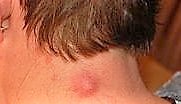
© Steven Fruitsmaak (Opera propria) - vista ravvicinata, CC BY-SA 3.0, tramite Wikimedia Commons
What causes epidermoid and pilar cysts?
It seems that some cells that are normally near to the surface of the skin (cells of the epidermis or cells in hair follicles) get into deeper parts of the skin and continue to multiply. The cells that multiply form into a sac and produce the keratin that they would normally make on the top layer of the skin. The keratin becomes soggy and forms into a cheese-like substance and a cyst can occur.
Usually epidermoid cysts pop up for no particular reason: there is nothing you can do to prevent them. They are not related to cleanliness, nor will exfoliating stop them occurring.
Pilar cysts on the scalp can be hereditary and run in families, although this is rare.
Rarely, epidermoid cysts can occur due to genetic disorders. A genetic condition might be present if someone has a lot of epidermoid cysts in unusual locations (like on the fingers and toes).
Are epidermoid and pilar cysts painful?
Not usually. If they do not bother you then it is best just to leave them alone. If one has grown recently it's worth asking your doctor to check that it is a harmless cyst. Sometimes a person with an epidermoid or pilar cyst requests that it be removed. This is usually for one of three reasons:
Cosmetic reasons. For example, the cyst is in an obvious site on the skin and looks unsightly.
They are sometimes easy to catch and traumatise. This typically occurs on the scalp when combing hair.
If the cyst often becomes infected or irritating.
Epidermoid and pilar cysts are non-cancerous (benign). They do not spread to other parts of the body or cause any serious problems.
Removal of epidermoid and pilar cysts
If required, the cyst can usually be easily removed by a simple operation under local anaesthetic. The surrounding skin is numbed by injecting some local anaesthetic. A small cut is made over the cyst. It can then be gradually teased out by the doctor. The wound is then stitched up. A small scar will result. Sometimes, after the removal of a cyst, it gradually regrows in the same site under the scar.
Bear in mind you then exchange a small cyst for a scar: some people would rather have been left with the cyst, once they see the results of the surgery.
Scelte del paziente per Eruzioni cutanee

Salute della pelle, delle unghie e dei capelli
Lupus discoide
Il lupus discoide è una condizione cutanea rara, ma molto duratura. È generalmente sensibile alla luce solare e provoca cicatrici quando le lesioni guariscono.
di Dr Colin Tidy, MRCGP

Salute della pelle, delle unghie e dei capelli
Cheratosi attinica
Una cheratosi attinica (nota anche come cheratosi solare) è la condizione cutanea più comune causata dai danni del sole. È il risultato della pelle danneggiata dal sole per molti anni. Le cheratosi attiniche sono solitamente chiazze ruvide e squamose su aree esposte al sole come la testa e il viso. Le cheratosi attiniche sono comuni, specialmente nelle persone anziane, molte delle quali ne hanno più di una. Di solito sono innocue, ma c'è un piccolo rischio che possano eventualmente trasformarsi in cancro della pelle e quindi potrebbe essere consigliato un trattamento.
di Dr Doug McKechnie, MRCGP
Domande frequenti
Le cisti sebacee possono causare prurito?
Le cisti epidermoidali e pilari, a volte erroneamente chiamate cisti sebacee, di solito non causano alcun sintomo. Sebbene possano infiammarsi, diventare dolorose o perdere liquido, l'articolo non menziona il prurito come sintomo tipico.
Le cisti pilari continuano a crescere?
Le cisti epidermoidali e pilari possono crescere lentamente nel corso di diversi mesi, a volte raggiungendo alcuni centimetri di diametro.
Come prevenire le cisti del cuoio capelluto?
L'articolo afferma che le cisti epidermoidi di solito compaiono senza una ragione particolare e non c'è nulla di specifico che si possa fare per prevenirle. Non sono legate alla pulizia o all'esfoliazione. Sebbene le cisti pilari sul cuoio capelluto possano talvolta essere ereditarie, l'articolo non fornisce metodi di prevenzione.
Ulteriori letture e riferimenti
- Cisti; DermNet NZ
- Jawa DS, Sircar K, Somani R, et al; Gorlin-Goltz syndrome. J Oral Maxillofac Pathol. 2009 Jul;13(2):89-92. doi: 10.4103/0973-029X.57677.
- Ali SY, Prabhat S, Ramanamurty ChV, et al; Coexistence of porokeratosis of Mibelli with Gardner's syndrome: A rare case report. Indian Dermatol Online J. 2011 Jul;2(2):94-6. doi: 10.4103/2229-5178.86001.
- Verma S, Kushwaha JK, Sonkar AA, et al; Giant sublingual epidermoid cyst resembling plunging ranula. Natl J Maxillofac Surg. 2012 Jul;3(2):211-3. doi: 10.4103/0975-5950.111386.
Informazioni sull'autoreVisualizza il profilo completo

Dr Doug McKechnie, MRCGP
Scrittore Medico
MA, MBBS, MSc, DRCOG, MRCP(UK), MRCGP(2021), FHEA
Il dottor Doug McKechnie è un medico di base del NHS che lavora a Londra. Lavora a tempo pieno in ambito clinico ed è anche Vice Responsabile del modulo di Pratica Clinica e Professionale presso la Scuola di Medicina dell'University College London.
Informazioni sul recensoreVisualizza il profilo completo

Dr Colin Tidy, MRCGP
Medico di base, Autore medico
MBBS, MRCGP, MRCP (Paediatrics), DCH
Il Dr Colin Tidy è un medico del NHS, con sede nell'Oxfordshire.
Storia dell'articolo
Le informazioni su questa pagina sono scritte e revisionate da clinici qualificati.
Articolo disponibile anche in Inglese, Tedesco, Spagnolo, Francese, Italiano, Portoghese, Hindi, Ebraico, Arabo, and Svedese.
Prossima revisione prevista: 12 maggio 2028
12 giu 2023 | Ultima versione

Chiedi, condividi, connettiti.
Esplora le discussioni, fai domande e condividi esperienze su centinaia di argomenti di salute.

Non ti senti bene?
Valuta i tuoi sintomi online gratuitamente
Iscriviti alla newsletter di Patient
La tua dose settimanale di consigli sulla salute chiari e affidabili - scritti per aiutarti a sentirti informato, sicuro e in controllo.
Abbonandoti accetti i nostri Informativa sulla Privacy. Puoi annullare l'iscrizione in qualsiasi momento. Non vendiamo mai i tuoi dati.
Più sulla salute della pelle, delle unghie e dei capelli
- Ustioni e scottature
- Dermatite da contatto
- Calli e duroni
- Morsi di cani e gatti
- Vesciche ai piedi
- Impetigine
- Unghia incarnita
- Rimozione dei peli con laser
- Cancro della pelle melanoma
- Virus Mpox
- Paronychia
- Test epicutaneo per dermatite da contatto
- Psoriasi
- Rosacea
- Eruzioni cutanee
- Effluvio telogen
- Steroidi topici per l'eczema
- Ulcere venose alle gambe