Impianto contraccettivo
Revisione paritaria di Dr Philippa Vincent, MRCGPUltimo aggiornamento di Dr Toni Hazell, FRCGPUltimo aggiornamento 10 Gen 2025
Rispetta le linee guida editoriali
- ScaricaScarica
- Condividi
- Language
- Discussione
- Versione audio
- Aggiungi alle fonti preferite su Google
In questa serie:Contraccettivi reversibili a lunga durataIniezione contraccettivaDispositivo contraccettivo intrauterinoDispositivo intrauterino al levonorgestrel
Un impianto contraccettivo è un dispositivo inserito sotto la pelle per offrirti una dose costante di contraccezione senza dover assumere una pillola quotidiana.
A colpo d'occhio
The contraceptive implant is a small, flexible rod placed under the skin in your arm that prevents pregnancy.
It is over 99% effective and works for three years.
A trained doctor or nurse inserts and removes the implant, usually in a short procedure.
The most common side effect is a change in your period.
Most women can use the implant, but it is not suitable if you are pregnant or have breast cancer.

What is the contraceptive implant?
A contraceptive implant is a small, flexible rod about the size of a matchstick. The implant contains a progestogen hormone which provides contraception (prevents pregnancy) without you having to take a daily pill.
The rod is put under the skin on your arm. The only contraceptive implant currently available in the UK is Nexplanon® (there are other devices available elsewhere in the world).
Nexplanon® is 40 mm long and 2 mm wide. That is, about the size of a normal matchstick.
Efficacia
One of the benefits of the implant is that it is the most effective contraceptive (birth control) method available. The contraceptive implant is over 99% effective. Only around 1 in 2,000 sexually active women using the implant will become pregnant whilst using it. Some women may appear to have become pregnant whilst using the implant, but when things are checked more carefully, they were actually pregnant before it was put in.
Timing of fitting
If an implant is put in during the first five days of your period, you are protected against pregnancy immediately. If an implant is put in at any other time during your cycle, you are not protected until seven days have passed. You will need to use additional contraception if you wish to have sexual intercourse during this time.
You should only have an implant put in if it is certain that you are not already pregnant. You may still need to use contraception such as condoms to protect against infezioni sessualmente trasmissibili (IST), for example if you are in a new relationship or have any concern that you might be at risk of an STI.
How does the contraceptive implant work?
Playlist: Contraceptive Implant
4 video
Come funziona l'impianto sul corpo?
Dr Rosemary Leonard MBE, MRCGP
Come funziona l'impianto sul corpo?
Dott. Rosemary Leonard MBE, MRCGP

Quanto tempo dopo l'inserimento dell'impianto si può essere sessualmente attivi?
Dott. Rosemary Leonard MBE, MRCGP

Puoi rimanere incinta quando hai l'impianto?
Dott. Rosemary Leonard MBE, MRCGP

Puoi rimuovere l'impianto in anticipo?
Dott. Rosemary Leonard MBE, MRCGP
The progestogen hormone in the implant is called etonogestrel. It is released into the bloodstream at a slow, steady rate.
The contraceptive implant works mainly by stopping the release of the egg from the ovary. It also thickens the cervical mucus which forms a plug in the neck of the womb (cervix). This stops sperm getting through to the womb (uterus) to fertilise an egg.
It also makes the lining of the womb thinner. This means that if an egg were to fertilise, it would not be likely to be able to attach to the womb (implantation).
In order for you to get pregnant you need all of these things to be working (ovulation, sperm getting through the cervix, and implantation). The contraceptive implant blocks all three stages.
How long do contraceptive implants last?
The contraceptive implant is fully effective for three years, but it stops being effective if it is removed. After three years, if you want to continue using this method of contraception, you will need a new implant. It is a type of contraception called a LARC (long-acting reversible contraception).
How is the contraceptive implant put in?
The contraceptive implant is about the size of a matchstick and is placed under the skin of the inner side of your upper arm. A trained doctor or nurse will put the implant in.
An injection of local anaesthetic is used to numb the skin.
A special device is used to place the implant under the skin. The wound is dressed and will soon heal.
The procedure only takes a few minutes. The area around the implant may be bruised and tender for a few days.
How is the contraceptive implant taken out?
A trained doctor or nurse must take your implant out. The procedure is similar to putting the implant in.
An injection of local anaesthetic is used to numb the skin.
A tiny cut is made in your skin the implant is gently pulled out.
A dressing will be put on your arm which should be left in place for a few days. You may also have Steristrips® (paper stitches)
Implanon v
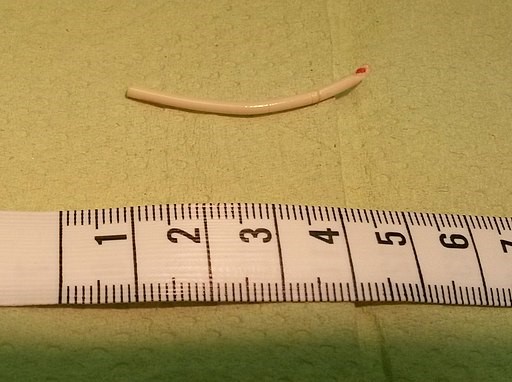
© Vera de Kok, CC BY-SA 4.0 , via Wikimedia Commons
Occasionally, an implant is difficult to feel under the skin, in which case you may be referred to a specialist centre to have it removed with the help of an ultrasound scan. If you want to carry on using an implant, the doctor or nurse can put a new one in at the same time, usually in the other arm. If you do this there will be no break in your contraceptive protection.
The implant can be taken out at any time if you request removal. It loses its effect immediately after being removed.
When should the contraceptive implant be put in?
You can have an implant fitted at any time in your menstrual cycle if it is certain that you are not pregnant.
If the implant is put in during the first five days of your period you will be protected against pregnancy immediately.
After day 5 and if you haven't had unprotected sexual intercourse (UPSI) since your last period, the implant can be inserted immediately but you should avoid sexual intercourse or use a barrier method of contraception (such as condoms) for 7 days.
If you have had unprotected sexual intercourse since your last period you may need a pregnancy test and emergency contraception. You should discuss this with your clinician.
If you have recently had a baby the implant can be put in at any time after the birth. If the implant is inserted on or before day 21, your contraceptive protection starts straightaway. (You can't become pregnant in the first 21 days after delivery, so as long as you have it inserted any time up to day 21 you are protected.)
If it is fitted later than this and you have had unprotected sexual intercourse, you may need a pregnancy test and emergency contraception. You should discuss this with your clinician.
If you have had a termination of pregnancy or a miscarriage the implant can be put in at the same time, or in the first five days, and is effective immediately.
It is sometimes possible to have an implant fitted even if you aren't certain that you are not pregnant. For example, if you have had unprotected sex and it is too early for a pregnancy test to be reliable. This is called quick starting. If you quick start the implant, it is important that you do a pregnancy test at least three weeks after your last episode of unprotected sex. This test would be bought from a chemist or supermarket and not usually supplied by the GP. Your doctor or nurse will talk you through the pros and cons of quick starting.
Side-effects of the contraceptive implant
Most side-effects caused by the contraceptive implant occur when you first start using the implant. They are not usually severe. Of this list, changes in your period is the commonest side-effect.
Gli effetti collaterali più comuni sono:
Changes in your periods (see below).
Fluid retention and breast tenderness.
Acne: your skin may temporarily worsen, although it can also improve.
Itching or bruising after implant insertion.
Sensibilità al seno.
The contraceptive implant does not usually cause altered sex drive (libido), but some women who have experienced other side-effects also say that their sex drive was reduced.
Does the contraceptive implant stop periods?
Most women experience changes in their periods with a contraceptive implant.
Most commonly, the periods will be lighter and less regular.
Some women find that their periods stop altogether with the implant (amenorrea).
A few women have longer, irregular periods, which can be heavy.
Changes in your periods may settle in the first three months of using the implant, and it is not ideal to remove it due to side-effects before this time. If that doesn't happen, your doctor may prescribe extra hormones on top of the implant to try and settle the bleeding. These might be used for a short period of time, or long-term.
Does the contraceptive implant cause weight gain?
There is no strong evidence that the contraceptive implant makes women put on weight.
Risks from using the contraceptive implant
Women who use progestogen only contraception such as the implant have a small increased risk of cancro al seno. The risk is very small - if 100,000 women aged 16 - 20 use the implant for 5 years, there will be an extra 8 cases which happen over the next 15 years. This figure increases to 265 for women aged 35 - 39 (who are also more likely to have breast cancer without an implant) - that is just under an extra 3 cases per 1000 women over 15 years.
Can I have the implant after emergency contraception?
Levonorgestrel. After taking levonorgestrel (Levonelle®) as emergency contraception the implant can be inserted immediately. You should avoid sex or use a barrier method of contraception (such as condoms) for 7 days. In addition you should take a pregnancy test 3 weeks or so after the time you had unprotected sex.
Ulipristal acetate. If you took ulipristal acetate (ellaOne®) the implant should be inserted 5 days dopo taking the tablet. You should avoid having unprotected sex or use a barrier method of contraception (such as condoms) until the implant is inserted and for 7 days after. You should also take a pregnancy test no sooner than 3 weeks after the last time you had unprotected sex.
Can a contraceptive implant be used when breastfeeding?
Yes, an implant can be used when breastfeeding. The implant will not affect your milk production and will not harm your baby.
Although breastfeeding does slightly reduce the chance of another pregnancy, it is not a reliable contraceptive and it is possible to become pregnant whilst breastfeeding.
Can anything make an implant less effective?
Some medicines may make an implant less effective. This includes some medicines used in epilepsy, test HIV and tuberculosis, and St John's wort (a herbal remedy often used to treat headaches, mood disturbances and premenstrual syndrome).
These medications reduce the effectiveness of the implant by increasing the rate at which your body disposes of the hormone in the blood. If you are using one of these medicines you will need to consider a different or additional contraceptive method.
The implant is not affected by common antibiotics, or by an attack of diarrea or being sick (vomiting).
Who should not have a contraceptive implant?
Most women can have an implant fitted but there are a few exceptions. You should not have a contraceptive implant put in if you think you might be pregnant, or if you don't want to use a contraceptive method that might affect your periods.
You also should not use the contraceptive implant if you currently have breast cancer. This is known as an absolute contraindication, that is you should never use the implant if you have breast cancer.
Other health conditions are relative contraindications, in which the risks of using the implant might outweigh the benefits. Your doctor or nurse can help you to understand how important any relative contraindication is, or how more than one risk might combine to affect your decision as to whether or not to use the implant.
Relative contraindications include:
Some types of severe cardiache oppure malattie epatiche.
Past breast cancer.
Current unexplained vaginal bleeding.
A hereditary blood disorder called porfiria.
You have an increased risk of blood clots in the veins due to sindrome da anticorpi antifosfolipidi, antithrombin deficiency or factor V Leiden.
You have previously had a trombosi venosa profonda oppure embolia polmonare.
Hai emicranie.
You have gene mutations associated with breast cancer - for example, BRCA1.
Hai cancro cervicale.
You have experienced a ictus, angina oppure attacco di cuore.
You have several risk factors for heart disease, such as smoking, colesterolo alto, ipertensione, diabete.
You have had ittero or itching caused by previous use of a hormonal contraceptive.
If I have a contraceptive implant, what do I do when I want to try to get pregnant?
If you want to try for a baby, you need to have the implant removed. Your periods will return to normal, although it can be up to three months before you get back to your old rhythm. However, it is possible to get pregnant before you have your first period.
Inizio pre-pregnancy care such as taking folic acid, stopping smoking and considering any regular medication you take beforehand. You can ask your doctor or nurse for further advice.
Where can I get the contraceptive implant?
The contraceptive implant has to be fitted by a specially trained nurse or doctor. This service may be offered at your local GP surgery and, if it is, how to arrange it will probably be explained on their website. Alternatively, a family planning, sexual health or community gynaecology clinic will do this for you. You can find details of services in your area in the UK online.
In the UK the contraceptive implant is free of charge.
All contraceptive services are completely confidential. You will not need an internal examination, a breast examination or a smear before you can have a contraceptive implant. In some cases you may need a pregnancy test to be certain that you are not already pregnant.
La Dott.ssa Mary Lowth è un'autrice o l'autrice originale di questo opuscolo.
Scelte del paziente per Contraccezione

Salute sessuale
Segni che stai usando la pillola anticoncezionale sbagliata
La pillola contraccettiva spesso ha una cattiva reputazione a causa della sua serie di potenziali effetti collaterali, che possono variare da lievemente fastidiosi a decisamente debilitanti. Tuttavia, vale la pena notare che ci sono circa 30 diversi tipi di pillola contraccettiva attualmente disponibili nel Regno Unito, e non tutte le pillole sono create uguali.
di Sarah Graham

Salute sessuale
Preservativi per donne
The first female condom (Femidom®) was introduced in 1992. It is made of a soft plastic material. It fits into the vagina and lines the inside walls.
di Dr Mary Harding, MRCGP
Domande frequenti
Can the contraceptive implant cause hormonal imbalance?
The implant works by releasing a progestogen hormone, etonogestrel, which primarily stops egg release and thickens cervical mucus. While it introduces hormones, the article does not indicate that it causes a general 'hormonal imbalance'. The side-effects listed are specific changes related to its mechanism of action, such as period changes and occasional breast tenderness.
Can the implant affect libido?
The contraceptive implant does not usually cause altered sex drive (libido). However, some women who experience other side-effects have reported a reduced sex drive.
Can I get the contraceptive implant if I have migraines?
Migraines are listed as a 'relative contraindication' for the contraceptive implant. This means that the risks of using the implant might outweigh the benefits in this situation. It is important to discuss this with your doctor or nurse to understand the implications for your specific case.
What should I do if I want to have a new implant but the current one is difficult to remove?
Occasionally, an implant might be difficult to feel under the skin for removal. In such cases, you may be referred to a specialist centre where the removal can be assisted with an ultrasound scan. If you wish to continue using an implant, a new one can often be inserted at the same time, typically in the other arm, ensuring continuous contraceptive protection.
Do I need any examinations before getting a contraceptive implant?
You will not need an internal examination, a breast examination, or a smear test before you can have a contraceptive implant. In some instances, a pregnancy test may be required to confirm you are not already pregnant.
Ulteriori letture e riferimenti
- Trussell J; Fallimento contraccettivo negli Stati Uniti, Contraccezione, 2011
- Tabella riassuntiva dei criteri di idoneità medica del Regno Unito per la contraccezione intrauterina e ormonale; Facoltà di Salute Sessuale e Riproduttiva, 2016 - modificato a settembre 2019
- Contraccezione - Metodi solo progestinici; NICE CKS, novembre 2024 (accesso solo Regno Unito)
- Contraccezione - valutazione; NICE CKS, gennaio 2024 (accesso solo Regno Unito)
- Impianti solo progestinici; Facoltà di Salute Sessuale e Riproduttiva (Feb 2021 - Aggiornato Lug 2023)
Informazioni sull'autoreVisualizza il profilo completo

Dr Toni Hazell, FRCGP
MBBS, BSc, FRCGP, DFSRH, Dip GU med, DRCOG, DCH (London, UK, 2000)
La Dott.ssa Toni Hazell si è laureata presso la St. Mary’s Hospital Medical School e ha completato il suo VTS al Northwick Park Hospital.
Informazioni sul recensoreVisualizza il profilo completo

Dr Philippa Vincent, MRCGP
Medico di base, Autore medico
MB BS, Bsc, MRCGP (2000), DCH, DFSRH, DRCOG
Dr Philippa Vincent è un medico di base del NHS che lavora nel nord di Londra.
Storia dell'articolo
Le informazioni su questa pagina sono scritte e revisionate da clinici qualificati.
Articolo disponibile anche in Inglese, Tedesco, Spagnolo, Francese, Italiano, Portoghese, Hindi, Ebraico, Arabo, and Svedese.
Prossima revisione prevista: 9 Gen 2028
10 Gen 2025 | Ultima versione

Chiedi, condividi, connettiti.
Esplora le discussioni, fai domande e condividi esperienze su centinaia di argomenti di salute.

Non ti senti bene?
Valuta i tuoi sintomi online gratuitamente
Iscriviti alla newsletter di Patient
La tua dose settimanale di consigli sulla salute chiari e affidabili - scritti per aiutarti a sentirti informato, sicuro e in controllo.
Abbonandoti accetti i nostri Informativa sulla Privacy. Puoi annullare l'iscrizione in qualsiasi momento. Non vendiamo mai i tuoi dati.
Più sulla salute sessuale
- Preservativo
- Contraccezione dopo aver avuto un bambino
- Pillole, cerotti e anelli ormonali contraccettivi
- Cerotto contraccettivo
- Diaframmi e cappucci
- Disfunzione erettile
- Herpes genitale
- HIV e AIDS
- Infertilità
- Trattamenti per l'infertilità
- Sindrome di Klinefelter
- Dispositivo intrauterino al levonorgestrel
- Basso testosterone
- Emicrania e contraccezione ormonale combinata
- Malattia infiammatoria pelvica
- Sesso sicuro
- Test del seme
- Test per le IST
- Candidosi negli uomini
- Secrezione vaginale