Condoms for women
Peer reviewed by Dr Jacqueline Payne, FRCGPLast updated by Dr Mary Harding, MRCGPLast updated 22 Nov 2018
Meets Patient’s editorial guidelines
- DownloadDownload
- Share
- Language
- Discussion
- Audio Version
- Add to preferred sources on Google
In this series:Contraception barrier methodsCondomDiaphragms and caps
This page has been archived.
It has not been reviewed recently and is not up to date. External links and references may no longer work.
The first female condom (Femidom®) was introduced in 1992. It is made of a soft plastic material. It fits into the vagina and lines the inside walls.
At a glance
The female condom is a barrier method of contraception and protection against STIs.
It is a soft plastic pouch that lines the vagina.
When used perfectly, about 5 women in 100 will become pregnant each year.
Always check the 'use by' date and use each condom only once.
Always read the instructions that come with the packet for correct use.
It is available for free at family planning clinics in the UK.
Do not use a male and female condom together.
The female condom is an effective method of contraception if used correctly. It also helps to protect against sexually transmitted infections.
What is the female condom?
The first female condom (Femidom®) was introduced in 1992. It is made of a soft plastic material. It fits into the vagina and lines the inside walls. It therefore forms a barrier between the man's sperm and the woman's womb.
Female condom
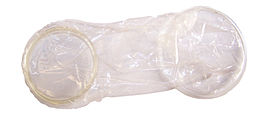
© By Ceridwen (Own work), via Wikimedia Commons
How effective is the female condom?
When no contraception is used more than 80 out of 100 sexually active women become pregnant within one year.
About 5 women in 100 will become pregnant each year, if female condoms are used perfectly for contraception. In comparison about 2 women in 100 will become pregnant each year if male condoms are used perfectly for contraception.
Nearer to 21 women in 100 will become pregnant with normal (not perfect) usage.
Correct use means using the condom every time you have sex. It is very important to avoid any contact between the penis and the vaginal area before the condom is inserted.
How do I use a female condom?
You should read the instructions that come with the packet. The following is a general guide:
Check the condom is within its 'use by' date.
Use each condom only once.
Insert the closed end of the condom into the vagina. Do this by holding the inner ring between your finger and thumb and placing it as far in the vagina as possible. Then put one or two fingers inside the condom, up to the inner ring. Then push it in the vagina as far as it will go. The outer ring should then lie against the outside of the vagina.
Unlike the male condom, it is loose-fitting and will move during sex. If the outer ring gets pushed inside the vagina then stop and put it back in the right place.
Make sure the penis enters the condom during sex and does not go between the condom and the wall of the vagina.
After sex, a slight twist and pull will remove the condom. Take care not to spill any semen on to the vagina. Don't flush it down the toilet. Wrap it up and put it in a bin.
Note: DO NOT use a male and female condom at the same time. This is more likely to result in slippage or splitting of one or both condoms. This increases your risk of getting pregnant or getting a sexually transmitted infection.
What are the advantages of the female condom?
It is safe for anybody to use a female condom and there are no side-effects or risks.
It is easy to obtain and to use.
It helps to protect against sexually transmitted infections.
It may help to protect against cancer of the neck of the womb (cervix).
It is less likely to split than the male condom.
What are the disadvantages of the female condom?
It is more expensive than the male condom to buy. Female condoms are cheaper if bought in a multi-pack or online, but cost around £1-£2 each. However, both types of condom are available for free at family planning clinics in the UK.
The outer ring may be pushed into the vagina during sex. It then becomes less effective.
Some people feel that condoms can interfere with sensation during sex.
Common errors when using a female condom
The penis may leak sperm before the man 'comes' (ejaculates). If there is any contact with the vaginal area before the condom is inserted, the woman may become pregnant.
The penis may go between the condom and the wall of the vagina. If the man ejaculates whilst the penis is there, the woman may become pregnant.
If you have already had sex, there may be sperm still on the man's penis. If there is any contact with the vagina before a new condom is inserted, the woman may become pregnant.
Damage to the condom may cause the condom to split - for example, when handled by women with sharp fingernails.
Note: if any of the above happen then you should obtain emergency contraception within 72 hours. It is more effective the sooner it is taken after sexual intercourse.
See the separate leaflet called Emergency Contraception for more details.
Patient picks for Contraception

Sexual health
Signs you're on the wrong contraceptive pill
The contraceptive pill often gets a bad rap for its host of potential side effects, which can range from the mildly inconvenient to the downright debilitating. However, it's worth noting that there are around 30 different types of contraceptive pill currently available in the UK, and not all pills are created equal.
by Sarah Graham

Sexual health
Natural family planning methods
Natural family planning is a method of preventing pregnancy that does not involve medicines or devices. The fertility awareness method is a type of natural family planning that involves being able to predict your fertile time. This is the time you are likely to conceive.
by Dr Jacqueline Payne, FRCGP
Frequently asked questions
What is a femidom?
The Femidom is the brand name of the first female condom, introduced in 1992. It is constructed from a soft plastic material specifically designed to fit inside the vagina. Its purpose is to line the internal walls of the vagina, creating a physical barrier to prevent sperm from reaching the womb.
Further reading and references
- Trussell J; Contraceptive failure in the United States, Contraception, 2011
- Barrier methods for contraception and STI prevention; Faculty of Sexual and Reproductive Healthcare (August 2012 - updated October 2015)
- Contraception - barrier methods and spermicides; NICE CKS, April 2016 (UK access only)
- Beksinska M, Greener R, Kleinschmidt I, et al; A randomized noninferiority crossover controlled trial of the functional performance and safety of new female condoms: an evaluation of the Velvet, Cupid2, and FC2. Contraception. 2015 Sep;92(3):261-7. doi: 10.1016/j.contraception.2015.05.008. Epub 2015 May 20.
About the authorView full bio

Dr Mary Harding, MRCGP
General Practitioner, Medical Author
BA, MA, MB, BChir, MRCGP, DFFP
Dr Mary Harding qualified from Cambridge University medical school in 1989.
About the reviewerView full bio

Dr Jacqueline Payne, FRCGP
General Practitioner, Medical Author
MB, BS, DFFP, DRCOG, FRCGP
Jacqueline was a GP in Kendal, Cumbria for 25 years, where she trained young GPs for the RCGP and was an Instructing Doctor for the FSRH.
Article history
Article also available in English, German, Spanish, French, Italian, Portuguese, Hindi, Hebrew, Arabic, and Swedish.
22 Nov 2018 | Latest version
Join the conversation
Share your thoughts or experiences with others in our patient communities.

Ask, share, connect.
Browse discussions, ask questions, and share experiences across hundreds of health topics.

Feeling unwell?
Assess your symptoms online for free
Sign up to the Patient newsletter
Your weekly dose of clear, trustworthy health advice - written to help you feel informed, confident and in control.
By subscribing you accept our Privacy Policy. You can unsubscribe at any time. We never sell your data.
More in sexual health
- Chlamydia
- Condom
- Contraceptive implant
- Diaphragms and caps
- Emergency contraception
- Epilepsy and contraception
- Female sexual dysfunction
- Gender dysphoria
- Genital warts
- Hypersexuality
- Intrauterine contraceptive device
- Klinefelter's syndrome
- Levonorgestrel intrauterine device
- Non-gonococcal urethritis
- Pelvic inflammatory disease
- Pubic lice and body lice
- Safer sex
- Sexually transmitted infections
- Thrush in men
- Trichomoniasis