
Epididymal cyst
Peer reviewed by Dr Toni Hazell, FRCGPLast updated by Dr Colin Tidy, MRCGPLast updated 2 Oct 2024
Meets Patient’s editorial guidelines
- DownloadDownload
- Share
- Language
- Discussion
- Audio Version
- Add to preferred sources on Google
In this series:Scrotal lumps, pain and swellingTesticular torsionEpididymo-orchitisVaricoceleHydrocele in adultsHydrocele in infants
An epididymal cyst is a harmless fluid-filled growth on a man's testicle (testis). They are quite common and don't usually require treatment.
Many men feel them and are concerned that they have testicular cancer, but a doctor can usually tell the difference by examination and/or using an ultrasound scan.
At a glance
An epididymal cyst is a harmless, fluid-filled growth near a testicle.
It usually feels like a soft lump at the top or bottom of the testicle.
These cysts are not usually painful and do not affect exercise, urination, or ejaculation.
Most men develop them in middle age.
Small cysts that cause no problems usually do not need treatment.
Large or painful cysts can be surgically removed or treated to shrink them.
Seek medical help if a painful lump appears suddenly, especially if severe.
What is an epididymal cyst?
An epididymal cyst is a harmless growth that grows from the tubes that transport sperm. The tubes are located around a man's testicle.
A cyst is just any small bulge that is filled with fluid. Cysts can grow almost anywhere in the body.
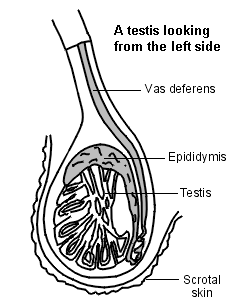
The epididymis is the name of the little tubes just above the testicle (testis). This picture shows where the epididymis is and also shows the rest of the anatomy, including the testis and vas deferens:
Cross-section view
Epididymal cyst symptoms
An epididymal cyst usually presents as a soft, slightly squidgy lump at the top or bottom of your testicle (testis). It is not usually painful and won't affect your ability to exercise, pass urine or ejaculate. They do not usually get infected.
Who develops epididymal cysts?
Men are most likely to develop these cysts during middle age. Children rarely get them before they become teenagers. It's hard to give an exact percentage of boys or men who have epididymal cysts because most people who have them don't know that they do.
Causes of epididymal cysts
We don't really know what causes epididymal cysts, though it may be that infection or inflammation might make it more likely that one will occur.
What else could it be?
Inflammation: some illnesses cause a thickening of the epididymis and surrounding structures which can feel like an epididymal cyst.
Hydrocele: this is caused by a collection of fluid in the scrotum.
Varicocele: this is like varicose veins of the small veins next to one testicle (testis) or both testes. It is usually described as feeling like a 'wriggling bag of worms'.
Lipoma: this is a fatty lump which can sometimes cause difficulty because it can be felt separate from the testicle, just like an epididymal cyst.
Diagnosing epididymal cysts
Usually they are quite typical in the way they feel and a doctor can confidently reassure you by undertaking a physical examination.
If the doctor isn't quite sure what the lump is, they could arrange an ultrasound scan of your scrotum - they may do this anyway even if they are pretty sure that it is an epididymal cyst, just for reassurance.
Illnesses associated with epididymal cysts
Most men with epididymal cysts are quite healthy. There are some quite rare conditions that are associated with epididymal cysts:
Cystic fibrosis: an inherited illness in which there are cysts in the lungs, pancreas and other areas of the body.
Polycystic kidney disease: an inherited condition in which cysts develop in the kidneys and other parts of the body.
Males who have epididymal cysts are not at increased risk of infertility if they are otherwise well.
Treatment for epididymal cysts
No treatment
If the cyst is small and causing no pain or discomfort, then all you need to do is keep an eye on it and see a doctor if it increases in size.
Surgical removal
Large or painful cysts can be surgically removed or treated by aspiration and injection of a substance to shrink and seal the cyst.
Children do not usually need treatment because most cysts disappear by themselves. However it may take up to four years to resolve. Surgical removal may be necessary if they become painful or don't start to shrink.
Complications of epididymal cysts
Usually epididymal cysts don't cause any problems at all. But occasionally they can twist around and become very painful. This is called torsion and happens pretty quickly: within about half an hour. It is really painful and usually needs surgery to untwist it and remove it.
Patient picks for Testicle and scrotum disorders

Men's health
Testicular torsion
When a testicle (testis) twists around in the scrotum, the condition is called testicular torsion. An emergency operation is usually needed to treat this condition.
by Dr Toni Hazell, FRCGP

Men's health
Varicocele
A varicocele is like varicose veins of the small veins (blood vessels) next to one testicle (testis) or both testicles (testes).
by Dr Doug McKechnie, MRCGP
Frequently asked questions
What should I do if my epididymal cyst starts to get bigger?
If you notice that your epididymal cyst is increasing in size, you should see a doctor. This is a good way to monitor its progress and ensure there are no issues that need further attention.
Could an epididymal cyst prevent me from having children?
Having an epididymal cyst does not increase your risk of infertility, as long as you are otherwise healthy. It should not affect your ability to have children.
Is there anything an epididymal cyst can be confused with, and how is it differentiated?
An epididymal cyst can sometimes be mistaken for other conditions such as inflammation near the epididymis, a hydrocele (fluid collection in the scrotum), a varicocele (swollen veins often described as feeling like a 'bag of worms'), or a lipoma (a fatty lump). A doctor can usually differentiate these through a physical examination, and may perform an ultrasound scan for confirmation.
What is involved in the surgical removal of an epididymal cyst?
For large or painful cysts, surgical removal is an option. Another treatment method involves aspiration, where the fluid is drained, followed by an injection of a substance designed to shrink and seal the cyst. For children, surgical removal might be needed if cysts become painful or do not shrink on their own, though many disappear without intervention.
Further reading and references
- Mukendi AM; Bilateral epididymal cyst with spontaneous resolution. Clin Case Rep. 2020 Aug 22;8(12):2689-2691. doi: 10.1002/ccr3.3199. eCollection 2020 Dec.
- Weatherly D, Wise PG, Mendoca S, et al; Epididymal Cysts: Are They Associated With Infertility? Am J Mens Health. 2018 May;12(3):612-616. doi: 10.1177/1557988316644976. Epub 2016 Apr 26.
- Low LS, Nair SM, Davies AJW, et al; Aspiration and sclerotherapy of hydroceles and spermatoceles/epididymal cysts with 100% alcohol. ANZ J Surg. 2020 Jan;90(1-2):57-61. doi: 10.1111/ans.15467. Epub 2019 Oct 18.
About the authorView full bio
Updated by

Dr Colin Tidy, MRCGP
General Practitioner, Medical Author
MBBS, MRCGP, MRCP (Paediatrics), DCH
Dr Colin Tidy is an NHS Doctor, based in Oxfordshire.
About the reviewerView full bio

Dr Toni Hazell, FRCGP
MBBS, BSc, FRCGP, DFSRH, Dip GU med, DRCOG, DCH (London, UK, 2000)
Dr. Toni Hazell qualified from St. Mary’s Hospital Medical School and did her VTS at Northwick Park Hospital.
Join the conversation
Share your thoughts or experiences with others in our patient communities.

Ask, share, connect.
Browse discussions, ask questions, and share experiences across hundreds of health topics.

Feeling unwell?
Assess your symptoms online for free
Sign up to the Patient newsletter
Your weekly dose of clear, trustworthy health advice - written to help you feel informed, confident and in control.
By subscribing you accept our Privacy Policy. You can unsubscribe at any time. We never sell your data.