
Testicular torsion
Peer reviewed by Dr Colin Tidy, MRCGPLast updated by Dr Toni Hazell, FRCGPLast updated 15 Sept 2023
Meets Patient’s editorial guidelines
- DownloadDownload
- Share
- Language
- Discussion
- Audio Version
- Add to preferred sources on Google
In this series:Scrotal lumps, pain and swellingEpididymo-orchitisEpididymal cystVaricoceleHydrocele in adultsHydrocele in infants
When a testicle (testis) twists around in the scrotum, the condition is called testicular torsion. An emergency operation is usually needed to treat this condition.
At a glance
Testicular torsion occurs when a testicle twists, cutting off its blood supply.
It usually affects teenage boys but can occur at any age.
Symptoms include sudden, severe pain in the testicle and sometimes the lower tummy.
Nausea and vomiting can also occur alongside the pain.
Testicular torsion is a medical emergency requiring urgent surgery.
Seek immediate medical help if you experience sudden, severe testicular pain.
Early surgery within 6-8 hours offers the best chance of saving the testicle.
What is testicular torsion?
In some young men the tissues that surround the testicle (testis) in the scrotum are loose. Therefore, the testes can move around in the scrotum more than usual. This can be called a 'bell-clapper' deformity. If a testis twists around, the spermatic cord has to twist around too as it is fixed higher up. If this happens, the blood flow to the testicle is blocked in the twisted spermatic cord.
Musculature and inner workings of the scrotum
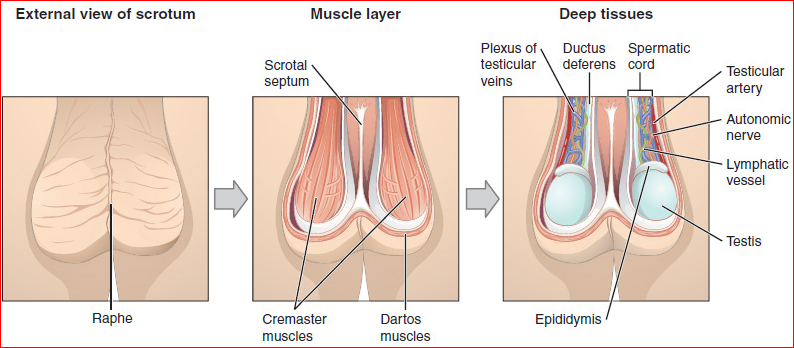
How common is testicular torsion?
Testicular torsion occurs in teenage boys aged 13-18 years. This is found to happen in around 1 in 4,000 young men. Newborn babies and younger children sometimes develop this problem. It is uncommon over the age of 25 but does occur sometimes in older adults and can occur at any age.
A testis with its blood supply cut off is likely to die unless the blood flow is quickly restored.
Testicular torsion symptoms
The typical symptom of torsion of the testicle (testis) is severe pain that develops quickly - within a few hours, often much more quickly. The pain might be in the lower abdomen (tummy). This is because the testis and the tummy share a nerve supply. Any boy or young man with abdominal pain that came on quickly and severely should have their testes checked.
Testicular torsion pain often starts during sport or physical activity. Alternatively symptoms may start in the night and the pain wakes you from sleep. Nausea and vomiting often also occur.
Note: easing pain is not necessarily a good sign because pain also eases as the testis starts to die.
Occasionally, the symptoms are milder.
What else might it be?
There is a condition called torsion of the epididymal appendage - see image above. This is where an additional part of the epididymis twists, instead of the whole testis. It usually happens in younger boys aged between 7 and 12 years. The pain is in a specific (upper) part of the testis.
Sometimes, in lighter-skinned boys, you might see a small tender lump with bluish discolouration on the upper part of the testis.
Infective conditions such as epididymo-orchitis can be caused by infected urine or sexually transmitted infection such as gonorrhoea (in an older age group).
If there is some doubt about diagnosis, a particular type of ultrasound that looks at blood flow through the scrotum, may be used.
Testicular torsion treatment
Twisting (torsion) of the testicle (testis) is an emergency. If the blood supply to your testis is cut off for more than about six hours then permanent damage is likely to occur. An emergency operation is usually done:
A small cut is made in the skin of your scrotum to expose the testis. The affected testis and spermatic cord are untwisted. The testis is then stitched to the surrounding tissue and fixed in position to prevent torsion happening again. The other testis is also fixed at the same time, as it has a higher-than-average chance of twisting in the future.
The sooner the operation is done, the better the outlook to save your testis. Ideally, the operation should be done within 6-8 hours of symptoms starting. Sometimes the affected testicle is removed if the operation is done too late and the testis has died.
Although the operation is usually done as an emergency, it is a fairly small operation which does not take very long.
Occasionally, the twisted testis can be untwisted by a doctor, without needing an operation - this is called manual detorsion. However, this procedure can be painful and often not successful. An operation is usually still needed afterwards to fix the testis in place.
Partial torsion and warning pains
Some boys and men have warning pains in a testicle (testis) every now and then, before a full-blown twisting (torsion). These occur suddenly, last for a few minutes, then ease just as suddenly. These pains occur if a testis twists a little and then returns back to its normal place on its own.
An operation to fix the testes in place is usually advised if these warning pains occur. This is because it is likely that at some point a testis will twist fully and emergency surgery will be needed. A planned operation to fix the testes is preferable to waiting for a full-blown torsion to occur.
Outlook (prognosis)
Both how badly the testis has twisted and how long it stays twisted for are important in the outcome. If correcting surgery happens within six hours of torsion, 9 or 10 out of 10 testes will be saved on average. If surgery is delayed until between 12 hours and 24 hours from the start of symptoms then only one testis is saved out of 10.
If a testis cannot be saved and has to be removed, then an implant can be inserted later to restore the appearance of the scrotum to normal.
Research suggests that early treatment is most likely to preserve the ability to father children. Longer delays to treatment and removal of a testis may reduce that ability.
Patient picks for Testicle and scrotum disorders
Men's health
Blood in semen
Haematospermia means there is blood in the semen. Usually there are no other symptoms such as pain. In men under 40 years old it is usually harmless and resolves without any treatment. However, it can also be caused by a number of conditions that need investigations and treatment.
by Dr Hayley Willacy, FRCGP

Men's health
Epididymo-orchitis
Epididymo-orchitis is an inflammation of the epididymis and/or testicle. The epididymis and testicle can swell and the scrotum may become enlarged, tender and red. In adults, epididymo-orchitis is usually due to infection, most commonly from a urine infection or a sexually transmitted infection. A course of antibiotic medicine will usually clear the infection.
by Dr Rachel Hudson, MRCGP
Frequently asked questions
Can testicular torsion occur in people over 25?
While testicular torsion is uncommon over the age of 25, it can still occur in older adults and at any age, even though it is most frequently observed in teenage boys.
What is 'bell-clapper' deformity?
A 'bell-clapper' deformity describes a situation where the tissues surrounding the testicle in the scrotum are looser than usual. This increased looseness allows the testicle to move more freely, making it more susceptible to twisting.
If the pain from a possible testicular torsion eases, does that mean it's not serious?
No, easing pain is not necessarily a good sign. The pain can also ease as the testicle starts to die due to the cut-off blood supply. Therefore, any severe, sudden testicular pain should be medically evaluated immediately.
How quickly must surgery be performed for a good outcome?
For the best chance of saving the testicle, the operation should ideally be performed within 6-8 hours of the symptoms starting. If corrected within six hours, approximately 90% of testicles can be saved. Delays beyond 12-24 hours significantly reduce the chances of saving the testicle.
What happens if a testicle cannot be saved?
If a testicle cannot be saved and must be removed, an implant can be inserted later to restore the normal appearance of the scrotum. Early treatment is crucial for preserving the ability to father children, and longer delays or removal of a testicle may reduce this ability.
Further reading and references
- EAU Paediatric Urology Guidelines. Edn. presented at the EAU Annual Congress Copenhagen; European Association of Urology, 2018 - updated 2023
- Pomajzl AJ, Leslie SW; Appendix Testes Torsion
- Vasconcelos-Castro S, Soares-Oliveira M; Abdominal pain in teenagers: Beware of testicular torsion. J Pediatr Surg. 2020 Sep;55(9):1933-1935. doi: 10.1016/j.jpedsurg.2019.08.014. Epub 2019 Aug 29.
About the authorView full bio
Updated by

Dr Toni Hazell, FRCGP
MBBS, BSc, FRCGP, DFSRH, Dip GU med, DRCOG, DCH (London, UK, 2000)
Dr. Toni Hazell qualified from St. Mary’s Hospital Medical School and did her VTS at Northwick Park Hospital.
About the reviewerView full bio

Dr Colin Tidy, MRCGP
General Practitioner, Medical Author
MBBS, MRCGP, MRCP (Paediatrics), DCH
Dr Colin Tidy is an NHS Doctor, based in Oxfordshire.
Join the conversation
Share your thoughts or experiences with others in our patient communities.

Ask, share, connect.
Browse discussions, ask questions, and share experiences across hundreds of health topics.

Feeling unwell?
Assess your symptoms online for free
Sign up to the Patient newsletter
Your weekly dose of clear, trustworthy health advice - written to help you feel informed, confident and in control.
By subscribing you accept our Privacy Policy. You can unsubscribe at any time. We never sell your data.