Problemi comuni della cervice
Revisione paritaria di Dr Surangi Mendis, MRCGPUltimo aggiornamento di Dr Toni Hazell, FRCGPUltimo aggiornamento 17 Settembre 2024
Rispetta le linee guida editoriali
- ScaricaScarica
- Condividi
- Language
- Discussione
- Versione audio
- Aggiungi alle fonti preferite su Google
There are many different conditions that can affect the neck of the womb (cervix), ranging from mild inflammation to cervical cancer. Some conditions affecting the cervix are more common than others; some are more serious than others. They can all cause different symptoms, such as abnormal bleeding or discharge from your vagina, or may not cause any symptoms at all.
Some conditions are normal and do not need any treatment. The type of treatment, if needed, will depend on the underlying condition. Your doctor will be able to discuss the most appropriate treatment for you.
A colpo d'occhio
Problems affecting the cervix can include cervical ectropion, nabothian cysts, and infections.
Symptoms can include lower tummy pain, abnormal vaginal bleeding, and pain during sex.
Some women may have no symptoms, with problems found during a cervical smear test.
Infections are a common cause of cervical problems, including sexually transmitted infections (STIs).
Many cervical problems can be diagnosed by examination, sometimes with swabs or a biopsy.
A colposcopy may be done if a cervical smear test shows cell changes.
Utero e cervice
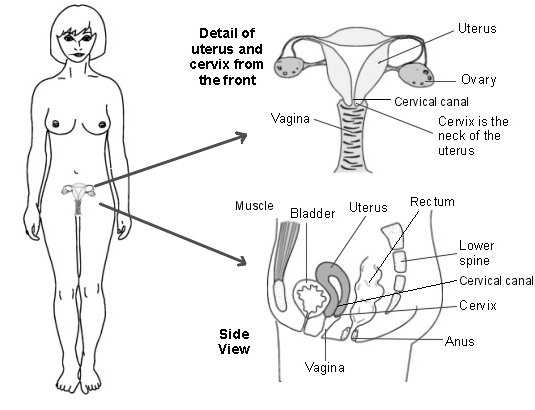
Problems affecting the cervix
Endometriosi. This can also affect the uterus, fallopian tubes and other sites in the pelvis and around the body.
Ectropion cervicale. Cervical ectropion (or erosion) is a harmless change. It is related to oestrogen and is therefore more common in young women, pregnant women and those taking combined oral contraceptive pills. It may cause increased vaginal discharge or bleeding. If an ectropion is causing no symptoms it does not need treating, but if a healthcare professional is not sure that what they are seeing is definitely an ectropion they may refer you for a further opinion to be sure. An ectropion which is causing symptoms can be safely treated with a burning technique (cautery), using an electrical current (diathermy). This treatment is under local anaesthetic (when you are awake).
Nabothian cysts. Nabothian cysts are tiny cysts that form on the surface of the neck of the womb (cervix). They are fairly common and do not usually cause any symptoms. They do not usually need any treatment, but if a healthcare professional is not sure that what they are seeing is definitely a Nabothian cyst, they may refer you for a further opinion to be sure.
Infezioni.
Polyps of the cervix (cervical polyps). A polyp is a small growth which arises from a stalk on either the surface or the inside of the neck of your womb (cervix). They are not usually cancerous, although very rarely they can be due to cancer. For this reason, any polyp which is removed must be sent to the lab to check that it is benign (not caused by cancer).
Symptoms of common cervical problems
The symptoms you may experience will depend on the underlying condition. Some women will not have any symptoms at all. A problem with the neck of the womb (cervix) may be detected by the doctor or nurse who is examining them for another reason. For example, when a test di screening cervicale is taken.
I sintomi possono includere:
Abnormal vaginal bleeding. For example, bleeding after having sex (intercourse) or bleeding in between your periods.
Diagnosing cervical problems
Most conditions that affect your cervix can be diagnosed by examining you. However, it is sometimes necessary for other tests to be undertaken. For example:
Internal swabs may be taken by your GP or in a hospital clinic. A swab is a small ball of cotton wool on the end of a thin stick. It can be gently rubbed on your cervix to obtain samples.
A biopsy may be carried out. In this procedure, done in hospital, a small sample of tissue is taken from a lump. The sample can then be examined under a microscope in the laboratory.
Other tests may also be carried out, depending on your symptoms. These tests may include blood tests and an ultrasound of your womb and ovaries.
Colposcopy is a test to look at your cervix in more detail. A colposcopy is often done if your cervical smear test finds any changes to the cells of your cervix. See also the separate leaflet called Colposcopy and cervical treatments.
Causes of problems affecting the cervix
Infections are caused by germs such as bacteria and viruses and lead to inflammation of the neck of the womb (cervix). Inflammation of your cervix is called cervicitis. The most common symptom in women with cervicitis is vaginal discharge. Other symptoms can include pain on passing urine, lower tummy (abdominal) pain and bleeding in between periods.
Infezioni sessualmente trasmissibili
Infections of your cervix are usually caught through having sex. The most common infezioni sessualmente trasmissibili (IST) which affect the cervix are:
Human papilloma virus
Virus del papilloma umano (HPV) is transmitted by sex but is not thought of in the same way as other STIs. 80% of people who are sexually active will get HPV at some point in their life, and their body may clear it naturally. No treatment is needed and you do not need to tell their partner or suggest that they are tested, as you would do with any other STI.
Some types of HPV can lead to changes in the cells of the cervix; 99.7% of all cervical cancer is linked to HPV. The NHS cervical screening programme now has a different process to in the past - the process is as follows:
The sample is tested for HPV - if this is negative, it is discarded and you go back to normal recall (three or five years depending on your age and the country of the UK in which you live, one year if you have HIV).
If the HPV test is positive then your sample is examined under the microscope (cytology), where abnormal cells (called squamous or glandular cells) may be found.
If the cytology shows abnormalities then you will be referred to a colposcopy clinic.
If the cytology is normal then you will have another smear in one year. If this happens three years in a row (positive HPV test but negative cytology) then you will also be referred to a colposcopy clinic.
Vaginosi batterica
Vaginosi batterica is not an STI, but can cause a smelly discharge - typically described as a fishy smell. It is caused by an overgrowth of normal germs in your vagina and is usually treated with antibiotics.
Other causes of inflammation of the cervix
Inflammation of the neck of the womb (cervix), called cervicitis, can also be caused by other conditions. These include:
Allergies - for, example to condoms or to spermicides.
Irritation - for example, from tampons, particularly if one is left in for a long time.
Radioterapia - cervicitis can be a side-effect of radiotherapy which is used to treat some cancers.
Symptoms of cervicitis include discharge, bleeding between the periods or after sex, and pelvic pain.
For cervicitis not caused by infections, there is usually no treatment. They settle when the cause is removed.
See the links for further information about endometriosis and cancer of the cervix.
Scelte del paziente per Cervix and uterus problems

Salute delle donne
Prolasso degli organi pelvici
The organs inside a woman's pelvis include the womb (uterus), the bladder and the back passage (rectum). Normally, these are supported and held in position by certain structures including ligaments and the muscles at the bottom of the pelvis (pelvic floor muscles). Pelvic organ prolapse (also known as genitourinary prolapse) occurs when these normal support structures are weakened and are no longer effective. The result is that one (or more) of the organs inside the pelvis drops down (prolapses). The space available for the organ(s) to drop down into is the vagina. There can be different degrees of prolapse, depending on how much, or how far, the organ(s) might have dropped down into the vagina. Sometimes, the prolapse can be so much that it causes the walls of the vagina, or the uterus, or both, to protrude outside the opening of the vagina.
di Dr Toni Hazell, FRCGP

Salute delle donne
Fibromi
A fibroid is a non-cancerous (benign) growth of the womb (uterus). They are also called uterine myomas, fibromyomas or leiomyomas. Their size can vary. Some are the same size as a pea and some can be as big as a melon. Fibroids are common and usually cause no symptoms. However, they can sometimes cause heavy periods, tummy (abdominal) swelling and urinary problems.
di Dr Colin Tidy, MRCGP
Domande frequenti
What is the function of the cervix?
The article refers to the cervix as the 'neck of the womb'. While it doesn't describe its specific functions, its location suggests it connects the uterus to the vagina, playing a role in reproduction and menstruation.
Do nabothian cysts ever need to be removed?
Nabothian cysts usually do not require any treatment as they typically do not cause symptoms. However, if a healthcare professional is uncertain about the diagnosis, they may refer you for further evaluation to ensure it is indeed a Nabothian cyst.
Can cervical polyps come back after being removed?
The article states that cervical polyps are small growths arising from a stalk on the surface or inside the cervix. It mentions they are usually not cancerous and are sent to a lab to confirm they are benign after removal. However, it does not specify if they can recur.
What are common symptoms unique to cervicitis?
Cervicitis, which is inflammation of the cervix, commonly causes vaginal discharge. Other symptoms can include pain when urinating, lower abdominal pain, and bleeding between periods or after sex. These symptoms can also overlap with other cervical issues.
If my cervical smear is positive for HPV but shows no abnormal cells, what is the next step?
If your HPV test is positive but the cytology (examination of cells under a microscope) is normal, you will be asked to have another smear test in one year. If you have a positive HPV test but normal cytology three years in a row, you will then be referred to a colposcopy clinic.
Is bacterial vaginosis considered a sexually transmitted infection?
No, bacterial vaginosis is not an STI. It is caused by an overgrowth of normal bacteria already present in your vagina and often results in a discharge with a distinctive fishy smell. It is typically treated with antibiotics.
What happens if an ectropion is causing symptoms?
If an ectropion causes symptoms such as increased vaginal discharge or bleeding, it can be safely treated. The treatment involves a burning technique called cautery, which uses an electrical current (diathermy), and is performed under local anaesthetic while you are awake.
Ulteriori letture e riferimenti
- Casey PM, Long ME, Marnach ML; Abnormal cervical appearance: what to do, when to worry? Mayo Clin Proc. 2011 Feb;86(2):147-50; quiz 151. doi: 10.4065/mcp.2010.0512. Epub 2011 Jan 26.
- CKS Cancro cervicale e HPV; NICE CKS, febbraio 2022 (accesso solo Regno Unito)
- Screening cervicale; NICE CKS, settembre 2022 (accesso solo Regno Unito)
- Clamidia - genitale non complicata; NICE CKS, aprile 2022 (accesso solo Regno Unito)
- Gonorrea; NICE CKS, marzo 2024 (accesso solo Regno Unito)
- Endometriosi; NICE CKS, novembre 2024 (accesso solo Regno Unito)
Informazioni sull'autoreVisualizza il profilo completo

Dr Louise Newson, MRCGP
BSc (Hons) Pathology, MB, ChB (Hons), MRCP, MRCGP, DFFP, FRCGP
Louise si è laureata all'Università di Manchester nel 1994 ed è un medico di base ed esperta di menopausa a Solihull, West Midlands.
Informazioni sul recensoreVisualizza il profilo completo

Dr Surangi Mendis, MRCGP
Consulente e Autore Medico
MBBS, BSc (1st), MRCGP (2014), DFSRH, PGcert otology and audiology
Surangi Mendis è una consulente in Medicina Audiovestibolare e Neuro-otologia presso il Royal National ENT e Eastman Dental Hospitals, UCLH.
Storia dell'articolo
Le informazioni su questa pagina sono scritte e revisionate da clinici qualificati.
Articolo disponibile anche in Inglese, Tedesco, Spagnolo, Francese, Italiano, Portoghese, Hindi, Ebraico, Arabo, and Svedese.
Prossima revisione prevista: 16 settembre 2027
17 Settembre 2024 | Ultima versione
8 Maggio 2015 | Pubblicato originariamente
Autore:
Dr Louise Newson, MRCGP

Chiedi, condividi, connettiti.
Esplora le discussioni, fai domande e condividi esperienze su centinaia di argomenti di salute.

Non ti senti bene?
Valuta i tuoi sintomi online gratuitamente
Iscriviti alla newsletter di Patient
La tua dose settimanale di consigli sulla salute chiari e affidabili - scritti per aiutarti a sentirti informato, sicuro e in controllo.
Abbonandoti accetti i nostri Informativa sulla Privacy. Puoi annullare l'iscrizione in qualsiasi momento. Non vendiamo mai i tuoi dati.
Di più sulla salute delle donne
- Metodi di barriera contraccettiva
- Contraccezione per donne sopra i 40 anni
- Metodi contraccettivi
- Anello vaginale contraccettivo
- Cistite nelle donne
- Fibromi
- Dispositivo intrauterino al levonorgestrel
- Emicrania e contraccezione ormonale combinata
- Malattia infiammatoria pelvica
- Prolasso degli organi pelvici
- Dolore mestruale
- Mestruazioni e problemi mestruali
- Depressione postnatale
- Endometrite postpartum
- Psicosi postpartum
- Gravidanza e attività fisica
- Bambini prematuri
- Pillola contraccettiva solo progestinica
- Cistite ricorrente nelle donne
- Infezione urinaria in gravidanza