Blood in urine
Peer reviewed by Dr Caroline Wiggins, MRCGP Last updated by Dr Rachel Hudson, MRCGPLast updated 8 Apr 2025
Meets Patient’s editorial guidelines
- DownloadDownload
- Share
- Language
- Discussion
- Audio Version
- Add to preferred sources on Google
Passing blood in your urine (haematuria) usually results in your urine turning a pink, red or brown colour.
At a glance
Blood in urine, also known as haematuria, means there are red blood cells in your pee.
You might see visible blood in your urine, or it might only be found with a urine test.
Common causes include urinary tract infections, kidney stones, and kidney infections.
Blood in your urine can also be a sign of more serious conditions like bladder or kidney cancer.
Always see a doctor if you notice blood in your urine to find out the cause.
Your doctor will ask about your symptoms and may do a physical examination and tests.
What is blood in the urine?
Although this can be alarming, passing blood in urine is often not due to a serious condition. However, it is important to see your doctor if you notice blood in your urine to determine the underlying cause for this. Blood in your urine (sometimes known as 'peeing blood' or 'blood in wee') can be due to a number of reasons, which will be discussed below.
Alternatively, some people only have a small amount of blood (small numbers of red blood cells) in their urine which cannot be seen unless using a microscope - microscopic haematuria, (also known as non-visible haematuria), but are found when a dipstick is put in a sample of their urine, or seen under a microscope when a sample is sent to the lab for testing.
What is haematuria?
Haematuria is the medical term for blood in your urine. This usually occurs when there is a problem with your bladder or kidneys. You may notice other symptoms when you have blood in your urine. You may have blood in the urine with pain or blood in the urine with no pain. You may feel completely well.
Understanding urine and the bladder
Your kidneys make urine continuously. A trickle of urine is constantly passing to your bladder down the tubes (called ureters) which run from the kidneys to the bladder. You make different amounts of urine, depending on how much you drink, eat and sweat.
Urinary tract
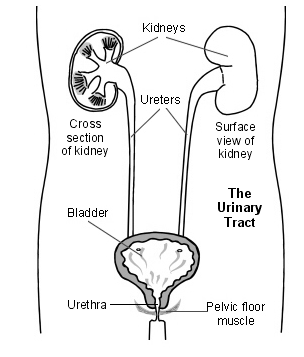
Your bladder is made of muscle and stores the urine. It expands like a balloon as it fills with urine. The outlet for urine (your urethra) is normally kept closed. This is helped by the muscles below your bladder that surround and support your urethra (the pelvic floor muscles).
When a certain volume of urine is in your bladder, you become aware that your bladder is becoming full. When you go to the toilet to pass urine, your bladder muscle squeezes (contracts) and your urethra and pelvic floor muscles relax to allow the urine to flow out.
How common is blood in urine?
It is difficult to know precisely how common this symptom occurs, but because so many different problems can cause haematuria, it is a quite a common problem for a GP to see. Some people are more likely to have blood in their urine than others, such as women with urine infections, or older men with prostate problems.
Blood in urine causes
There are many different reasons for blood in urine. The blood may be coming from your kidneys or from any area along your urinary tract - for example, from your bladder, ureters or urethra.
Understanding what can cause blood in urine may give you an idea as to what is going on. Blood in urine in females can have different causes to blood in urine in males. It can sometimes be difficult for women to know exactly where the blood is coming from. The blood from a menstrual cycle (period) or from another cause from the vagina can also lead to blood in the urine.
Urinary tract infection
A urine infection (UTI) is the most common cause of blood in your urine, especially in women. Men who have recurrent urine infection may have underlying enlarged prostate (also called benign prostatic hyperplasia). A urine infection causes inflammation of your bladder (cystitis). The most common symptoms are pain passing urine and passing urine more often than normal.
You may also have pain in your lower tummy and a high temperature (fever). UTI blood in urine can occur in your urine as a result of this inflammation occurring in your bladder.
Urinary tract infections are usually very effectively treated with a short course of antibiotics. Further tests may be necessary if you have:
Frequent episodes of infections. See the separate leaflet called Recurrent cystitis in women.
Other underlying conditions - for example, kidney problems in the past.
See the separate leaflets called Cystitis in women (Urine infection), Urine infection in pregnancy, Urine infection in men, Urine infection in older people, and Urine infection in children for more information.
Kidney infection
Kidney infections (also known as pyelonephritis) usually occur as a complication of a bladder infection. Symptoms of kidney infections are usually more severe than with a urinary tract infection. Often there is a very high temperature (fever) and pain in the side of your tummy (abdomen) or over the side of your back.
Kidney infections are treated with a longer course of antibiotics. If the infection is more severe, then the antibiotics may need to be given straight into the vein in hospital. See the separate leaflet called Kidney infection (Pyelonephritis) for more details.
Urethritis
This is inflammation of the tube (your urethra) draining urine out of your body. Urethritis is often caused by a sexually transmitted infection which is easily treated with antibiotics.
Kidney stones
Bleeding into your urinary tract can occur when a stone is being passed, as the stone rubs against the inside of your urethra. It is common to have pain from your back and across your tummy towards your groin when this occurs. Some people with kidney stones only have blood in their urine, which is picked up by a dipstick test.
Although many stones do not need any treatment as they will pass by themselves, some people need to have specific treatment to remove any kidney stones. See the separate leaflet called Kidney stones for more information.
Tumours in the bladder or kidney
The most common early sign of bladder cancer or kidney cancer is blood in the urine, usually without any other symptoms. About 1 in 5 adults with visible blood in their urine will be found to have bladder cancer. However, the vast majority of people (4 out of 5) who have blood in their urine do not have cancer.
The outlook for people with bladder and kidney cancer is better the earlier it is diagnosed. It is therefore very important that certain people have tests to look for bladder cancer if they have blood in their urine. For example, a person aged over 45 years with no infection causing blood in their urine would be referred for tests. These may include an ultrasound scan or a procedure where a small thin telescope is passed into your bladder (a cystoscopy).
Inflammation in the kidney
There are various conditions which can lead to inflammation in your kidneys. These can then result in blood in your urine, which is usually only found when a dipstick test of your urine is performed. This inflammation of the kidneys is called glomerulonephritis. Other symptoms such as tiredness and swelling around your eyes and legs can also sometimes occur.
The inflammation leads to glomerulonephritis which is usually due to a problem with your body's immune system. This can sometimes be triggered by an infection. Glomerulonephritis is the most common cause of blood in the urine of children and young adults. However, it can occur in people of any age. See the separate leaflet called Glomerulonephritis for more information.
Bleeding disorders
There are some conditions which can cause problems with the way your blood clots in your body. An example of this is haemophilia. This is an uncommon but important cause of blood in your urine.
If you are taking an anticoagulant medicine (often called blood-thinners, such as warfarin), it is important that you have your blood checked promptly if you develop blood in your urine. This is because your dose of warfarin may be too high.
There are also other, more uncommon conditions that can lead to blood in your urine. These include sickle cell disease, injuries to your urinary tract and polycystic kidney disease.
Note: some people notice their urine turns red but do not actually have blood in their urine. The urine can turn red in some people after eating beetroot and also after taking some medications - for example, the antibiotic rifampicin.
Diagnosing blood in urine
When you see a clinician they will start by asking about your symptoms and they might do a physical examination, if that is needed. They will then order some investigations depending on many different factors, such as your symptoms, if you have any other illnesses or conditions, and your age.
It is likely that you will need to provide a sample of urine which will be sent to the local laboratory to be tested for infection. You may have blood tests, X-rays, or magnetic resonance imaging (mri) and computed tomography (ct) scans.
Cystoscopy
A cystoscopy may be performed to assess your bladder. Having a cystoscopy entails a doctor or nurse looking into your bladder with a special thin telescope called a cystoscope. The cystoscope is passed into your bladder via your outlet for your urine (urethra). A cystoscopy which is done just to look into your bladder is usually carried out under local anaesthetic.
More details about the different tests can be found in the separate individual condition leaflets, mentioned above.
Blood in urine treatment
The treatment will obviously depend on the underlying cause for the blood in your urine. More information can be found in the separate individual leaflets on the various conditions that can cause blood in your urine.
If no cause can be found then you should still report any further bleeding to your GP who may want to you to undergo more tests. You should not ignore any blood in your urine even if you have had normal tests in the past.
Patient picks for Urinary tract symptoms

Women's health
Lower urinary tract symptoms in women
Lower urinary tract symptoms (LUTS) are common in women of all ages, especially between the ages of 40-60. For many women, the symptoms come and go. But for some women, the symptoms are ongoing and interfere with normal life. The symptoms may include wetting yourself (incontinence), needing to pass urine frequently, or discomfort passing urine. These and other symptoms can result in poor quality of life. Many women never tell anyone about their symptoms. Your doctor may recommend tests to look for an underlying cause. Referral to a specialist is not usually needed. Often, no specific underlying cause is found. Treatment may help to relieve symptoms.
by Dr Rachel Hudson, MRCGP

Kidney and urinary tract
Proteinuria
Proteins are molecules that are found in almost every part of the body, including in the blood. The kidneys normally have a filter which stops protein from entering the urine, except in very tiny amounts; however, kidney problems can cause higher levels of protein to be found in the urine.
by Dr Doug McKechnie, MRCGP
Frequently asked questions
Can certain foods or medications make my urine appear bloody when it isn't?
Yes, some people notice their urine turns red after eating beetroot. Additionally, certain medications, such as the antibiotic rifampicin, can also cause a red discoloration of the urine that is not actually due to blood.
What is the difference between visible and non-visible blood in urine?
Visible blood in urine, sometimes called 'peeing blood,' is when you can clearly see blood in your urine. Non-visible, or microscopic, haematuria refers to small amounts of blood (red blood cells) in your urine that can only be detected with a dipstick test or by examining a urine sample under a microscope.
Are there specific causes of blood in urine that affect women more than men, or vice versa?
Yes, women are more prone to urinary tract infections (UTIs), which are a common cause of blood in the urine. For men, prostate problems like an enlarged prostate can be an underlying cause of recurrent UTIs and blood in the urine. Also, for women, it can sometimes be difficult to distinguish if blood is coming from the urinary tract or from menstruation or other vaginal causes.
How is a kidney infection different from a bladder infection in terms of symptoms and treatment?
Kidney infections (pyelonephritis) usually develop as a complication of a bladder infection and typically present with more severe symptoms. These often include a very high temperature and pain in the side of your tummy or back. Treatment for kidney infections involves a longer course of antibiotics, and sometimes requires antibiotics to be given directly into a vein in the hospital if the infection is severe. Bladder infections (cystitis) commonly cause pain when passing urine and more frequent urination, along with possible lower tummy pain and a fever.
What happens if a cause for blood in my urine cannot be found after initial tests?
If initial tests do not identify a cause for the blood in your urine, you should still report any further instances of bleeding to your GP. They may decide that you need to undergo more tests. It's important not to ignore blood in your urine, even if previous tests were normal.
Further reading and references
- Suspected cancer: recognition and referral; NICE guideline (2015 - last updated April 2026)
- Rees J; Non-visible Haematuria, Primary Care Urology Society, 2017
- Benton T et al; Assessment of non-visible haematuria, BMJ Best Practice, 2021
- Saleem MO, Hamawy K; Hematuria.
- EAU: Urological infections 2024
About the authorView full bio

Dr Rachel Hudson, MRCGP
General Practitioner and Medical Author
MBChB, MRCGP (2008), BSc (Medical Science), DFSRH, DRCOG, DCH
Dr Rachel Hudson, is an NHS GP working in the North West of England.
About the reviewerView full bio

Dr Caroline Wiggins, MRCGP
General Practitioner, Medical Author
MBBS Honours (with Distinction), MRCGP (2016), MSc.SEM (with Distinction), BSc (Hons)
Dr Caroline Wiggins is a GP locum currently in the South-West of England.
Article history
Article also available in English, German, Spanish, French, Italian, Portuguese, Hindi, Hebrew, Arabic, and Swedish.
Next review due: 7 Apr 2028
8 Apr 2025 | Latest version
Join the conversation
Share your thoughts or experiences with others in our patient communities.

Ask, share, connect.
Browse discussions, ask questions, and share experiences across hundreds of health topics.

Feeling unwell?
Assess your symptoms online for free
Sign up to the Patient newsletter
Your weekly dose of clear, trustworthy health advice - written to help you feel informed, confident and in control.
By subscribing you accept our Privacy Policy. You can unsubscribe at any time. We never sell your data.
More in kidney and urinary tract
- Bedwetting
- Bedwetting alarms
- Bladder cancer
- Cystitis in women
- Diabetes insipidus
- Estimated glomerular filtration rate
- Glomerulonephritis
- IgA nephropathy
- Interstitial cystitis
- Intravenous urography
- Ketones in urine
- Kidney stones
- Lower urinary tract symptoms in women
- Midstream specimen of urine
- Overactive bladder syndrome
- Polycystic kidney disease
- Urinary incontinence
- Urinary tract infection in older people
- Urine infection in men
- Urodynamic testing