Gambe gonfie
Revisione paritaria di Dr Philippa Vincent, MRCGPUltimo aggiornamento di Dr Doug McKechnie, MRCGPUltimo aggiornamento 29 May 2024
Rispetta le linee guida editoriali
- ScaricaScarica
- Condividi
- Language
- Discussione
- Versione audio
- Aggiungi alle fonti preferite su Google
In questa serie:EdemaEdema idiopaticoLinfedema e lipedema
Le gambe possono gonfiarsi per numerose ragioni. Alcune delle possibili diagnosi sono elencate in questo opuscolo.
A colpo d'occhio
Swollen legs can be caused by various factors, including excess fluid build-up (oedema).
Oedema can affect one or both legs and may be pitting, meaning a dent remains after pressing the skin.
Swelling can be painful or painless, and the skin colour may be red or normal.
Pitting oedema is common and can be caused by heat, long journeys, or pregnancy.
One-sided swelling may be due to injury, infection, arthritis, or a deep vein thrombosis (DVT).
See a doctor urgently if you suspect a DVT, feel out of breath, have a high temperature, or severe pain.
Treatment for swollen legs depends on the cause and may include medication or compression stockings.
In questo articolo:
Scelte video per Gonfiore
Continua a leggere sotto
Types of swollen legs
There are many different kinds of swelling of the legs. One leg or both legs could be swollen. If both legs, it could be symmetrical or worse on one side. A specific part of the leg(s) could be swollen, or the entire leg(s).
It could have come on suddenly or gradually. It could be there all the time, or it could come and go. It could be painful nor not. Taking into account all these things will help narrow down the likely cause.
What causes swollen legs?
Torna ai contenutiEdema
The most common cause of swollen legs is oedema. This is a collection of excess fluid in between the cells, which are the building blocks of the tissues of our body.
Oedema can occur in one particular part of the body, or it can be generalised. If generalised, gravity takes the fluid to the part of you which is hanging down, or 'dependent'. This type may be called 'dependent oedema' by a healthcare professional.
For most people, this oedema affects their legs and tends to improve overnight after you have had your legs up. See the separate leaflet called Oedema (Swelling).
If both legs are swollen to the same level, this is likely to be oedema. It is called pitting oedema if a dent made when you press with your fingertip stays in the skin after you have taken the fingertip away.
Causes of oedema
Causes of oedema affecting both legs symmetrically include:
Heat. Some people will find their legs swell up a little in hot weather. Usually this is nothing to worry about and does not need treatment.
Long journeys or being immobile for other reasons. If your legs are hanging down and not moving for long periods of time, you can develop swollen legs. This improves once you are walking about again, or once you lie down at night.
Gravidanza. Pregnant women may have swollen legs in late pregnancy. Usually this is nothing to worry about, but if you are pregnant, your midwife will be doing regular checks to be sure you don't have a blood pressure problem (pre-eclampsia) causing it.
Insufficienza cardiaca. If you have this condition, your heart is not working as effectively to push the blood around your circulation. You may also feel out of breath, and this can be worse when lying down flat at night or on walking.
Anemia. This is a problem with the red blood cells of your body.
Venous insufficiency (which also causes varicose veins).
Kidney diseases such as sindrome nefrotica, lesione renale acuta e malattia renale cronica.
Conditions where there are low levels of protein. If there are low levels of protein in the blood, less fluid is drawn into the blood from the surrounding areas. Conditions causing low protein levels include malnutrition, nephrotic syndrome, liver failure, and a gut condition called protein-losing enteropathy.
Side-effects of medicines such as bloccanti dei canali del calcio.
Having very low thyroid levels (hypothyroidism). This is normally accompanied by other symptoms such as tiredness and gaining weight.
Idiopathic oedema. This means there is oedema but no specific cause has been found for it.
Continua a leggere sotto
What causes one swollen leg?
Torna ai contenutiThere are numerous causes including:
Injuries - for example, fractures, sprains, large bruises.
Wear and tear arthritis (osteoartrite) - in particular this might affect a knee (or both knees) or the big toe(s).
Joint problems caused by inflammation - for example, gotta, artrite reumatoide, artrite psoriasica. One or more joints would be warm, red and painful.
Skin infections - for example collections of pus (ascessi) o cellulite.
Skin reactions - for example an allergy to a bite or sting or medicine.
Deep vein thrombosis (DVT). This is a blood clot in the deep blood vessels, which most commonly affects the calf. You are more at risk of a DVT if you have recently had a period of time when you didn't move very much. Examples include a long plane journey, an illness, an operation. If you have cancer, your risk is also increased.
Lymphoedema. In this condition lymph fluid collects in the tissues because it can't drain very well. This is usually because the lymph nodes are blocked for some reason. This can happen after an operation, after radiotherapy, or due to cancer, injury or infection.
Cisti di Baker. This is a soft swelling at the back of your knee.
Edema periferico
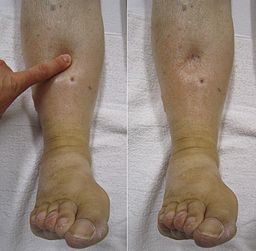
© James Heilman, MD (opera propria) tramite Wikimedia Commons
What are the symptoms of swollen legs?
Torna ai contenutiHaving 'swollen legs' is a symptom itself, but legs can be swollen in different ways. The clue to the cause (and therefore the treatment) may well be in the type of swelling. The swelling can be:
One-sided or both-sided. Oedema due to conditions of general body systems is usually on both sides and is symmetrical (for example, if due to heart failure or pregnancy or kidney problems.) One-sided swelling is more likely to be due to a problem with a particular part of that leg.
In a specific area or generalised. Swelling around joints is usually caused by injury or a type of arthritis. Swelling in specific areas of skin may be caused by allergy or infection. Swelling around the back of the heel suggests a problem of the Achilles tendon, etc. Generalised swelling, especially if on both sides, is likely to be oedema.
Painful or painless. Painful conditions include infections, deep vein thrombosis (DVT), injuries and joint problems. Oedema is not usually painful, although legs can ache and feel tight.
Accompanied by red (inflamed) or normal skin colour. If the skin is reddened, it may be due to an infection (such as cellulitis), or inflammation (for example, gotta, artrite reumatoide or DVT). However if both legs are red then infection as a cause is very unlikely.
Pitting or not. Pitting means that if you press a fingertip into the swollen area and then take your fingertip away, a dent remains in the skin. (See photo earlier in leaflet.) Oedema tends to be pitting. Linfedema, a condition where there is a blockage to lymph fluid, does not usually pit so much.
Continua a leggere sotto
Are there any other symptoms?
Torna ai contenutiIn addition to the leg or legs being swollen, there may be other associated symptoms. Again, these help give a clue to the cause of the leg swelling. For example:
Breathlessness which started at the same time as the leg swelling might suggest heart failure (if both legs) or DVT (if one leg) spreading to the lungs (pulmonary embolism).
A high temperature (fever) suggests infection.
Tiredness might suggest a more general illness, such as anaemia or kidney problems.
Diarrhoea might suggest a gut problem affecting the amount of protein being absorbed in the guts.
Being yellow (jaundiced) suggests a liver problem, such as cirrosi.
Swelling in other places other than the legs - for example, in the tummy, hands or around the eyes. This would suggest a problem with another or a general body system rather than a problem with the leg or legs.
When to see a doctor for swollen legs
Torna ai contenutiYou should see your GP urgently if you:
Think you might have a deep vein thrombosis (DVT). This might be the case if one calf is warm, swollen, red and tender. You might have swelling in the foot of that leg.
Feel out of breath.
Have a high temperature.
Feel generally unwell in yourself.
Are in severe pain.
Notice your skin has turned a yellow colour.
If your legs swell up a little in the hot weather but go down again overnight, you don't need to see a doctor. Or if both ankles are a little puffy after a long flight but there is no pain or redness of the calf, and the puffiness settles quickly then you do not need to see a doctor.
Minor swellings from bites or trivial injuries don't usually need medical attention. In most other situations, it is wise to consult a health professional.
If you have swollen legs and are pregnant, make sure you keep your regular appointment with your midwife. Your midwife will regularly check your blood pressure, and check your wee (urine) for protein to make sure your swollen ankles are not a sign of anything serious.
What tests will be done for swollen legs?
Torna ai contenutiThis will depend on the information the doctor has obtained by listening to you and examining you. In some cases, no further tests will be needed. In others, tests will be advised. These might include:
Testing your urine. This can usually be done in the doctor's surgery. The urine is tested with a dipstick to see if there is any protein in it, which might suggest a kidney problem, for example.
Blood tests. You might have blood tests to check you for anaemia or heart failure . Tests may be done to check the function of your kidney, fegato oppure thyroid gland.
A chest X-ray. This would check you for medical conditions such as heart failure or a pulmonary embolism.
Un ecografia of the leg. This can look at the nature of the swelling and establish where it is coming from. It can be helpful to diagnose tendon problems (such as Tendinopatia di Achille), DVT and other problems in the veins of the legs.
An X-ray if a fracture or infection of the bone is suspected.
Depending on the results of these tests, other investigations may be needed in some cases.
What is the treatment for swollen legs?
Torna ai contenutiTreatment will be different depending on the cause. If the cause is fluid in the legs (oedema), this can often be relieved in the short term by taking tablets called 'water tablets' (diuretics).
Diuretics increase the amount of fluid that the kidney filters off to be passed in your wee (urine). So when you take diuretics you eventually pee away some of the fluid which was collecting around your legs.
Diuretics are useful when swollen legs occur due to too much fluid in the body (for example, in heart failure). However, when the cause is something else (such as venous insufficiency, which causes fluid to pool in the legs, but not elsewhere in the body), they are usually not helpful, and can potentially cause problems, such as dehydration or kidney issues.
A few examples of some treatments of some common causes are as follows.
DVT is treated with medicines to thin the blood. These help to stop the blood clot from enlarging, and from spreading to the lungs, whilst the body slowly breaks down the clot itself.
Heart failure is usually treated with a number of medications to improve your heart function, including diuretic medicines.
Skin infections (cellulite) o bone infections (osteomyelitis) are treated with antibiotici.
Where the cause is a medicine, that medicine can usually be changed, or stopped, or the dose reduced.
Sometimes, doctors may recommend wearing compression stockings to reduce swelling of the legs; for example, when venous insufficiency is the cause.
Are there any complications of swollen legs?
Torna ai contenutiThis depends on the cause. The most common complication in swollen tissue is infection.
Where the skin is stretched, it is more prone to be dry. If it is dry, it is more prone to breaks in the skin, allowing germs from the outside of the skin underneath. This can result in cellulitis of the legs. If this is the case a large area of the skin of the legs becomes hot and red. It may cause a high temperature (fever).
Scelte del paziente per Gonfiore

Segni e sintomi
Edema
L'edema è un ristagno di fluidi. L'edema può essere più facilmente osservato intorno ai piedi e alle caviglie, spesso dopo aver passato molto tempo in piedi (edema periferico). Dopo aver sdraiato per un po', la pelle intorno agli occhi può apparire gonfia e tumefatta. Nei casi gravi, l'edema può anche accumularsi nei polmoni causando mancanza di respiro. L'edema lieve è comune e di solito innocuo. L'edema può essere causato da farmaci, allergie o da malattie più gravi sottostanti. Spesso non si trova una causa particolare. Le cause più comuni sono riportate di seguito.
di Dr Philippa Vincent, MRCGP

Segni e sintomi
Edema idiopatico
L'edema idiopatico è il termine per la ritenzione di liquidi che non è causata da una condizione medica nota. È più comune nelle donne e a volte può peggiorare con l'età. Sebbene non esista una cura per l'edema idiopatico, seguire una dieta sana a basso contenuto di sale può fare una vera differenza. Le calze elastiche e l'esercizio fisico regolare sono anche benefici.
di Dr Colin Tidy, MRCGP
Domande frequenti
Why do my legs swell at night?
If you experience oedema, which is a collection of excess fluid in between the body's cells, gravity causes this fluid to accumulate in dependent areas like your legs during the day. This type of swelling, called 'dependent oedema', typically improves overnight after you have had your legs elevated.
Can allergies cause swelling in legs?
Yes, skin reactions due to allergies, such as a reaction to a bite, a sting, or a medicine, can cause one of your legs to swell. This would typically be a localised swelling in a specific area of the skin rather than generalised oedema.
Does arthritis cause swollen legs?
Yes, certain types of arthritis can cause swollen legs. Wear and tear arthritis, like osteoarthritis, can affect a knee or both knees, or the big toe(s). Inflammatory joint problems such as gout, rheumatoid arthritis, or psoriatic arthritis can also lead to swelling, often accompanied by the affected joint(s) becoming warm, red, and painful.
What is lymphoedema?
Lymphoedema is a condition where lymph fluid collects in the tissues because it cannot drain properly. This issue typically arises because the lymph nodes are blocked, which can occur after surgery, radiotherapy, or due to cancer, injury, or infection. Unlike regular oedema, lymphoedema usually doesn't leave a dent when pressed.
What is a Baker's cyst?
A Baker's cyst is a soft swelling that can occur at the back of your knee. It is one of the potential causes of a swollen leg.
What are 'water tablets' (diuretics) and how do they help swollen legs?
'Water tablets', or diuretics, are medications that increase the amount of fluid your kidneys filter out to be passed as urine. This helps to remove some of the excess fluid that has collected in areas like your legs, particularly when the swelling is due to too much fluid in the body, such as with heart failure.
Ulteriori letture e riferimenti
- Cellulite - acuta; NICE CKS, marzo 2024 (accesso solo Regno Unito)
- Trombosi venosa profonda; NICE CKS, giugno 2023 (accesso solo Regno Unito)
- Insufficienza cardiaca cronica negli adulti - diagnosi e gestione; Linee guida NICE (settembre 2018)
Continua a leggere sotto
Informazioni sull'autoreVisualizza il profilo completo

Dr Mary Harding, MRCGP
Medico di base, Autore medico
BA, MA, MB, BChir, MRCGP, DFFP
La Dott.ssa Mary Harding si è laureata alla facoltà di medicina dell'Università di Cambridge nel 1989.
Informazioni sul recensoreVisualizza il profilo completo

Dr Philippa Vincent, MRCGP
Medico di base, Autore medico
MB BS, Bsc, MRCGP (2000), DCH, DFSRH, DRCOG
Dr Philippa Vincent è un medico di base del NHS che lavora nel nord di Londra.
Storia dell'articolo
Le informazioni su questa pagina sono scritte e revisionate da clinici qualificati.
Next review due: 28 May 2027
29 May 2024 | Ultima versione
4 Jul 2017 | Pubblicato originariamente
Autore:
Dr Mary Harding, MRCGP

Chiedi, condividi, connettiti.
Esplora le discussioni, fai domande e condividi esperienze su centinaia di argomenti di salute.

Non ti senti bene?
Valuta i tuoi sintomi online gratuitamente
Iscriviti alla newsletter di Patient
La tua dose settimanale di consigli sulla salute chiari e affidabili - scritti per aiutarti a sentirti informato, sicuro e in controllo.
Abbonandoti accetti i nostri Informativa sulla Privacy. Puoi annullare l'iscrizione in qualsiasi momento. Non vendiamo mai i tuoi dati.