Gozzo
Thyroid swelling
Revisione paritaria di Dr Surangi Mendis, MRCGPUltimo aggiornamento di Dr Rachel Hudson, MRCGPUltimo aggiornamento 31 Oct 2023
Rispetta le linee guida editoriali
- ScaricaScarica
- Condividi
- Language
- Discussione
- Versione audio
In questa serie:Ghiandola tiroidea iperattivaMalattia oculare tiroideaTest di funzionalità tiroideaScansioni tiroidee e test di assorbimentoMedicinali antitiroidei
Un gozzo (pronunciato goy-ter, a volte scritto come 'goiter') è una ghiandola tiroidea ingrossata. Questo provoca un rigonfiamento nella parte anteriore del collo. Alcune persone con un gozzo hanno una ghiandola tiroidea ipoattiva o iperattiva. Ciò significa che producono troppo o troppo poco ormone tiroideo. Ci sono varie cause di gozzo e il trattamento dipende dalla causa.
In questo articolo:
Video consigliati per Problemi alla tiroide
Continua a leggere sotto
What is a goitre?
Sezione trasversale del collo che mostra la ghiandola tiroidea
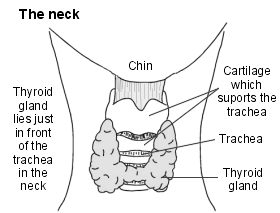
A goitre is an enlarged thyroid gland. A goitre can mean that all the thyroid gland is swollen or enlarged, or one or more swellings or lumps develop in a part or parts of the thyroid gland.
Where is the thyroid gland?
The thyroid gland is in the lower part of the front of the neck. It lies just in front of the windpipe (trachea). It has a right and left lobe which are connected together by a narrow band of thyroid tissue called the isthmus.
It is roughly the shape of a butterfly. You cannot usually see or feel a normal thyroid gland. If the thyroid gland enlarges, it causes a swelling in the neck which you can see - a goitre.
The thyroid gland makes thyroid hormones - called thyroxine (T4) and triiodothyronine (T3). These hormones are carried around the body in the bloodstream. T4 and T3 help to keep the body's functions (the metabolism) working at the correct pace. Many cells and tissues in the body need T4 and T3 to keep them working correctly.
Causes of goitre
Torna ai contenutiThere are different types of goitre, each with various causes.
Diffuse smooth goitre
This means that the entire thyroid gland is larger than normal. The thyroid gland feels smooth but is larger than normal.
There are a number of causes. For example:
malattia di Graves - an autoimmune disease which causes the thyroid to swell and produce too much of the thyroid hormone thyroxine (T4). In autoimmune disorders your body produces proteins called antibodies which damage a different part of your body - in this case, your thyroid gland.
Inflammation of the thyroid gland (thyroiditis) - which can be due to various causes. For example, another autoimmune condition called tiroidite di Hashimoto can damage the thyroid gland. Infections with germs such as bacteria and viruses can cause different types of thyroiditis. Radioterapia treatment to the neck can also lead to inflammation of the thyroid gland.
Iodine deficiency. The thyroid gland needs iodine to make T4 and triiodothyronine (T3). If you lack iodine in your diet, the thyroid swells as it tries to make enough T4 and T3.
Alcuni medicinali come litio e amiodarone can cause the thyroid gland to swell as a side-effect.
Hereditary factors - some people inherit a tendency for a thyroid gland to swell. In particular, it may swell at times of life when you may make more T4 and T3 - for example, when you are pregnant, or during puberty.
Any other disorder which causes problems in the making of T4 or T3 may cause the thyroid gland to swell.
Nodular goitres
A thyroid nodule is a small lump which develops in the thyroid gland. There are two types:
A multinodular goitre. This means the thyroid gland has developed many lumps or nodules. The thyroid gland feels generally lumpy.
A single nodule. Causes include:
A cyst. This is a non-cancerous sac-like swelling filled with fluid.
An adenoma. This is a solid non-cancerous tumour.
Un cancerous tumour (thyroid cancer is rare however).
Other rare causes.
Continua a leggere sotto
Goitre symptoms
Torna ai contenutiSwelling in the neck. The size of a goitre can range from very small and barely noticeable, to very large.
A lack of pain. However, an inflamed thyroid gland (thyroiditis) can be painful.
Difficulty with breathing or with swallowing. A large goitre may press on the windpipe (trachea) or the gullet (oesophagus).
If your thyroid gland makes too much or too little thyroxine (T4) or triiodothyronine (T3), this can cause a range of symptoms. See the separate leaflets called Overactive Thyroid Gland (Hyperthyroidism), Ghiandola Tiroidea Poco Attiva (Ipotiroidismo) e Thyroid Eye Disease per maggiori dettagli.
Diagnosing a goitre
Torna ai contenutiExamination by a doctor
This is done to determine if a neck swelling arises from the thyroid, or from another structure in the neck.
Esami del sangue
When you have a goitre, a doctor will usually do some esami del sangue to check if you are making too much or too little thyroxine (T4) or triiodothyronine (T3). Blood tests may also help to find out the cause of some goitres. See the separate leaflet called Test di funzionalità tiroidea.
Ecografia
Un ecografia of the thyroid. This is the best test for thyroid swellings. An ultrasound scan is a safe and painless test which uses sound waves to create images of organs and structures inside your body. It can tell if a nodule is a cyst or a solid lump. See the separate leaflet called Thyroid Scans and Uptake Tests.
Biopsia
A small piece of tissue (a biopsy) may be taken from a nodule to look at under the microscope. The biopsy is done by inserting a thin needle into the nodule. It is a simple and safe procedure. The specialist doing the biopsy can see where they are inserting the needle by doing an ultrasound scan at the same time.
Altri test
Occasionally other specialist blood tests are needed to help establish the cause. Occasionally a tomografia computerizzata (TC) o una risonanza magnetica (RM) is needed.
Continua a leggere sotto
Goitre treatment
Torna ai contenutiTreatment depends on the cause, the size of the goitre, and whether it is causing symptoms. For example:
If you have a small goitre that is not due to a cancerous nodule, and your thyroid gland is making the correct amounts of thyroid hormones then you may not need any treatment.
You will need treatment if you make too much or too little of your thyroid hormones. For medicines used in the treatment of an overactive thyroid gland, see the separate leaflet called Antithyroid Medications.
An operation to remove some or all of the thyroid gland may be an option in some cases.
Trattamento con iodio radioattivo may be an option for a goitre causing an overactive thyroid gland (hyperthyroidism).
This involves taking a drink, or swallowing a capsule, which contains radioactive iodine.
The radioactive iodine builds up in the thyroid gland.
As the radioactivity is concentrated in the thyroid gland, it destroys some thyroid tissue.
You may need to take thyroxine (T4) tablets after having radioactive iodine, if too much of the thyroid is destroyed.
Se hai cancer of the thyroid, you will probably need an operation to remove the cancer and some of the thyroid gland.
Iodine replacement is given if the goitre is due to lack of iodine in the diet.
Scelte dei pazienti per Problemi alla tiroide
Ormoni
Malattia oculare tiroidea
La malattia oculare tiroidea provoca il gonfiore dei muscoli e dei tessuti molli all'interno dell'orbita oculare. Questo spinge il bulbo oculare in avanti e causa vari sintomi oculari, tra cui occhi sporgenti. Il trattamento prevede misure per proteggere l'occhio mentre la malattia segue il suo corso. Questo può comportare l'uso di colliri per fornire lacrime lubrificanti artificiali, farmaci e, in alcuni casi, interventi chirurgici. La malattia oculare tiroidea è solitamente associata a un'anomalia della funzione della ghiandola tiroidea. Anche questo deve essere trattato.
di Dr Colin Tidy, MRCGP
Ormoni
Carenza di iodio
Iodine is essential for the body to make thyroid hormone. Low levels of iodine may cause an underactive thyroid gland and symptoms of hypothyroidism (eg, tiredness, constipation and weight gain). Iodine deficiency in pregnant women may cause problems for the baby, including learning disability. There has been a worldwide campaign to prevent iodine deficiency by using salt containing added iodine. However, iodine deficiency is still a widespread problem in many countries. Mild iodine deficiency may still affect some people in the UK.
di Dott.ssa Rosalyn Adleman, MRCGP
Ulteriori letture e riferimenti
- Malattie della tiroide: valutazione e gestione; Linee guida NICE (novembre 2019 - ultimo aggiornamento ottobre 2023)
Continua a leggere sotto
Storia dell'articolo
Le informazioni su questa pagina sono scritte e revisionate da clinici qualificati.
Next review due: 29 Oct 2028
31 Oct 2023 | Ultima versione
Ultimo aggiornamento di
Dr Rachel Hudson, MRCGP
Revisione paritaria di
Dr Surangi Mendis, MRCGP

Chiedi, condividi, connettiti.
Esplora le discussioni, fai domande e condividi esperienze su centinaia di argomenti di salute.

Non ti senti bene?
Valuta i tuoi sintomi online gratuitamente
Iscriviti alla newsletter di Patient
La tua dose settimanale di consigli sulla salute chiari e affidabili - scritti per aiutarti a sentirti informato, sicuro e in controllo.
Abbonandoti accetti il nostro Informativa sulla Privacy. Puoi annullare l'iscrizione in qualsiasi momento. Non vendiamo mai i tuoi dati.