Thyroid scans and uptake tests
Peer reviewed by Dr Doug McKechnie, MRCGPLast updated by Dr Colin Tidy, MRCGPLast updated 16 Oct 2024
Meets Patient’s editorial guidelines
- DownloadDownload
- Share
- Language
- Discussion
- Audio Version
- Add to preferred sources on Google
In this series:Overactive thyroid glandGoitreThyroid eye diseaseThyroid function testsAntithyroid medicines
Thyroid scans and uptake tests use small doses of radioactive chemicals to create pictures of your thyroid gland. These tests help to assess the size, structure and function of your thyroid.
Note: the information below is a general guide only. The arrangements, and the way tests are performed, may vary between different hospitals. Always follow the instructions given by your doctor or local hospital.
At a glance
Thyroid scans and uptake tests use radioactive chemicals and a gamma camera to create pictures of your thyroid gland.
These tests can check how well your thyroid is working and help diagnose conditions like an overactive thyroid or cancer.
You will either swallow a radioactive iodine capsule or liquid, or have an injection.
You will lie on a table while a camera takes pictures of your thyroid gland.
Pregnant women should not have these tests; tell your doctor if you are pregnant or breastfeeding.
The amount of radiation is small and usually leaves your body quickly.
What are thyroid scans and uptake tests?
Thyroid scans and uptake tests use small doses of radioactive chemicals to create special pictures of the thyroid gland. These pictures can help doctors to look at the structure of the thyroid gland and assess how well it is working.
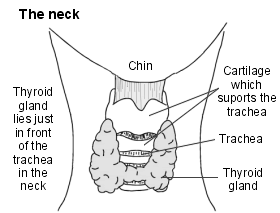
Neck cross-section showing the thyroid gland
What is the thyroid?
The thyroid is a gland found in your neck, at the front and in the middle. You can't usually feel your thyroid, unless it is enlarged (such as occurs in a goitre - see the separate leaflet called Goitre (Thyroid swelling) for more details).
Its main function is to make hormones. Hormones are chemicals which are released into your bloodstream. They act as messengers, affecting cells and tissues in distant parts of your body. Thyroid hormones affect your body's metabolic rate and the levels of certain minerals in your blood. See the separate leaflet called Thyroid problems (also including parathyroid glands) for more details.
How do thyroid scans and uptake tests work?
Thyroid scans and uptake tests use special chemicals called radionuclides. A radionuclide (sometimes called a radioisotope or isotope) is a chemical which emits a type of radioactivity called gamma rays. In these tests a tiny amount of radionuclide is put into your body, usually by an injection into a vein. (Sometimes it is swallowed, depending on the test. This is usually for an uptake test.)
There are different types of radionuclides. Different ones tend to collect or concentrate in different organs or tissues. So, the radionuclide used depends on which part of your body is to be scanned. To test your thyroid gland, radioactive iodine is used. This is because your thyroid gland uses iodine to make certain hormones in the body. So, when the radioactive iodine is given, it is quickly taken up by the tissues of your thyroid gland. Cells which are most active in the target tissue or organ will take up more of the radionuclide. So, active parts of the tissue will emit more gamma rays than less active or inactive parts.
Gamma rays are similar to X-rays and are detected by a device called a gamma camera. The gamma rays which are emitted from inside the body are detected by the gamma camera. The gamma rays are then converted into an electrical signal and sent to a computer. The computer builds a picture by converting the different intensities of radioactivity emitted into different colours or shades of grey.
For example, areas of the target organ or tissue which emit lots of gamma rays may be shown as red spots ('hot spots') on the picture on the computer monitor. Areas which emit low levels of gamma rays may be shown as blue ('cold spots'). Various other colours may be used for in-between levels of gamma rays emitted.
Doctors may use the term 'thyroid scan' to mean a test that includes a scan of your thyroid structure and a test of how well your thyroid works. In a thyroid scan doctors are generally looking at the size, shape and structure of the thyroid gland. A thyroid uptake test checks how well the gland is working. Both tests are based on the same principles and use the same equipment, just in slightly different ways.
What are thyroid scans and uptake tests used for?
Thyroid scans and uptake tests can be used for a number of different reasons, including to:
Check if your thyroid is working properly.
Help diagnose problems with your thyroid gland, such as an overactive thyroid gland (hyperthyroidism), thyroid cancer or other growths.
Assess the nature of a lump (nodule) discovered in your gland.
Determine whether thyroid cancer has spread outside your thyroid gland.
Look at how your thyroid gland may have changed following surgery, radiotherapy or chemotherapy.
What happens during thyroid scans and uptake tests?
In a thyroid scan you will either swallow a dose of the radioactive iodine or have an injection of the chemical into a vein. The injection is usually given a short time before the test is due to be done. The capsule or liquid form is usually given approximately 24 hours before the test is due to begin.
If you are given an injection, it may make you feel slightly warm and flushed. These feelings should pass fairly quickly.
When it is time to take the images, you will be asked to lie on an examination table with your head tipped back. The gamma camera will then take a series of images, capturing pictures of the thyroid gland from different angles. You will need to remain still for brief periods of time while the camera is taking pictures.
When the scanning is completed, you may be asked to wait until the images have been checked in case additional images are needed. Occasionally, more images are needed to obtain better views of certain areas or structures. This does not necessarily mean there was a problem or that something abnormal was found. You will not be exposed to more radiation during this process.
A thyroid uptake scan is carried out in a very similar way to the scan described above. The main difference is that the scan may be repeated at different times over a 24-hour period. This allows doctors to see how the iodine is taken up by the thyroid gland over a certain time period.
What should I do to prepare for thyroid scans and uptake tests?
Your local hospital should give you specific information to help you prepare for these tests. As these tests involve a small amount of radiation, pregnant women should not have them. Let your doctor know if you are, or think you could be, pregnant. You should also let your doctor know if you are breastfeeding.
You may be asked to have some blood tests which help to check the function of the thyroid gland. See the separate leaflet called Thyroid function tests for more details.
You should let your doctor know if you are taking any medications or supplements which have iodine in them. This can include things like heart medications, kelp, seaweed or cough syrups. Your doctor may also ask you to stop taking certain medications for a few days before the test. It is usually necessary to stop eating for a few hours before these tests. Your hospital should be able to give you advice on this.
What can I expect after thyroid scans and uptake tests?
Thyroid scans and uptake tests do not generally cause any after effects. Through the natural process of radioactive decay, the small amount of radioactive chemical in your body will lose its radioactivity over time. It may also pass out of your body through your urine or poo during the first few hours or days following the test. You may be instructed to take special precautions after urinating, to flush the toilet twice and to wash your hands thoroughly.
If you have contact with children or pregnant women you should let your doctor know. Although the levels of radiation used in the scan are small, they may advise special precautions. Your hospital should give you more advice on this.
Are there any side-effects or complications from a thyroid radionuclide scan?
The term 'radioactivity' may sound alarming. But, the radioactive chemicals used in radionuclide scans are considered to be safe and they leave the body quickly. The dose of radiation that your body receives is very small. In many cases, the level of radiation involved is not much different to a series of a few normal X-rays. However:
As with any other types of radiation (such as X-ray), there is a small risk that the gamma rays may affect an unborn child. So, tell your doctor if you are pregnant or if you may be pregnant.
Rarely, some people have an allergic reaction to the injected chemical.
Theoretically, it is possible to receive an overdose when the chemical is injected. This is very rare.
Patient picks for Imaging
Tests and investigations
DMSA scan
A DMSA scan uses a radioactive chemical to create specialised pictures of the kidneys. It can help to show whether the kidneys are damaged or scarred. Note: the information below is a general guide only. The arrangements, and the way tests are performed, may vary between different hospitals. Always follow the instructions given by your doctor or local hospital.
by Dr Doug McKechnie, MRCGP
Tests and investigations
Endoscopic ultrasound scan
An endoscopic ultrasound scan uses an endoscope with an ultrasound probe attached to create detailed pictures of internal organs and structures. Note: the information below is a general guide only. The arrangements and the way tests are performed, may vary between different hospitals. Always follow the instructions given by your doctor or local hospital.
by Dr Toni Hazell, FRCGP
Frequently asked questions
What is the typical duration of a thyroid scan appointment?
The article mentions that in a thyroid scan, images are taken while you lie still, and sometimes additional images are needed, but it doesn't specify the total time duration for the appointment. For uptake tests, it notes that the scan may be repeated over a 24-hour period, implying the process can span a day.
Will I receive my test results immediately after the scan?
After the scanning is completed, you might be asked to wait while the images are checked to see if more pictures are needed. However, the article does not specify when or how you will receive the final results from the doctor after the scan has been completed and reviewed.
Are there any specific dietary restrictions I need to follow before a thyroid scan or uptake test?
The article states that it is usually necessary to stop eating for a few hours before these tests. Your hospital should provide advice on specific dietary instructions.
How long does it take for the radioactive chemical to completely leave my body after the test?
The small amount of radioactive chemical in your body will lose its radioactivity over time due to natural decay. It may also pass out of your body through urine or stool during the first few hours or days following the test.
Can I drive myself home after having a thyroid scan or uptake test?
The article doesn't explicitly state whether driving is permitted after the test. It does mention that the injection may make you feel slightly warm and flushed, but these feelings usually pass quickly, and there are generally no after effects.
Further reading and references
- Iqbal A, Rehman A; Thyroid Uptake and Scan. StatPearls, Oct 2022.
- Thyroid disease: assessment and management; NICE guidance (November 2019 - last updated October 2023)
About the authorView full bio
Updated by

Dr Colin Tidy, MRCGP
General Practitioner, Medical Author
MBBS, MRCGP, MRCP (Paediatrics), DCH
Dr Colin Tidy is an NHS Doctor, based in Oxfordshire.
About the reviewerView full bio

Dr Doug McKechnie, MRCGP
Medical Writer
MA, MBBS, MSc, DRCOG, MRCP(UK), MRCGP(2021), FHEA
Dr Doug McKechnie is an NHS GP working in London. He works full-time clinically and is also the Deputy Lead for the Clinical and Professional Practice module at University College London Medical School.
Join the conversation
Share your thoughts or experiences with others in our patient communities.

Ask, share, connect.
Browse discussions, ask questions, and share experiences across hundreds of health topics.

Feeling unwell?
Assess your symptoms online for free
Sign up to the Patient newsletter
Your weekly dose of clear, trustworthy health advice - written to help you feel informed, confident and in control.
By subscribing you accept our Privacy Policy. You can unsubscribe at any time. We never sell your data.