Ritenzione urinaria
Revisione paritaria di Dr Toni Hazell, FRCGPUltimo aggiornamento di Dr Rosalyn Adleman, MRCGPUltimo aggiornamento 16 Set 2024
Rispetta le linee guida editoriali
- ScaricaScarica
- Condividi
- Language
- Discussione
- Versione audio
- Aggiungi alle fonti preferite su Google
In questa serie:Problemi alla prostataProstata ingrossataTest PSAStenosi uretraleProstatite cronicaSintomi del tratto urinario inferiore negli uomini
Urinary retention means that you are having problems emptying the bladder completely. It may occur suddenly (acute urinary retention) or it may develop over a longer period of time (chronic urinary retention). Acute urinary retention is a medical emergency.
Urinary retention is more common in men than in women. It becomes more common as you become older. In men aged in their 70s, urinary retention occurs in about 1 in every 100 men. For men in their 80s, urinary retention occurs in about 3 in every 100 men.
You may need tests to help find the cause of your urinary retention. The treatment and outcome for both acute and chronic urinary retention will depend on the underlying cause.
You should see a doctor immediately if you are unable to pass any urine when your bladder feels full and painful.
A colpo d'occhio
Urinary retention means you cannot empty your bladder partially or completely.
Acute urinary retention is a sudden, painful inability to pass urine.
Chronic urinary retention may cause frequent urination or a weak urine stream.
Causes include blockages, nerve problems, certain medicines, or weak bladder muscles.
Treatment depends on the cause and may involve draining the bladder or surgery.
See a doctor immediately if you cannot pass urine or have bad lower tummy pain.
Tratto urinario
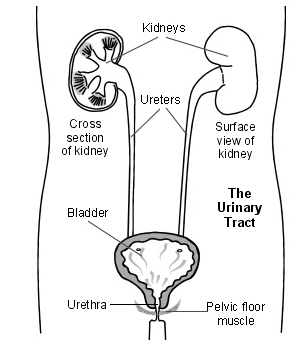
Urinary retention symptoms
Ritenzione urinaria acuta
The symptoms of acute urinary retention may include being unable to pass any urine despite a strong urge to pass urine. There is often also pain and bloating of the lower tummy (abdomen).
You should see your doctor immediately if you are completely unable to pass any urine or if you have bad pain in your lower abdomen.
Ritenzione urinaria cronica
Some people with chronic urinary retention may not have any symptoms. They may not be aware that they are unable to empty their bladder properly.
People with chronic urinary retention may not become aware they have this condition until they develop another problem, such as urinary incontinence or a urinary tract infection (UTI).
The symptoms of chronic urinary retention may include:
Passing urine more frequently (urinary frequency).
Difficulty passing urine (dysuria).
A weak or an interrupted urine stream.
An urgent need to pass urine with little success.
Constantly feeling the need to pass more urine, even after just passing urine.
Mild and constant discomfort in the lower abdomen.
See also the separate leaflets called Sintomi del tratto urinario inferiore negli uomini e Sintomi del tratto urinario inferiore nelle donne (LUTS).
What causes urinary retention?
Urinary retention can result from many different causes.
Blockage (obstruction) of the tube passing urine out from the bladder (the urethra)
A common cause of a blockage for men is due to an enlarged prostate gland. See the separate leaflet called Prostate gland enlargement.
Other causes include a narrowing of the urethra (urethral stricture) e stipsi. Urinary retention in women can also be caused by genitourinary prolapse (when one of the organs inside the pelvis drops down).
Problems with the nerves supplying the bladder
Urinary retention can result from problems with the nerves that control the bladder and the valves (sphincters) that control the urine flow from the bladder.
Even when the bladder is full, the bladder muscles that squeeze urine out may not receive the signal to push. The sphincters may not receive the signal to relax and allow the bladder to empty.
Possible causes of nerve problems that may cause urinary retention include diabete, a ictus, sclerosi multipla or after an injury to the pelvis.
Some children are born with conditions that may affect the nerve signals to the bladder. For example spina bifida may cause urinary retention in new born babies.
After an operation
Many people have urinary retention right after surgery. However, normal bladder function usually returns once the anaesthetic wears off. Urinary retention after an operation doesn't usually cause any long-term problems. If urinary retention is expected, then a catheter will be used.
Farmaci
Some medicines may sometimes cause urinary retention. Examples include:
Some antidepressant medicines (particularly antidepressivi triciclici).
Alcuni miorilassanti (eg, diazepam e baclofene).
Medicines that relax the bladder and are used to treat an overactive bladder and urinary incontinence (eg, ossibutinina).
Medicines for nasal congestion that can be bought over the counter without a prescription (eg, ephedrine).
Weakened bladder muscles
Weakened bladder muscles may not squeeze (contract) strongly enough or long enough to empty the bladder completely. This may result in urinary retention. This is much more common in the elderly.
How is urinary retention diagnosed?
Your doctor will take a history which will include:
Your urinary symptoms.
Any past history of any medical problems.
A review of the medicines that you are taking (including prescription medicines and medicines bought over the counter).
Your doctor will also perform an examination of your tummy (abdomen) to feel for any increase in size (enlargement) of the bladder and any abnormality of your kidneys. An examination of the prostate gland may be required for men. A vaginal examination may be required for women in order to help find the cause of the urinary retention.
Your doctor may be able to diagnose and treat the cause of your problems passing urine on the basis of the history and examination. Blood tests may be arranged, including a test of how well your kidneys are working.
If you have sudden (acute) urinary retention and cannot pass any urine then you will need to be seen straightaway in hospital. If you have persistent (chronic) urinary retention your doctor will often refer you to see a urology specialist for tests. These are undertaken to find out the cause of your urinary retention and the best ways to treat the problem.
Post-voiding residual volume
This test measures the amount of urine left in your bladder after you have tried to empty your bladder. This test can be done using an ultrasound scan to measure the amount of urine left in your bladder.
Another way to measure the amount of urine is to pass a thin flexible tube (catheter) through the tube through which you urinate (your urethra) and into your bladder. This will drain the bladder's remaining urine, which can then be measured.
Cistoscopia
Cystoscopy is a procedure that requires a tube-like instrument, called a cystoscope, to look inside the urethra and bladder. An anaesthetic is required but this may be a local anaesthetic or a general anaesthetic.
A healthcare professional may use cystoscopy to diagnose a urethral stricture or look for a bladder stone blocking the opening of the urethra.
Computerised tomography (CT) scans
For a CT scan, a healthcare professional may give you a special solution to drink and an injection of a special dye, called contrast medium. CT scans help to identify the cause of the urinary retention, such as urinary tract stones, tumours or any fluid-containing sacs (cysts).
Urodynamic tests
Urodynamic tests look at how well the bladder and urethra store and release urine. See the separate leaflet called Urodynamic tests for more information.
Elettromiografia
Electromyography uses special sensors to measure the electrical activity of the muscles and nerves of the bladder. Special sensors are placed on the skin near the opening of your urethra and your back passage (anus).
Alternatively, the sensors can be placed on a catheter which is inserted into your urethra or your back passage. The patterns of the nerve impulses show whether the messages sent to the bladder and sphincters are working properly.
Urinary retention treatment
The treatment for urinary retention will depend on the cause. For example, an enlargement of the prostate gland may be treated with medicines or surgery.
Bladder drainage
Bladder drainage involves passing a thin, flexible tube (catheter) to drain the urine from your bladder. A catheter needs to be used as soon as possible if you have sudden (acute) urinary retention. A catheter is not always needed straightaway if you have persistent (chronic) urinary retention.
However, if the cause of your chronic urinary retention cannot be treated or the urinary retention is causing damage to your bladder or kidneys, you may need a long-term catheter, which might stay in all the time, or which you might be taught to insert regularly to empty the bladder.
Medical treatments
Medicines may be needed to treat the underlying cause of the urinary retention. For example, medicines may be needed to treat l'ingrossamento della prostata oppure stipsi.
Chirurgia
Depending on the underlying cause of urinary retention, surgery may be a treatment option. Examples of surgical treatments include the following:
Urethral dilatation
Widening of the urethra (urethral dilatation) treats a urethral stricture by inserting increasingly wider tubes into the urethra to widen the stricture.
Urethral stents
Another treatment for a urethral stricture involves inserting an artificial tube, called a stent, into the urethra to the area of the stricture. The stent then keeps the urethra open and allows urine to flow normally.
Internal urethrotomy
A special catheter is inserted into the urethra until it reaches the stricture. A special knife or laser is then used to make a cut (incision) that opens the stricture.
Prostate gland surgery
For men with urinary retention caused by prostate gland enlargement, prostate surgery may cure the urinary retention. Transurethral resection of the prostate is when a small amount of the prostate is removed, in an operation carried out via the urethra.
Cystocele or rectocele repair
Women may need surgery to lift a fallen bladder, uterus or rectum into its normal position. See also the separate leaflet called Pelvic organ prolapse.
Other surgery
Removal of tumours from the bladder or urethra may reduce urethral obstruction and urinary retention.
Complications of urinary retention
The complications of urinary retention and its treatments may include:
The normal flow of urine usually prevents germs (bacteria) from infecting the urine. With urinary retention, bacteria may be able to infect the urine because the urine cannot flow out of the bladder.
Bladder damage
If the bladder becomes stretched too far or for long periods, the muscles may become damaged and unable to work properly.
For some people, urinary retention causes urine to flow backwards into the kidneys. This backward flow is called reflux and it may damage or scar the kidneys.
This may occur together with chronic urinary retention or after surgery (eg, for prostate enlargement).
Prostate gland surgery may cause urinary incontinence in some men. This problem is often temporary and gets better quite quickly. Most men recover their bladder control in a few weeks or months after surgery.
Qual è il risultato?
The outcome (prognosis) will depend on the underlying cause of urinary retention and whether the urinary retention has caused any damage to your kidneys:
Some causes of urinary retention resolve quickly without any long-term problems - eg, urinary retention after a general anaesthetic.
In other cases, urinary retention will resolve once the underlying cause has been treated - eg, prostate gland enlargement.
Occasionally the cause of urinary retention cannot be cured and a long-term small, flexible tube (catheter) is needed. Sometimes this can be done by regularly inserting a catheter into the bladder and then removing the catheter once the bladder is emptied.
Scelte del paziente per Bladder conditions

Reni e vie urinarie
Incontinenza urinaria
Urinary incontinence is a common problem, affecting women more commonly than men. Stress incontinence and urge incontinence are the most common types of incontinence. Many people are embarrassed by the problem but, importantly, incontinence is often treatable so you should see your GP for help. This leaflet provides a general overview of urinary incontinence. It may help you to understand the bladder and why incontinence occurs.
di Dr Rachel Hudson, MRCGP

Reni e vie urinarie
Incontinenza da urgenza
L'urgenza è un sintomo in cui si ha un improvviso e impellente desiderio di urinare. Non si riesce a rimandare l'andare in bagno. L'incontinenza da urgenza è il termine usato quando l'urina fuoriesce prima di arrivare al bagno quando si ha urgenza.
di Dr Toni Hazell, FRCGP
Domande frequenti
Can I have urinary retention without realising it?
Yes, some people with chronic urinary retention may not have any symptoms and may not be aware that their bladder is not emptying properly. Often, they only discover they have the condition when another problem develops, such as urinary incontinence or a urinary tract infection.
Does urinary retention go away on its own?
The outcome depends on the underlying cause. Some causes, like urinary retention after a general anaesthetic, can resolve quickly without long-term problems. In other cases, it will resolve once the underlying cause, such as an enlarged prostate gland, has been treated. However, sometimes the cause cannot be cured, and long-term management with a catheter may be necessary.
What kind of doctor treats urinary retention?
If you have persistent chronic urinary retention, your doctor will often refer you to a urology specialist. These specialists conduct further tests to determine the cause and the best treatment options.
Can certain medications cause problems with bladder emptying?
Yes, some medicines can sometimes lead to urinary retention. These include certain antidepressant medicines (especially tricyclic antidepressants), some muscle relaxants like diazepam and baclofen, medications used to relax the bladder for an overactive bladder (such as oxybutynin), and over-the-counter nasal congestion medicines like ephedrine.
What happens if urine flows backward into the kidneys?
If urine flows backward into the kidneys, a condition called reflux, it can potentially cause damage or scarring to the kidneys. This is one of the possible complications of urinary retention.
Ulteriori letture e riferimenti
- Sintomi del tratto urinario inferiore negli uomini: valutazione e gestione; NICE Guidelines (June 2015)
- Negro CL, Muir GH; Chronic urinary retention in men: how we define it, and how does it affect treatment outcome. BJU Int. 2012 Dec;110(11):1590-4. doi: 10.1111/j.1464-410X.2012.11101.x. Epub 2012 Mar 27.
- Linee guida sulla gestione dei sintomi del tratto urinario inferiore maschile non neurogenico (LUTS), incl. ostruzione prostatica benigna (BPO); Associazione Europea di Urologia (2022)
- LUTS negli uomini; NICE CKS, giugno 2025 (accesso solo Regno Unito)
Informazioni sull'autoreVisualizza il profilo completo

Dr Rosalyn Adleman, MRCGP
MRCGP
La Dott.ssa Rosalyn Adleman è un medico di base del NHS che lavora nel nord di Londra.
Informazioni sul recensoreVisualizza il profilo completo

Dr Toni Hazell, FRCGP
MBBS, BSc, FRCGP, DFSRH, Dip GU med, DRCOG, DCH (London, UK, 2000)
La Dott.ssa Toni Hazell si è laureata presso la St. Mary’s Hospital Medical School e ha completato il suo VTS al Northwick Park Hospital.
Storia dell'articolo
Le informazioni su questa pagina sono scritte e revisionate da clinici qualificati.
Articolo disponibile anche in Inglese, Tedesco, Spagnolo, Francese, Italiano, Portoghese, Hindi, Ebraico, Arabo, and Svedese.
Prossima revisione prevista: 15 Set 2027
16 Set 2024 | Ultima versione

Chiedi, condividi, connettiti.
Esplora le discussioni, fai domande e condividi esperienze su centinaia di argomenti di salute.

Non ti senti bene?
Valuta i tuoi sintomi online gratuitamente
Iscriviti alla newsletter di Patient
La tua dose settimanale di consigli sulla salute chiari e affidabili - scritti per aiutarti a sentirti informato, sicuro e in controllo.
Abbonandoti accetti i nostri Informativa sulla Privacy. Puoi annullare l'iscrizione in qualsiasi momento. Non vendiamo mai i tuoi dati.
Più su reni e vie urinarie
- Allarmi per pipì a letto
- Malattia renale cronica
- Cistite nelle donne
- Diabete insipido
- Malattia renale diabetica
- Tasso di filtrazione glomerulare stimato
- Glomerulonefrite
- Cistite interstiziale
- Medicinali per l'urgenza urinaria e l'incontinenza
- Campione di urine a metà percorso
- Sindrome nefrosica
- Proteinuria
- Cistite ricorrente nelle donne
- Stenosi uretrale
- Incontinenza urinaria
- Infezioni del tratto urinario
- Infezione urinaria nei bambini
- Infezione urinaria negli uomini
- Infezione urinaria in gravidanza
- Cistouretrografia minzionale