Eruzione polimorfa da luce
Revisione paritaria di Dr Colin Tidy, MRCGPUltimo aggiornamento di Dr Hayley Willacy, FRCGP Ultimo aggiornamento 23 Ott 2023
Rispetta le linee guida editoriali
- ScaricaScarica
- Condividi
- Language
- Discussione
- Versione audio
- Aggiungi alle fonti preferite su Google
In questa serie:Sole e scottatureEruzione cutanea da calore e sudaminaEsaurimento da calore e colpo di calore
L'eruzione polimorfica solare è un'eruzione cutanea che può verificarsi quando si esce al sole.
A colpo d'occhio
L'eruzione polimorfica solare (PMLE) è un'eruzione cutanea causata da una forte esposizione al sole.
I sintomi includono pelle rossa, pruriginosa, a volte con vesciche, spesso su braccia e petto.
Può comparire entro poche ore dall'esposizione al sole e di solito scompare entro una settimana se si evita il sole.
PMLE is caused by UVA rays, which can pass through glass.
La prevenzione include l'uso di crema solare, abbigliamento protettivo e l'evitare il sole forte di mezzogiorno.
I trattamenti possono includere steroidi topici o antistaminici per alleviare il disagio.
Se grave, un medico può prescrivere steroidi orali o indirizzarti a un dermatologo.
Polymorphic light eruption symptoms
Polymorphic light eruption (PMLE) is a rash which comes on after being in strong sunlight.
It looks like reddened skin with raised red spots or small blisters.
It is generally itchy and uncomfortable.
It can feel sore or burning.
It occurs most often on areas of skin that haven't seen the sun for a while - it is more common on the arms and the chest than on the face or the hands.
It can take as little as 20 minutes of strong sun to trigger the rash. The rash generally comes on within a few hours of going into the sun.
The rash usually gets better within a few days.
The rash heals completely, without scarring.
The rash can look quite different in different people according to their skin type, although in any one person it usually looks the same each time it comes. It can range from mild to severe.
Some people have a more severe form of PMLE which can even occur in winter or under fluorescent lights. Another form di PMLE that solo appears nel un localised area is called juvenile spring eruption.
Polymorphic light eruption on the chest
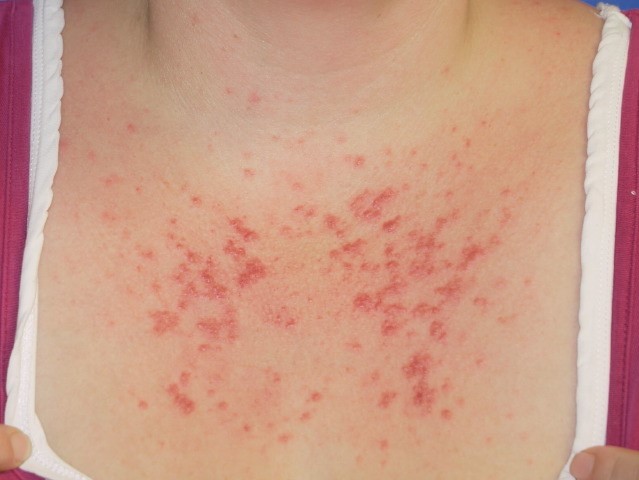
© DermNetNZ, CC BY 4.0, via Wikimedia Commons
How long does polymorphic light eruption last?
The rash generally clears up within a week if you stay out of the sun. However, if you get more sunshine on your skin then it is likely to get worse. The rash may come back if you go into strong sun again. However, symptoms tend to improve during the summer, as your skin becomes more adapted to sunlight.
What causes polymorphic light eruption?
PMLE tends to happen when you go out in the sun in the spring or early in the summer, when your skin is not used to sunshine. The rash may also occur if you go on holiday to a sunny place. It is thought that in people who get PMLE, there is an immune system reaction in the skin which is triggered by UVA (see below).
Sunlight contains various types of rays (radiation). The ones which can cause PMLE are ultraviolet (UV) light and visible light. UV light has two types, UVA and UVB.
While sunburn is caused by UVB, it is UVA which causes PMLE. Unlike UVB, UVA and visible light can pass through glass, so it is possible to get PMLE when exposed to strong sunlight through a window. Sometimes it can even occur after exposure to fluorescent lighting.
It is not known exactly how the sunlight causes PMLE, or why some people get PMLE and others don't. Some studies have suggested that it is more common in people who smoke or drink six or more alcoholic drinks a week.
Can polymorphic light eruption cause cancer?
You can't catch PMLE (it is not infectious) and it has nothing to do with cancro della pelle.
How common is polymorphic light eruption?
Polymorphic light eruption (PMLE) mostly affects people aged 20-40 years. It is more common in women. It probably affects around 1 in 10 European women.
It doesn't only occur in people with pale skin; it can also occur in people with darker skin.
The problem is more common in countries with temperate climates - that is, neither hot like the tropics nor cold. Northern Europe and much of North America have temperate climates.
How is polymorphic light eruption diagnosed?
The diagnosis of PMLE can usually be made by a doctor from a description of the appearance of the rash and the relationship of the rash to the time of exposure to sunlight.
Generally no tests are needed but sometimes blood tests or a skin sample (biopsia) are taken if the doctor wants to rule out other conditions.
If a biopsy is required, a small sample of skin is removed and examined under the microscope in a laboratory. This means the cells in the skin can be seen and an accurate diagnosis can be made.
Photo-testing is sometimes used to confirm the diagnosis. This involves shining some artificial sunlight-type rays (UV or visible light) on to a small area of skin to observe how the skin reacts.
Rarely, PMLE may be an early feature of a condition called lupus eritematoso sistemico (SLE).
How to prevent polymorphic light eruption
Prevention is definitely better than cure. If you have had PMLE in the past, you are quite likely to get it again the following year when you start to go out in the sun.
Sunscreen is helpful to prevent the rash.
Make sure you use one with a good sun protection factor (such as SPF 50) and also protection against UVA and UVB (star system).
Apply sunscreen frequently during the day, especially after swimming, towelling or sweating.
Remember that sunscreen doesn't offer 100% protection.
It is also important to stay out of the sun, especially in the middle of the day, between 11 am and 3 pm.
Put on a wide-brimmed hat and wear clothes with long sleeves.
Polymorphic light eruption treatment
If you do develop PMLE, there are several things you can try to ease the symptoms:
A mild topical corticosteroids like idrocortisone can help the redness to settle down.
Antihistamine tablets can help to reduce the itching as well.
If the rash is very severe then a doctor may prescribe a short course of oral corticosteroid tablets (often just called steroidi) such as prednisolone which will help the inflammation to settle.
If you get the rash, you should stay out of the sun as much as possible and the rash should settle within a week. If you go out in the sun while the rash is still there, it is likely to get worse. It may come back if you go out in the sun again but tends to get less severe as the summer progresses and your skin becomes adapted to being out in the sun.
What other treatments are there for polymorphic light eruption?
For severe or troublesome PMLE
If the above treatments are not sufficient, you may be referred to a dermatologist. This is a doctor who specialises in skin conditions. Other treatment options include:
Light therapy (phototherapy). This is treatment with UV light, in gradually increasing doses. It helps the skin to become more resistant to PMLE when you go into natural sunshine. Effectively it desensitises you to the sun by preparing your skin for sun exposure. This treatment is sometimes called photo-hardening which means increasing the skin's resistance to light - not actually making the skin hard. The treatment is usually given in a hospital outpatient department. It is normally given in the spring but its effects wear off, so it has to be repeated every year.
Idrossiclorochina. This is a tablet normally used against malaria. It helps to reduce PMLE symptoms but can have side-effects in some people.
Various other treatments have been tried, and might have a role in helping PMLE, although they are not standard treatment at present. These are:
Special sunscreens with high UVA protection.
Cream containing sunscreen plus antioxidants (alpha-glucosylrutin and vitamin E).
Tablets containing carotenoids such as beta-carotene.
Vitamin supplements (vitamin E or nicotinamide).
Cream containing a form of vitamin D.
A note about vitamin D
If your PMLE makes you avoid sunlight to a large extent, you may be at risk of carenza di vitamina D. This is because most of the body's vitamin D is made by the action of sunlight on skin, and it needs outdoor sunlight, without sunscreen, to make vitamin D.
You may need to take vitamin D supplements if you have very little sunlight exposure over a long period. You can discuss this with your doctor.
Does polymorphic light eruption ever go away?
Some people get PMLE each year. It starts each spring with a rash that lasts for up to a week, and then comes back if you go out in the sun again. But it is usually less severe each time it comes back
What is the outlook for polymorphic light eruption?
Although no treatment stops polymorphic light eruption (PMLE) developing for ever, the outlook is good. The rash heals completely, although while it lasts it may be uncomfortable or unsightly.
Nel lungo termine:
For most people, PMLE tends to follow a pattern and it usually comes back each year when you first get exposed to strong sunshine. Over time you learn how much sun your skin can tolerate and you should try to keep within that limit to avoid PMLE. You will learn to introduce your skin to sunlight gradually in the spring.
For some people, PMLE may improve or clear up completely over the years.
PMLE also tends to improve for women after the menopausa (when menstrual cycles stop at around the age of 50).
Scelte del paziente per Eruzioni cutanee

Salute della pelle, delle unghie e dei capelli
Cheratosi attinica
Una cheratosi attinica (nota anche come cheratosi solare) è la condizione cutanea più comune causata dai danni del sole. È il risultato della pelle danneggiata dal sole per molti anni. Le cheratosi attiniche sono solitamente chiazze ruvide e squamose su aree esposte al sole come la testa e il viso. Le cheratosi attiniche sono comuni, specialmente nelle persone anziane, molte delle quali ne hanno più di una. Di solito sono innocue, ma c'è un piccolo rischio che possano eventualmente trasformarsi in cancro della pelle e quindi potrebbe essere consigliato un trattamento.
di Dr Doug McKechnie, MRCGP

Salute della pelle, delle unghie e dei capelli
Milia
Milia sono piccole protuberanze molto piccole, sollevate, di colore bianco perla o giallastro sulla pelle. Si trovano più spesso sulla pelle intorno alle guance, al naso, agli occhi e alle palpebre, alla fronte e al petto. Tuttavia, possono comparire ovunque sul corpo. Le milia sono molto comuni nei neonati, ma possono colpire persone di qualsiasi età. Nei neonati, le milia scompaiono da sole e non è necessario alcun trattamento. In altre persone, possono richiedere più tempo per scomparire. In casi persistenti, può essere consigliato un trattamento.
di Dr Philippa Vincent, MRCGP
Domande frequenti
L'eruzione primaverile giovanile è pericolosa?
L'eruzione primaverile giovanile è una forma localizzata di eruzione polimorfa solare (PMLE). Sebbene la PMLE possa essere scomoda, non è infettiva e non ha nulla a che fare con il cancro della pelle. L'eruzione guarisce completamente senza lasciare cicatrici.
Posso avere un'eruzione polimorfica alla luce attraverso una finestra?
Sì, è possibile sviluppare un'eruzione polimorfa alla luce (PMLE) quando si è esposti a una forte luce solare attraverso una finestra. Questo perché i raggi UVA e la luce visibile, che causano la PMLE, possono passare attraverso il vetro.
Qual è la probabilità che la PMLE ritorni ogni anno?
Se hai avuto un'eruzione polimorfa solare (PMLE) in passato, è molto probabile che si ripresenti l'anno successivo quando sei esposto per la prima volta a un forte sole.
Perché la PMLE migliora durante l'estate?
I sintomi dell'eruzione polimorfa solare (PMLE) tendono a migliorare durante i mesi estivi. Questo perché la tua pelle diventa più adattata alla luce solare man mano che riceve più esposizione.
Può svilupparsi un'eruzione polimorfica alla luce dopo l'esposizione a illuminazione fluorescente?
Sì, in alcuni casi, forme gravi di eruzione polimorfa solare (PMLE) possono verificarsi anche dopo l'esposizione a luci fluorescenti.
Ulteriori letture e riferimenti
- Polymorphic Light Eruption; DermNet NZ
- Oakley AM, Ramsey ML; Polymorphic Light Eruption.
- Lembo S, Raimondo A; Polymorphic Light Eruption: What's New in Pathogenesis and Management. Front Med (Lausanne). 2018 Sep 10;5:252. doi: 10.3389/fmed.2018.00252. eCollection 2018.
- Duteil L, Queille-Roussel C, Aladren S, et al; Prevention of Polymorphic Light Eruption Afforded by a Very High Broad-Spectrum Protection Sunscreen Containing Ectoin. Dermatol Ther (Heidelb). 2022 Jul;12(7):1603-1613. doi: 10.1007/s13555-022-00755-5. Epub 2022 Jun 18.
Informazioni sull'autoreVisualizza il profilo completo

Dr Hayley Willacy, FRCGP
Medico di base, Autore medico
MBChB (1992), DRCOG, DFFP, MRCOG (Part 1) MRCGP (2007), DFSRH (2013), MSc - medical education (2020)
La Dott.ssa Hayley Willacy era un medico di base del NHS che lavorava nel nord-ovest dell'Inghilterra, e si è ritirata dalla pratica clinica nel 2022 dopo 30 anni.
Informazioni sul recensoreVisualizza il profilo completo

Dr Colin Tidy, MRCGP
Medico di base, Autore medico
MBBS, MRCGP, MRCP (Paediatrics), DCH
Il Dr Colin Tidy è un medico del NHS, con sede nell'Oxfordshire.
Storia dell'articolo
Le informazioni su questa pagina sono scritte e revisionate da clinici qualificati.
Articolo disponibile anche in Inglese, Tedesco, Spagnolo, Francese, Italiano, Portoghese, Hindi, Ebraico, Arabo, and Svedese.
Prossima revisione prevista: 21 Ott 2028
23 Ott 2023 | Ultima versione

Chiedi, condividi, connettiti.
Esplora le discussioni, fai domande e condividi esperienze su centinaia di argomenti di salute.

Non ti senti bene?
Valuta i tuoi sintomi online gratuitamente
Iscriviti alla newsletter di Patient
La tua dose settimanale di consigli sulla salute chiari e affidabili - scritti per aiutarti a sentirti informato, sicuro e in controllo.
Abbonandoti accetti i nostri Informativa sulla Privacy. Puoi annullare l'iscrizione in qualsiasi momento. Non vendiamo mai i tuoi dati.
Più sulla salute della pelle, delle unghie e dei capelli
- Cheratosi attinica
- Albinismo
- Eczema atopico
- Foruncoli, carbonchi e foruncolosi
- Pemfigoide bolloso
- Follicolite
- Infezione fungina dell'inguine
- Psoriasi guttata
- Impetigine
- Punture e morsi di insetti
- Puntura di medusa
- Lichen planus
- Calvizie maschile
- Cancro della pelle non melanoma
- Dermatite periorale
- Pompholyx
- Sclerosi sistemica
- Ulcere venose alle gambe
- Verruche e porri