Cimici dei letti
Revisione paritaria di Dr Colin Tidy, MRCGPUltimo aggiornamento di Dr Toni Hazell, FRCGPUltimo aggiornamento 16 Apr 2023
Rispetta le linee guida editoriali
- ScaricaScarica
- Condividi
- Language
- Discussione
- Versione audio
- Aggiungi alle fonti preferite su Google
Le cimici dei letti sono insetti molto piccoli, delle dimensioni di un seme di mela. Possono vivere nei mobili, nei vestiti e nella biancheria da letto. Tendono a mordere di notte. Il problema delle cimici dei letti sta diventando più comune. Sebbene i morsi delle cimici non causino malattie, possono essere fastidiosi.
A colpo d'occhio
Bedbugs are tiny, flat, oval, reddish-brown insects that feed on human or animal blood.
You might have bedbugs if you find itchy bites, blood spots, or brown spots on bedding.
They usually bite at night, causing itchy red marks that often appear in a line or curve.
Bedbugs can live in various cracks and crevices in your home, including mattresses and furniture.
Treat bites with mild steroid cream or antihistamines for itching, usually without needing a doctor.
See your doctor if bedbug bites become infected, spreading redness or pain.
To get rid of bedbugs, wash affected items in hot water and contact a pest control expert.
What are bedbugs?
There are two types. The most common type is the Cimex lectularius, also known as the common bedbug. They feed on blood from humans and other animals.
What do bedbugs look like?
Cimex lectularius are very small (around 2-5 mm long) oval insects. They do not have wings. They are reddish-brown in colour and are usually flat. However, they become more rounded and their colour changes to red/purple after they have had some blood.
Bedbug on skin
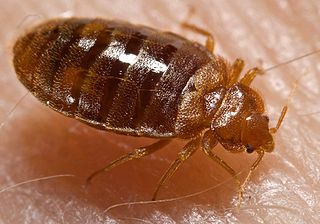
© Content Providers(s): CDC/Harvard University, Dr. Gary Alpert; Dr. Harold Harlan; Richard Pollack. Photo Credit: Piotr Naskrecki, Public domain, via Wikimedia Commons
How to know if you have bedbugs
You may find the following signs of bedbugs:
Developing itchy bites.
You may be able to see the insects if you look for them. They are tiny but are visible to the naked eye.
Seeing spots of blood on bedding.
Noticing brown spots on bedding, from their excrement.
A sweet almond odour may be noticeable if there are many bedbugs around.
There are different degrees of infestation with bedbugs. This can vary from light, causing one or two bites a week, through to heavy infestations where more than 50 bites per night occur.
Where are bedbugs found?
They can live in many different cracks and crevices in your home. For example, mattress seams, bed frames, within plug sockets, in clothing or in soft furnishings. Bedbugs can even be found hiding behind picture frames. They can move to different rooms, usually on clothing or furniture. They live in both clean and dirty environments. However, having high standards of hygiene and housekeeping can help to ensure that their presence is revealed at an early stage.
They are not usually seen in the daytime. They come out at night when they are attracted by the warmth of sleeping bodies and also the carbon dioxide in breath.
The adults can live for up to 18 months. They breed by laying eggs which hatch after around 10-20 days and take between 9-18 weeks to become adults. Females can lay around 300 eggs in their lifetime. The insects need blood to develop but can stay alive for as long as a year without feeding.
What causes a bedbug infestation?
Bedbugs might get into your home from somewhere else that was infested - they can be carried on clothes and bags. They can also travel between rooms in buildings that house more than one family, such as flats and hotels.
Do bedbugs cause diseases?
Although bedbugs have not been proven actually to cause any diseases, they are usually a nuisance. When you are sleeping they bite you to obtain your blood. As they bite they inject a substance which numbs the exposed skin so you are not usually aware of the bite. They feed on your skin for 2-10 minutes each time.
Rarely, people can develop a serious allergic reaction to the bite.
Sometimes the bites can become infected. The area around where you have been bitten may swell and become sore and reddened.
Having bedbugs can keep you from getting a good night's sleep, which, over time, can be bad for your health.
Come appare una puntura di cimice?
Bed bug bites can be very itchy and irritating. The bites can vary from being very small red bite marks on your skin to larger red areas with some swelling around them. Three to four bites forming a line or a curve on your body are very suggestive of bedbug bites. The bites tend to be in areas which are exposed as you are sleeping - for example, your face, neck or arms.
Bedbug bites on face
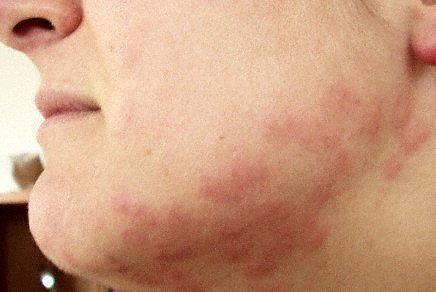
© Original uploader was Andybrookestar at English Wikipedia, Public domain, via Wikimedia Commons
Come trattare le punture di cimice
The bites usually improve without any treatment. If they are itchy, you can use a mild steroid cream such as hydrocortisone cream. You can buy this over the counter from a pharmacy - the treatment of bedbug bites generally doesn't need to involve a visit to your GP. If your bites are particularly bothersome - for example, very itchy and keeping you awake at night - then antihistamines may be beneficial and can also be bought over the counter.
When to see a doctor about bedbug bites
If your bites become infected then antibiotics may be needed to clear up the infection. See your doctor if the redness around the bites is spreading or becoming very painful.
How to prevent bedbug bites
Bedbugs can live in furniture (though humans are the preferred host) so it is worth thoroughly checking any second-hand furniture that you buy. If staying in a hotel where you are concerned about bedbugs, consider putting your bag on a stand rather than on the floor, and keeping it away from the walls. If you have stayed anywhere that you are concerned may have bedbugs, wash all clothes as soon as you get home.
Come eliminare le cimici
Wash affected bedding and clothing
Any affected bedding or clothes should be washed in a hot wash (at 60°C if possible). Tumble drying of affected linen or more delicate items has been shown to be effective. The tumble drier must be set to a hot temperature for at least half an hour. Also, freezing any affected materials has been shown to decontaminate infested clothing - this can be useful for clothing which would be damaged by a hot wash or a spell in the tumble dryer. Items have to be frozen for at least one week.
Wrap mattresses in plastic
Wrapping your mattress in plastic can prevent the insects from getting in. Any existing bedbugs which are trapped will eventually die.
If bites occur when you are on holiday then you should carefully inspect any hotel rooms for signs of infestation. It may be worth inspecting the beds before you unpack. If you are in an infested area, the insects can travel home with you on your clothing or luggage.
Call pest control
If you find your home is infested, always call a pest control expert. Your local pest control team should also be able to help to eradicate them by using an insecticide which is usually sprayed on and around the affected areas of your house. They usually use a combination of insecticides. This is usually a very effective method of bedbug control. In some cases, re-treatment at a later date is required. It is not safe to use these insecticides unless you are a trained professional.
Try contacting your local council which often has advice about pest control services. You can get further information and find a pest control expert from the British Pest Control Association. The US Environmental Protection Agency has produced some comprehensive information.
Scelte del paziente per Punture e morsi

Salute della pelle, delle unghie e dei capelli
Morsi di cani e gatti
Tutti i morsi di animali, tranne i più lievi, dovrebbero probabilmente essere valutati e trattati da un professionista sanitario - in particolare, i morsi alle mani.
di Dr Rachel Hudson, MRCGP

Salute della pelle, delle unghie e dei capelli
Puntura di medusa
Le meduse sono creature marine comuni e molte di esse pungono. La maggior parte delle punture di medusa non sono dannose. Le specie di meduse nel Regno Unito generalmente non sono pericolose, anche se le punture della caravella portoghese, della medusa criniera di leone e della medusa bussola possono essere dolorose e, se punti molte volte, dannose. È anche possibile avere una reazione allergica a qualsiasi puntura di medusa.
di Dr Hayley Willacy, FRCGP
Domande frequenti
How small are bed bugs?
Bed bugs (Cimex lectularius) are very small, measuring around 2-5 mm long. They are visible to the naked eye. After feeding on blood, they become more rounded and their colour changes.
Will bed bugs bite me in the daytime?
Bed bugs are not usually seen in the daytime. They are attracted by the warmth of sleeping bodies and the carbon dioxide in breath, so they typically come out at night to feed.
How do bed bugs start in a home?
Bed bugs can enter your home by being carried in from other infested places. They often travel on clothes, bags, or furniture. They can also move between rooms in multi-occupancy buildings like flats or hotels.
Are bed bug bites dangerous?
Bed bug bites are not usually dangerous and have not been proven to cause diseases. However, they can sometimes lead to complications such as an allergic reaction, or the bites becoming infected. A chronic lack of sleep due to bed bugs can also negatively impact your health over time.
How can I tell if a bite is from a bed bug?
Bed bug bites are often very itchy and irritating. They can appear as small red marks or larger red, swollen areas. A key sign is three or four bites forming a line or curve on your body. These bites typically occur on exposed skin areas during sleep, such as the face, neck, or arms.
How long do bed bug eggs take to hatch and develop?
Bed bug eggs typically hatch after around 10-20 days. Once hatched, it takes between 9 and 18 weeks for the young bed bugs to develop into adults. The insects require blood meals to grow and develop.
How long can bed bugs live without feeding?
Adult bed bugs can survive for as long as a year without a blood meal. They need blood to develop, but they are capable of living for extended periods without feeding.
Ulteriori letture e riferimenti
- Rukke BA, Sivasubramaniam R, Birkemoe T, et al; Temperature stress deteriorates bed bug (Cimex lectularius) populations through decreased survival, fecundity and offspring success. PLoS One. 2018 Mar 14;13(3):e0193788. doi: 10.1371/journal.pone.0193788. eCollection 2018.
- Singh N, Wang C, Zha C, et al; Testing a Threshold-Based Bed Bug Management Approach in Apartment Buildings. Insects. 2017 Jul 26;8(3). pii: insects8030076. doi: 10.3390/insects8030076.
- Report a pest problem; GOV.UK, 2019
- Dang K, Doggett SL, Veera Singham G, et al; Insecticide resistance and resistance mechanisms in bed bugs, Cimex spp. (Hemiptera: Cimicidae). Parasit Vectors. 2017 Jun 29;10(1):318. doi: 10.1186/s13071-017-2232-3.
Informazioni sull'autoreVisualizza il profilo completo

Dr Toni Hazell, FRCGP
MBBS, BSc, FRCGP, DFSRH, Dip GU med, DRCOG, DCH (London, UK, 2000)
La Dott.ssa Toni Hazell si è laureata presso la St. Mary’s Hospital Medical School e ha completato il suo VTS al Northwick Park Hospital.
Informazioni sul recensoreVisualizza il profilo completo

Dr Colin Tidy, MRCGP
Medico di base, Autore medico
MBBS, MRCGP, MRCP (Paediatrics), DCH
Il Dr Colin Tidy è un medico del NHS, con sede nell'Oxfordshire.
Storia dell'articolo
Le informazioni su questa pagina sono scritte e revisionate da clinici qualificati.
Articolo disponibile anche in Inglese, Tedesco, Spagnolo, Francese, Italiano, Portoghese, Hindi, Ebraico, Arabo, and Svedese.
Prossima revisione prevista: 14 Apr 2028
16 Apr 2023 | Ultima versione
27 Oct 2010 | Pubblicato originariamente

Chiedi, condividi, connettiti.
Esplora le discussioni, fai domande e condividi esperienze su centinaia di argomenti di salute.

Non ti senti bene?
Valuta i tuoi sintomi online gratuitamente
Iscriviti alla newsletter di Patient
La tua dose settimanale di consigli sulla salute chiari e affidabili - scritti per aiutarti a sentirti informato, sicuro e in controllo.
Abbonandoti accetti i nostri Informativa sulla Privacy. Puoi annullare l'iscrizione in qualsiasi momento. Non vendiamo mai i tuoi dati.
Più sulla salute della pelle, delle unghie e dei capelli
- Foruncoli, carbonchi e foruncolosi
- Fattori scatenanti e irritanti dell'eczema
- Follicolite
- Vesciche ai piedi
- Congelamento
- Infezione fungina delle unghie
- Psoriasi guttata
- Morsi umani
- Ferite infette
- Unghia incarnita
- Chelòide
- Calvizie maschile
- Psoriasi
- Verruche seborroiche
- Ulcere cutanee
- Sindrome della guancia schiaffeggiata
- Sole e scottature
- Effluvio telogen