Avvelenamento da arsenico
Revisione paritaria di Dr Toni Hazell, FRCGPUltimo aggiornamento di Dr Caroline Wiggins, MRCGP Ultimo aggiornamento 20 Apr 2026
Rispetta le linee guida editoriali
- ScaricaScarica
- Condividi
- Language
- Discussione
- Versione audio
- Aggiungi alle fonti preferite su Google
Professionisti Medici
Gli articoli di riferimento professionale sono progettati per essere utilizzati dai professionisti della salute. Sono scritti da medici del Regno Unito e basati su prove di ricerca, linee guida del Regno Unito ed europee. Potresti trovare uno dei nostri articoli sulla salute più utile.
What is arsenic poisoning?
Arsenic poisoning is a condition that is caused by elevated levels of arsenic in the body. Arsenic is widely used in modern industry, especially in the production of pesticides, herbicides, wood preservatives, and semiconductors. The sources of arsenic, such as contaminated water, air, soil, rocks and food, can cause serious human diseases.1
Arsenic is a heavy metal which is a natural component of the earth's crust. Arsenic poisoning can occur by ingestion, inhalation and dermal absorption. Trivalent arsenic is well absorbed through the skin and is 60 times more toxic than pentavalent arsenic, which is well absorbed by the gut.2 Arsine gas is highly toxic.
Toxicity is due to arsenic's effect on many cell enzymes, which affect metabolism and DNA repair. Arsenic is excreted in urine but can also accumulate in many body tissues.3
Arsenic is currently used to treat acute promyelocytic leukaemia and other myeloproliferative disorders.4
How common is arsenic poisoning? (Epidemiology)
In Victorian times arsenic was famous as a homicidal or suicidal poison; it is now thankfully much harder to obtain. Health and safety at work have also improved so that, in the UK, both acute and chronic arsenic poisoning are rare. However arsenic contamination affects hundreds of millions of people globally.5
Geological contamination of underground water supplies occurs in parts of the world, causing chronic exposure to millions of people.6 7
Arsenic poisoning causes (aetiology)3
Questi includono:
Arsenic contaminated drinking water.
Some ayurvedic medicines. Some Chinese herbal medicines. Both as intended ingredient and as contaminant.
Pesticides,8 herbicides and fungicides - no longer licensed in the UK.
Wood preservatives.
Ceramic enamels.
Paints.
Tobacco.
Burning of fossil fuels - arsenic is a contaminant.
'Moonshine' - illicitly distilled high-proof alcohol.9
Occupational exposure10
This can occur in:
The smelting and plating industries: arsenic is a byproduct of ores containing lead, gold, zinc, cobalt and nickel.11
The microelectronics industry: gallium arsenide is used in some semi-conductor computer chips.
Coal power plants.
Manufacture of glass and fireworks.
Use of pesticides.
Contact with wood treated with arsenic as a preservative.
Note that organic arsenics found in fish and seafood are non-toxic and not a cause of arsenic poisoning. Arsenic solutes are tasteless, whilst arsine gas is odourless and colourless.
Arsenic poisoning symptoms
Acute arsenic poisoning symptoms2 3
Arsenic poisoning symptoms usually start within 30 minutes to two hours after exposure and affect every body system. Ingestion of high amounts of arsenic is typically followed by a severe gastroenteritis, a metallic taste in the mouth, garlic odour and hypersalivation. There is a characteristic sequence of multi-organ failure, with neurological symptoms (within hours) and cardiac features, succeeded by adult respiratory distress syndrome and renal/liver dysfunction. Marrow suppression develops after a few days to weeks in survivors, as does alopecia and an ascending motor neuropathy.
Details of acute arsenic poisoning features
Metallic taste in the mouth.
Garlic odour - often present in breath and body tissues.
Gastrointestinal (GI):
Hypersalivation, abdominal pain, vomiting, profuse watery diarrhoea leading to hypovolaemic shock.
Trivalent arsenic is corrosive - may cause oral burns, dysphagia and GI bleeding.
Cardiovascolare:
Toxic cardiomyopathy.
Disidratazione.
ECG changes including ST-segment changes, prolonged QT interval, ventricular tachycardia, torsades de pointes and ventricular fibrillation.
Gangrene of extremities.
Respiratorio:
Pulmonary oedema, adult respiratory distress syndrome and acute respiratory failure.
Inhaled arsenic causes irritation, bronchospasm and pulmonary oedema.
Renal and hepatic:
Haematuria or haemoglobinuria (from acute haemolysis), proteinuria, acute tubular necrosis with acute kidney injury.
Jaundice, hepatomegaly, pancreatitis.
Neurologico:
CNS depression, encephalopathy and coma.
Convulsioni.
Toxic polyneuropathy with irritation of the nerve trunks.
Ematologico:
Acute haemolysis.
Bone marrow suppression.
Basophilic stippling and rouleaux formation may be seen on a blood film.
Skin: rashes.
Chronic arsenic poisoning symptoms2 3 6 10
Chronic arsenic exposure through drinking water leads to an increase in mortality which is directly related to the dose of arsenic exposure.7
Main clinical features and possible complications
Lesioni cutanee:
Skin lesions are the most common effect of chronic exposure.
They typically start about ten years after first exposure.
Keratoses on the palms and soles are characteristic.
Mees' lines (transverse white lines on nails).
Mees' lines post-chemotherapy treatment
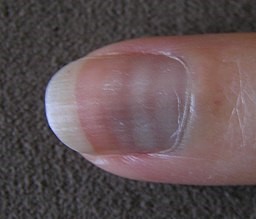
© Yannick Trottier, CC BY-SA 3.0, via Wikimedia Commons
Hyperpigmentation (especially on the arms and upper chest) - diffuse dark areas or 'raindrop' pigmentation.
Also, exfoliative dermatitis, alopecia, conjunctivitis, corneal ulceration.
GI:
Anorexia, weight loss, abdominal pain, diarrhoea.
Jaundice, hepatomegaly; development of portal fibrosis and cirrhosis.
Coronary heart disease, increased further in those who also smoke.
Myocarditis, pericarditis.
Ipertensione.
Malattia arteriosa periferica.
Restrictive or obstructive lung disease.
Effects in children are seen after an average of seven years of exposure.
Ematologico:
Pancytopenia,
Anemia aplastica.
Neurologico:
Peripheral neuropathy (sensory and motor at 1-3 weeks).
Muscle fasciculation and wasting.
Atassia.
Diabetes - increased risk.
There is mixed evidence of adverse pregnancy outcomes including still birth, miscarriage and teratogenicity among studies.
Cancer - increased risk of cancers of the skin, lung, bladder and kidney, liver and prostate.141516
Storia
Arsenic exposure is usually occupational or environmental but can result from deliberate poisoning.17
Take an occupational and travel history.
Other history: hobbies, unusual forms of alcohol or diet supplements, herbal medicines.
Diagnosi differenziale
Other forms of heavy metal poisoning - for example, lead. Botulismo, gastroenterite e sindrome emolitico-uremica. The skin lesions may look like other forms of dermatite.
Diagnosing arsenic poisoning (investigations)
Acute arsenic poisoning diagnosis2
Monitoring - for least four hours after suspected ingestion: pulse, blood pressure, respiratory rate, oxygen saturation and ECG, urine output.
Haematology, biochemistry and arterial blood gases - as for any acutely ill patient.
Analisi delle urine.
ECG.
Arsenic levels in blood and urine (see box below for normal levels).
CXR and plain abdominal X-ray (inorganic arsenic compounds are radio-opaque).
Informazioni importanti |
|---|
Arsenic levels - normal values Normal whole blood concentration is <10 mcg/L (<130 nmol/L). Nota: blood levels are of limited use, as the half-life of inorganic arsenic in the blood is short (approximately two hours). Normal 24-hour urinary excretion is <10 mcg (<130 nmol) arsenic/24 hours . Normal spot urinary arsenic concentration is <10 mcg/g creatinine (<15 nmol/mmol creatinine): Nota: organic arsenical compounds found in the urine are usually from food sources such as shellfish, rather than arsenic toxicity. Ask if seafood has been eaten in the previous 5 days and check whether the laboratory differentiates organic from inorganic arsenic compounds. Hair samples become positive 30 hours after exposure but may give falsely high results. They do not differentiate between ingestion and external exposure.2 |
Chronic arsenic poisoning diagnosis
Urinary concentrations are useful in chronic exposure.2
Hair samples.
Arsenic levels in drinking water (high levels of arsenic in drinking water in conjunction with relevant clinical features are useful for diagnosis in some settings).
Investigation and screening for complications may be appropriate (for example, look for diabetes, hypertension).
Arsenic poisoning treatment and management
Management of acute arsenic poisoning2
In the UK, contact Toxbase® for detailed advice. The following immediate principles apply.
Remove the patient from the source of arsenic; if there is skin contamination, wash with copious water; seal contaminated clothing.
Resuscitate ('ABC' principles).
Management is done in hospital and consists of supportive treatment (usually in ITU), possible removal by gastric lavage and management of the complications of arsenic poisoning.
Management of chronic arsenic poisoning
Provide arsenic-free drinking water, to reduce the risk of further disease developing. Anecdotal evidence suggests that mild-moderate keratoses may improve with cessation of exposure.
Chelation therapy studies have demonstrated mixed evidence regarding the benefit after chronic exposure. Combinations of chelating agents may prove beneficial but require further study.18 19 20 It is of no use if exposure to arsenic continues.
Co-administered micronutrients and antioxidants given with chelating agents may be beneficial, especially in undernourished populations.18
Certain plant compounds may help in chronic exposure. This may be due to antioxidative properties of the plant. Further study is required.18 21
Skin care for keratoses.
Screen and treat for complications - for example, diabetes, hypertension.
Other household members:
Check other members of the family, as they may also have been exposed.
Pregnancy and breastfeeding: arsenic is probably transferred to the baby via the placenta and breast milk.3
Prognosi3
The prognosis of arsenic poisoning varies with the amount and rate of arsenic ingestion.
Effects and complications can occur at different times after exposure - from days to years later.
Arsenic poisoning prevention
Provision of uncontaminated water for all is essential. WHO guidelines advise that a value of <10 mcg/L of arsenic in drinking water is a realistic target but with the proviso to keep concentrations as low as possible.6This has not been achieved worldwide.
Aggiornamenti esclusivi per i professionisti sanitari
Rimani informato con gli ultimi aggiornamenti clinici, approfondimenti professionali e linee guida basate su evidenze. La newsletter Patient Pro seleziona contenuti essenziali per i professionisti sanitari—consegnati direttamente nella tua casella di posta.
Abbonandoti accetti i nostri Informativa sulla Privacy. Puoi annullare l'iscrizione in qualsiasi momento. Non vendiamo mai i tuoi dati.
Ulteriori letture e riferimenti
- Kuivenhoven M, Mason K; Arsenic Toxicity. StatPearls, July 2021.
- Bjorklund G, Oliinyk P, Lysiuk R, et al; Arsenic intoxication: general aspects and chelating agents. Arch Toxicol. 2020 Jun;94(6):1879-1897. doi: 10.1007/s00204-020-02739-w. Epub 2020 May 9.
- TOXBASE®
- Ratnaike RN; Acute and chronic arsenic toxicity. Postgrad Med J. 2003 Jul;79(933):391-6. doi: 10.1136/pmj.79.933.391.
- Emadi A, Gore SD; Arsenic trioxide - An old drug rediscovered. Blood Rev. 2010 Jul-Sep;24(4-5):191-9. doi: 10.1016/j.blre.2010.04.001. Epub 2010 May 15.
- Mochizuki H; Arsenic Neurotoxicity in Humans. Int J Mol Sci. 2019 Jul 11;20(14). pii: ijms20143418. doi: 10.3390/ijms20143418.
- Guidelines for drinking-water quality, 4th edition; World Health Organization, 2017.
- Argos M, Kalra T, Rathouz PJ, et al; Arsenic exposure from drinking water, and all-cause and chronic-disease mortalities in Bangladesh (HEALS): a prospective cohort study. Lancet. 2010 Jul 24;376(9737):252-8. doi: 10.1016/S0140-6736(10)60481-3. Epub 2010 Jun 18.
- Lai MW, Boyer EW, Kleinman ME, et al; Acute arsenic poisoning in two siblings. Pediatrics. 2005 Jul;116(1):249-57.
- Gerhardt RE, Crecelius EA, Hudson JB; Moonshine-related arsenic poisoning. Arch Intern Med. 1980 Feb;140(2):211-3.
- Chronic arsenic poisoning - information and pictures on symptoms of chronic poisoning; DermNet NZ
- Correia N, Carvalho C, Frioes F, et al; Haemolytic anaemia secondary to arsenic poisoning: a case report. Cases J. 2009 Aug 11;2:7768. doi: 10.4076/1757-1626-2-7768.
- Chen Y, Graziano JH, Parvez F, et al; Arsenic exposure from drinking water and mortality from cardiovascular disease in Bangladesh: prospective cohort study. BMJ. 2011 May 5;342:d2431. doi: 10.1136/bmj.d2431.
- James KA, Byers T, Hokanson JE, et al; Association between lifetime exposure to inorganic arsenic in drinking water and coronary heart disease in Colorado residents. Environ Health Perspect. 2015 Feb;123(2):128-34. doi: 10.1289/ehp.1307839. Epub 2014 Oct 28.
- Karagas MR, Gossai A, Pierce B, et al; Drinking Water Arsenic Contamination, Skin Lesions, and Malignancies: A Systematic Review of the Global Evidence. Curr Environ Health Rep. 2015 Mar;2(1):52-68. doi: 10.1007/s40572-014-0040-x.
- Arita A, Costa M; Epigenetics in metal carcinogenesis: nickel, arsenic, chromium and cadmium. Metallomics. 2009;1(3):222-8. doi: 10.1039/b903049b.
- Benbrahim-Tallaa L, Waalkes MP; Inorganic arsenic and human prostate cancer. Environ Health Perspect. 2008 Feb;116(2):158-64. doi: 10.1289/ehp.10423.
- Duenas-Laita A, Perez-Miranda M, Gonzalez-Lopez MA, et al; Acute arsenic poisoning. Lancet. 2005 Jun 4-10;365(9475):1982.
- Kalia K, Flora SJ; Strategies for safe and effective therapeutic measures for chronic arsenic and lead poisoning. J Occup Health. 2005 Jan;47(1):1-21.
- Guha Mazumder DN, De BK, Santra A, et al; Randomized placebo-controlled trial of 2,3-dimercapto-1-propanesulfonate (DMPS) in therapy of chronic arsenicosis due to drinking arsenic-contaminated water. J Toxicol Clin Toxicol. 2001;39(7):665-74.
- Kosnett MJ; The role of chelation in the treatment of arsenic and mercury poisoning. J Med Toxicol. 2013 Dec;9(4):347-54. doi: 10.1007/s13181-013-0344-5.
- Misbahuddin M, Islam AZ, Khandker S, et al; Efficacy of spirulina extract plus zinc in patients of chronic arsenic poisoning: a randomized placebo-controlled study. Clin Toxicol (Phila). 2006;44(2):135-41.
Informazioni sull'autoreVisualizza il profilo completo

Dr Caroline Wiggins, MRCGP
Medico di base, Autore medico
Laurea in Medicina e Chirurgia con Lode, MRCGP (2016), MSc.SEM con Lode, BSc con Lode
La Dott.ssa Caroline Wiggins è un medico di base supplente attualmente nel sud-ovest dell'Inghilterra.
Informazioni sul recensoreVisualizza il profilo completo

Dr Toni Hazell, FRCGP
MBBS, BSc, FRCGP, DFSRH, Dip GU med, DRCOG, DCH (London, UK, 2000)
La Dott.ssa Toni Hazell si è laureata presso la St. Mary’s Hospital Medical School e ha completato il suo VTS al Northwick Park Hospital.
Storia dell'articolo
Le informazioni su questa pagina sono scritte e revisionate da clinici qualificati.
Articolo disponibile anche in Inglese, Tedesco, Spagnolo, Francese, Italiano, Portoghese, Hindi, Ebraico, Arabo, and Svedese.
Next review due: 20 Nov 2030
20 Apr 2026 | Ultima versione

Chiedi, condividi, connettiti.
Esplora le discussioni, fai domande e condividi esperienze su centinaia di argomenti di salute.

Non ti senti bene?
Valuta i tuoi sintomi online gratuitamente
Più su tossicologia e disturbi iatrogeni
- Astinenza acuta da alcol e delirium tremens
- Abuso e intossicazione da anfetamine
- Nefropatia da analgesici
- Reazioni trasfusionali
- Intossicazione da monossido di carbonio
- Gas di cloro
- Epatite indotta da farmaci
- Sovraccarico di fluidi
- Mal di testa da abuso di farmaci
- Intossicazione da metalli pesanti
- Ipervitaminosi
- Sindrome maligna da neurolettici
- Avvelenamento da oppiacei
- Sindrome da iperstimolazione ovarica
- Intossicazione da paracetamolo
- Avvelenamento da ricina
- Sindrome serotoninergica
- Avvelenamento da tallio
- Necrolisi epidermica tossica
- Avvelenamento da tungsteno