Xantelasma
Revisione paritaria di Dr Toni Hazell, FRCGPUltimo aggiornamento di Dr Colin Tidy, MRCGPUltimo aggiornamento 24 May 2022
Rispetta le linee guida editoriali
- ScaricaScarica
- Condividi
- Language
- Discussione
- Versione audio
- Aggiungi alle fonti preferite su Google
Professionisti Medici
Gli articoli di riferimento professionale sono progettati per essere utilizzati dai professionisti della salute. Sono scritti da medici del Regno Unito e basati su prove di ricerca, linee guida del Regno Unito ed europee. Potresti trovare il Iperlipidemia articolo più utile, o uno dei nostri altri articoli sulla salute.
Synonym: xanthelasma palpebrum
What is xanthelasma?
The appearance of xanthelasma is of yellow flat plaques over the upper or lower eyelids, most often near the inner canthus. They represent areas of lipid-containing macrophages but the exact pathophysiology is not known. In other areas of the body the individual lesion would be called a xanthoma; xanthelasma is the most common xanthoma.1 2
Xantelasma
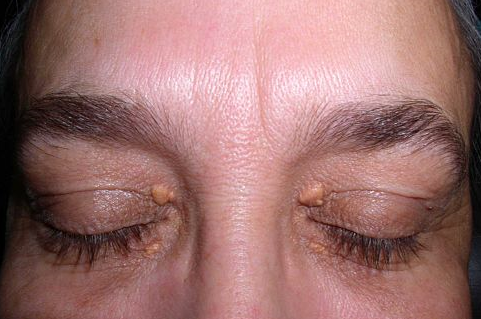
© By Klaus D. Peter, CC-BY-3.0, via Wikimedia Commons
Xanthelasma diagnosis
This is usually not a problem, since colour and site are characteristic. They occur a little more often in women than in men and the peak incidence is in the fourth to fifth decades. Once the plaque is established, it tends to remain static in size or grow slowly; it does not regress. Generally, eyelid function remains unimpaired. Ptosis is rare.
Diagnosi differenziale
Sometimes syringomas and milia may be misdiagnosed as xanthelasma.
Syringomas are small papules on lower eyelids and are skin-coloured.
Large milial cysts are white and spherical.
Xanthomas in other areas may appear more orange-yellow.
The list of differentials for lipid disorders also needs to be considered.
Malattie associate
Xanthelasma may represent a localised skin condition without any systemic abnormalities of lipoprotein metabolism or may be associated with an increase in the cholesterol-rich beta-lipoproteins (LDLs).3 Vedi il separato Iperlipidemia articolo.
Some patients exhibiting xanthelasma have normal lipid levels but this is less common in younger patients. Although these patients are not at increased risk of carotid atherosclerosis, they are more commonly found to have other risk factors for cardiovascular disease - eg, a higher BMI, waist circumference and LDL-C levels.4
Xanthelasma treatment and management
Lesions are typically asymptomatic and treatment is sought for cosmetic purposes. Treatments include topical trichloroacetic acid, liquid nitrogen cryotherapy, and various lasers. Surgical excision has also been used.2
Patients should have their fasting lipid levels checked and those with hyperlipidaemia should have a formal cardiovascular risk assessment using appropriate charts, with measures for prevention of cardiovascular disease as indicated.
The lesions can be left alone unless the patient wishes them removed for cosmetic reasons (not usually available on the NHS).
Various options are available including surgical excision (with or without skin grafting for large lesions), chemical treatment, laser treatment and cryocautery.5 Full-thickness skin grafting obtained via blepharoplasty is available.6 Xanthelasmas may recur after any of these interventions.
Lipid-lowering medication and diet modification have a limited (if any) effect on these lesions.
Prognosi
The condition itself is harmless. The prognosis depends on any association with underlying lipid abnormalities and cardiovascular risk.
Quando riferire
Surgical excision and cryocautery may be available in some primary care settings but it is likely that the other treatment options will require secondary care referral.
Aggiornamenti esclusivi per i professionisti sanitari
Rimani informato con gli ultimi aggiornamenti clinici, approfondimenti professionali e linee guida basate su evidenze. La newsletter Patient Pro seleziona contenuti essenziali per i professionisti sanitari—consegnati direttamente nella tua casella di posta.
Abbonandoti accetti i nostri Informativa sulla Privacy. Puoi annullare l'iscrizione in qualsiasi momento. Non vendiamo mai i tuoi dati.
Ulteriori letture e riferimenti
- Xanthomata; Società di Dermatologia delle Cure Primarie.
- Xanthomas; DermNet NZ
- Laftah Z, Al-Niaimi F; Xanthelasma: An Update on Treatment Modalities. J Cutan Aesthet Surg. 2018 Jan-Mar;11(1):1-6. doi: 10.4103/JCAS.JCAS_56_17.
- Xantelasma; DermIS (Sistema Informativo di Dermatologia)
- Chan CC, Lin SJ, Hwang JJ, et al; Xanthelasma is not associated with increased risk of carotid atherosclerosis in normolipidaemia. Int J Clin Pract. 2008 Feb;62(2):221-7. Epub 2007 Nov 23.
- Elabjer BK, Busic M, Sekelj S, et al; Operative treatment of large periocular xanthelasma. Orbit. 2009;28(1):16-9.
- Kose R; Treatment of large xanthelasma palpebrarums with full-thickness skin grafts obtained by blepharoplasty. J Cutan Med Surg. 2013 May-Jun;17(3):197-200.
Informazioni sull'autoreVisualizza il profilo completo

Dr Colin Tidy, MRCGP
Medico di base, Autore medico
MBBS, MRCGP, MRCP (Paediatrics), DCH
Il Dr Colin Tidy è un medico del NHS, con sede nell'Oxfordshire.
Informazioni sul recensoreVisualizza il profilo completo

Dr Toni Hazell, FRCGP
MBBS, BSc, FRCGP, DFSRH, Dip GU med, DRCOG, DCH (London, UK, 2000)
La Dott.ssa Toni Hazell si è laureata presso la St. Mary’s Hospital Medical School e ha completato il suo VTS al Northwick Park Hospital.
Storia dell'articolo
Le informazioni su questa pagina sono scritte e revisionate da clinici qualificati.
Articolo disponibile anche in Inglese, Tedesco, Spagnolo, Francese, Italiano, Portoghese, Hindi, Ebraico, Arabo, and Svedese.
Prossima revisione prevista: 8 Aprile 2027
24 May 2022 | Ultima versione

Chiedi, condividi, connettiti.
Esplora le discussioni, fai domande e condividi esperienze su centinaia di argomenti di salute.

Non ti senti bene?
Valuta i tuoi sintomi online gratuitamente
Altro in dermatologia
- Carcinoma a cellule basali
- Condrodermatite nodulare
- Psoriasi cronica a placche
- Larva migrans cutanea
- Infezioni fungine delle unghie
- Malattia del verme della Guinea
- Iperidrosi
- Impetigine
- Nevi intradermici e composti
- Prurito
- Dermatosi lineare da IgA
- Lipoma
- Cellulite orbitale e pre-settale
- Lesioni pigmentate della pelle
- Pitiriasi versicolor
- Eruzione polimorfa da luce
- Porfirie
- Pidocchi del pube e del corpo
- Manifestazioni cutanee di malattie sistemiche
- Sindrome di Werner