Intravenous urography
Pyelography
Peer reviewed by Dr Hayley Willacy, FRCGP Last updated by Dr Doug McKechnie, MRCGPLast updated 31 Oct 2023
Meets Patient’s editorial guidelines
- DownloadDownload
- Share
- Language
- Discussion
- Audio Version
- Add to preferred sources on Google
Intravenous urography is a test that uses X-rays and a special dye to help assess your kidneys, ureters, bladder and urethra.
Note: the information below is a general guide only. The arrangements, and the way tests are performed, may vary between different hospitals. Always follow the instructions given by your doctor or local hospital.
At a glance
Intravenous urography is an X-ray procedure to examine your urinary tract.
A special dye is injected into a vein to make your kidneys, ureters, and bladder visible on X-rays.
It can help find issues like kidney stones, recurrent infections, or causes of blood in urine.
Preparation involves checking kidney function, fasting, and potentially adjusting certain medications.
The procedure usually takes 30-60 minutes, with X-rays taken after dye injection.
Side effects can include a warm feeling or metallic taste; allergic reactions are uncommon.
Pregnant women should generally avoid this procedure due to a small risk to the baby.
What is intravenous urography?
Cross-section diagram of the urinary tract describing how an intravenous urography is performed
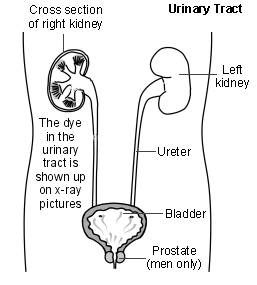
Intravenous urography (also known as intravenous pyelography) is an X-ray procedure which is used to assess problems in your kidneys, ureters, bladder and urethra. These structures make up your urinary tract. The ureters are tubes which go from each kidney to your bladder. The urethra is the tube from your bladder that passes out urine.
The urinary tract does not show up well on ordinary X-ray pictures. However, with intravenous urography a contrast dye is injected into a vein (an 'intravenous' injection). The dye travels in your bloodstream, concentrates in your kidneys, and is passed out into your ureters with urine made by your kidneys.
The dye blocks X-rays so the structure of your kidneys, ureters and bladder shows up clearly as white on X-ray pictures.
The X-ray pictures produced are called an intravenous urogram (IVU) but can also be called an intravenous pyelogram (IVP).
What is intravenous urography used for?
Intravenous urography can help to assess a range of problems. For example:
Kidney stones. A stone in a kidney or in the tube which goes from a kidney to the bladder (the ureter) will normally show up quite clearly.
Urine infections. If you have infections of your bladder or kidney which come back (recur), an IVU may help to find if you have a blockage or other abnormality of your urinary tract.
Blood in the urine. This can be due to various causes such as infection, inflammation and tumours of the kidney. An IVU may help to clarify the cause.
Obstruction or damage to any part of the urinary tract can often be seen on an IVU.
Intravenous urography has mostly been replaced by CT urography and MRI urography scans, as these tend to give better images of the bladder, ureters, and kidneys. However, intravenous urography is still sometimes used, especially if CT or MRI scans are not available.
How to prepare for intravenous urography
Your kidneys have to be able to filter the dye. Therefore, it is seldom performed if you have kidney failure. Before the procedure you may need a blood test to check that you do not have kidney failure.
Tell your doctor if you have any allergies, especially allergy to contrast dyes such as iodine.
You may be asked not to eat for several hours before the procedure. This ensures that your gut (intestines) is empty of food, which makes the X-ray pictures clearer.
You may be given some laxatives to take for a day or so before the procedure. The aim of this is to clear the intestines, which will make the X-ray pictures clearer.
You may be asked to sign a consent form to confirm that you understand the procedure.
You will need to remove any metal objects or jewellery that might interfere with the X-ray pictures.
If you have diabetes and take a medicine called metformin you may need to stop the metformin for two days prior to the procedure. This is because the combination of metformin and contrast dye may affect the kidneys. (You should discuss this, and how to manage your diabetes over this period, in more detail with your doctor.)
Editor’s note
Dr Krishna Vakharia, 1st November 2024
If you are having a procedure with contrast it is also important to let the department know if you have kidney disease or have had a kidney transplant. Let them know if you are under a kidney specialist or a urologist. You may also be asked to stop certain medications such as some used for high blood pressure before a procedure with contrast. Your doctor or scan department will discuss this with you if this is something you need to do.
How is intravenous urography done
You will be asked to wear a hospital gown and to lie on a couch.
Contrast dye is then injected into a vein in your hand or arm. This may sting a little. The dye then starts to filter through the kidneys into the tubes which go from each kidney to the bladder (the ureters).
A series of X-ray pictures is then taken over your tummy (abdomen), usually every 5-10 minutes for up to 60 minutes.
You stay on the couch between each X-ray picture; however, you may be asked to get up to empty your bladder before the final X-ray picture is taken.
The procedure usually takes about 30-60 minutes. Some pictures, however, may be taken hours later in certain circumstances.
You should be able to go home as soon as the procedure is finished. You can eat normally straight afterwards.
Side-effects from intravenous urography
An intravenous urogram involves exposure to X-rays, a type of radiation. This can increase the risk of developing cancer in the future, although the additional risk is low. The amount of radiation from an intravenous urogram is about the same as the amount of radiation that you would be exposed to in a year's worth of normal life.
Common side-effects include:
A flushing or warm feeling at the injection site when the dye is being injected.
A metallic taste in the mouth.
Uncommon side-effects include:
An allergic reaction to the dye.
Acute kidney injury.
An allergic reaction to the dye occurs in a small number of cases. Symptoms may be mild - for example, an itchy skin rash and some mild swelling of the lips. More severe symptoms are extremely rare - for example, breathing difficulties and collapse due to low blood pressure.
Who should not have intravenous urography?
Pregnant women, if possible, should not have any X-ray tests, as there is a small risk that X-rays may cause an abnormality to the unborn child. This is why women are asked before having an X-ray if they are, or might be, pregnant.
Patient picks for Urine and bladder tests

Tests and investigations
Cystoscopy
A cystoscopy is a procedure which looks into the bladder with a special telescope called a cystoscope. Note: the information below is a general guide only. The arrangements, and the way tests are performed, may vary between different hospitals. Always follow the instructions given by your doctor or local hospital.
by Dr Philippa Vincent, MRCGP
Tests and investigations
Urine dipstick test
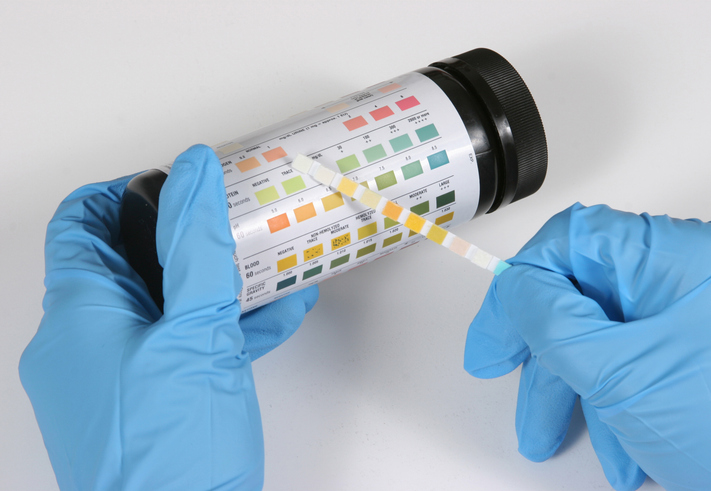
A urine dipstick test tests the urine using a special strip of paper that is dipped into a sample of urine. The result is available almost immediately. It is sometimes called a rapid urine test.
by Dr Philippa Vincent, MRCGP
Frequently asked questions
Why is an empty gut important before an IVU?
You may be asked not to eat for several hours before the procedure and might be given laxatives. This is done to ensure your intestines are clear of food and waste, which helps to produce clearer X-ray pictures of your urinary tract.
Can I leave immediately after the IVU procedure?
Yes, you should be able to go home as soon as the procedure is finished. You can also resume eating normally straight afterwards.
What is the small risk associated with X-rays during an IVU?
An intravenous urogram involves exposure to X-rays, which are a type of radiation. This carries a small, increased risk of developing cancer in the future. However, this additional risk is considered low, approximately equivalent to a year's worth of natural radiation exposure.
What are the common sensations I might experience during an IVU?
You might feel a flushing or warm sensation at the injection site when the contrast dye is administered. It's also common to experience a metallic taste in your mouth shortly after the injection.
Why would an IVU be a less preferred option than other scans?
Intravenous urography has largely been replaced by CT urography and MRI urography scans. These newer methods typically provide better images of the bladder, ureters, and kidneys. However, IVU is still used in situations where CT or MRI scans are not available.
About the authorView full bio

Dr Doug McKechnie, MRCGP
Medical Writer
MA, MBBS, MSc, DRCOG, MRCP(UK), MRCGP(2021), FHEA
Dr Doug McKechnie is an NHS GP working in London. He works full-time clinically and is also the Deputy Lead for the Clinical and Professional Practice module at University College London Medical School.
About the reviewerView full bio

Dr Hayley Willacy, FRCGP
General Practitioner, Medical Author
MBChB (1992), DRCOG, DFFP, MRCOG (Part 1) MRCGP (2007), DFSRH (2013), MSc - medical education (2020)
Dr Hayley Willacy was an NHS GP working in northwest England, who retired from clinical practice in 2022 after 30 years.
Article history
The information on this page is written and peer reviewed by qualified clinicians.
Article also available in English, German, Spanish, French, Italian, Portuguese, Hindi, Hebrew, Arabic, and Swedish.
Next review due: 29 Oct 2028
31 Oct 2023 | Latest version
Join the conversation
Share your thoughts or experiences with others in our patient communities.

Ask, share, connect.
Browse discussions, ask questions, and share experiences across hundreds of health topics.

Feeling unwell?
Assess your symptoms online for free
Sign up to the Patient newsletter
Your weekly dose of clear, trustworthy health advice - written to help you feel informed, confident and in control.
By subscribing you accept our Privacy Policy. You can unsubscribe at any time. We never sell your data.
More in tests and investigations
- Amniocentesis
- Antibody and antigen tests
- Blood glucose test (blood sugar) and HbA1c
- Cardiac catheterisation
- Cardiac enzymes
- Cervical screening
- Chorionic villus sampling
- CT colonography
- Exercise Tolerance Testing
- Gallium scan
- Gastroscopy
- Hearing tests
- Hysteroscopy
- Ketones in urine
- Nerve conduction studies
- Newborn physical examinations
- Newborn screening test
- Proteinuria
- Urine dipstick test
- Voiding cystourethrogram