Test del Synacthen
Revisione paritaria di Dr Toni Hazell, FRCGPUltimo aggiornamento di Dr Philippa Vincent, MRCGPUltimo aggiornamento 28 Lug 2023
Rispetta le linee guida editoriali
- ScaricaScarica
- Condividi
- Language
- Discussione
- Versione audio
- Aggiungi alle fonti preferite su Google
A synacthen test checks the function of the adrenal glands. It can help to see whether the adrenal glands are producing enough steroid hormone (cortisol).
Nota: the information below is a general guide only. The arrangements, and the way tests are performed, often vary between different hospitals. Always follow the instructions given by your doctor or local hospital.
A colpo d'occhio
A synacthen test checks how well your adrenal glands produce the hormone cortisol.
It involves an injection of a chemical called tetracosactide, which stimulates the adrenal glands.
Blood samples are taken before and after the injection to measure cortisol levels.
This test can help to diagnose conditions like Addison's disease.
You may need to stop certain medications before the test, such as some steroids or hormone therapy.
The test cannot be used if you are pregnant or have had a previous reaction to synacthen.
What is a synacthen test?
A synacthen test uses a special chemical to test how well the adrenal glands make a chemical (hormone) called cortisol. It involves stimulating the adrenal glands and then checking to see if they respond. Synacthen is another name for tetracosactide, the chemical used in the test.
How does a synacthen test work?
During the synacthen test a chemical called tetracosactide is given (synacthen is the commercial name of this chemical). Tetracosactide is a chemical copy of ACTH.
ACTH is the chemical (hormone) released by the pituitary gland which stimulates the adrenal glands to produce cortisol. If the adrenal glands are working properly they should respond to the tetracosactide by producing cortisol. Levels of cortisol are checked by taking a blood sample.
If levels of cortisol remain low, despite the tetracosactide injection, this suggests there is a problem with the function of the adrenal glands. See the separate leaflet called Addison's Disease for more details.
What happens during a synacthen test?
A synacthen test can be carried out in several different ways. Your local hospital will tell you how the test is to be carried out.
It is usual to be asked to come into hospital first thing in the morning. Here a sample of blood will be taken to see how much cortisol is present before the adrenals are stimulated. A small needle called a cannula may be put into a vein in the back of your hand. This allows doctors to take blood samples and give the tetracosactide.
An injection of tetracosactide will then be given, either into a vein via the cannula or sometimes into a muscle.
In the so-called 'short synacthen test' (which is the usual test), a sample of blood will be taken again approximately 30 minutes after receiving the injection of tetracosactide. This is to measure the levels of cortisol in the blood to see if the adrenals have responded to the tetracosactide.
Less commonly, a 'long synacthen test' is used. In this type of test, a blood sample is given at the start of the test. After the injection of tetracosactide, blood samples are taken at regular intervals over a 24-hour period.
What is a synacthen test used for?
A synacthen test is used to check the function of the adrenal glands. It can also give doctors information about how your hypothalamus, pituitary and adrenal glands work together. The test may also be used to diagnose Morbo di Addison.
A one-off measurement of blood cortisol is not accurate enough to diagnose Addison's disease as it may be low from time to time in normal people.
What are the adrenal glands?
The adrenal glands are endocrine glands. This means they make and release (secrete) hormones. Hormones are chemicals which are released into the bloodstream. They act as messengers, affecting cells and tissues in distant parts of the body. The adrenal glands produce hormones which help to control a number of the body's functions.
Where are the adrenal glands found?
There are two adrenal glands, one of which is found just above each kidney. About the size of a walnut, each adrenal gland has an outer part (adrenal cortex) and an inner part (adrenal medulla). Cells in different parts of the adrenal glands make different chemicals (hormones).
What do the adrenal glands do?
Cells in the outer part of the adrenal glands (the adrenal cortex) make the chemicals (hormones) cortisol, aldosterone and androgens.
Cortisol is a steroid hormone and is vital for health. It has many functions which include:
Aiutare a regolare la pressione sanguigna.
Aiutare a regolare il sistema immunitario.
Aiutare il corpo a rispondere allo stress.
Helping to balance insulin in regulating blood sugar (glucose) level.
Aldosterone is a hormone which also helps to regulate blood pressure by helping to regulate the salt and water balance in the body.
Androgens are hormones such as testosterone. These hormones contribute to growth and reproduction in men and women.
How do the adrenal glands work?
Each adrenal chemical (hormone) is controlled in a different way.
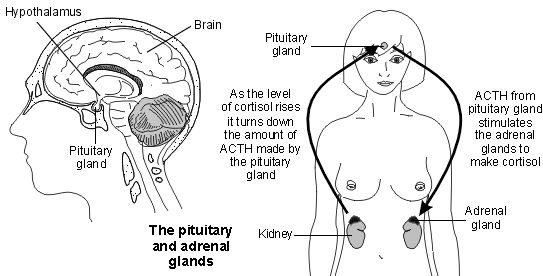
The release of cortisol is controlled by hormones produced by two parts of the brain - the hypothalamus and the pituitary. The hypothalamus receives input from the body about the state of many different bodily functions.
When the hypothalamus senses levels of cortisol are low, it releases a special hormone called corticotropin-releasing hormone (CRH). CRH travels to the pituitary gland via the connecting blood vessels. CRH stimulates the pituitary gland to release (secrete) adrenocorticotropic hormone (ACTH).
ACTH is released into the bloodstream and travels to the adrenal glands. Here ACTH causes cells within the outer part of the adrenal glands (the adrenal cortex) to make more cortisol.
High levels of cortisol stop the hypothalamus and pituitary gland from secreting more of their hormones. This system ensures that cortisol should only be made when the level of cortisol in the body is too low.
Ghiandole pituitaria e surrenali
What should I do to prepare for a synacthen test?
Usually there is very little preparation needed for a synacthen test. Your local hospital should give you more information if you need to do anything specific.
Are there any side-effects or complications from a synacthen test?
There are usually no side-effects from a synacthen test apart from a small bruise which may appear at the place where the needle was inserted. Rarely, the vein used to take the blood may become swollen; this usually settles within a few days.
Who cannot have a synacthen test?
This test cannot be used in someone who is pregnant or has had a reaction to synacthen in the past. It is usual to have to wait at least six weeks after having an operation on the pituitary gland before having this test.
Someone taking the pillola contraccettiva orale oppure terapia ormonale sostitutiva is usually asked to stop this six weeks before having the test. Steroid tablets should not usually be taken for 24 hours before this test. Topical steroids (via inhalers, nasal sprays or creams) should be discussed with the doctor requesting the synacthen test.
Scelte del paziente per Esami del sangue

Test e indagini
Gruppi sanguigni e tipi
ABO e rhesus sono entrambi tipi di antigeni presenti sulla superficie dei globuli rossi. Ci sono molti altri tipi, ma questi sono i più importanti.
di Dott.ssa Rosalyn Adleman, MRCGP

Test e indagini
Iponatriemia
L'iponatriemia è un basso livello di sodio nel sangue. I livelli di sodio nel sangue devono essere strettamente controllati. Diversi messaggeri chimici (ormoni) e organi sono coinvolti in questo processo. Ad esempio, gli ormoni coinvolti includono l'ormone antidiuretico e il cortisolo, e gli organi coinvolti includono il cervello e i reni. Esiste una relazione molto stretta tra il sodio nel corpo e i livelli di liquidi corporei.
di Dr Hayley Willacy, FRCGP
Domande frequenti
What is the purpose of the cannula line during the test?
A small needle, called a cannula, might be inserted into a vein, usually in the back of your hand. This device allows medical staff to conveniently take multiple blood samples and administer the tetracosactide injection without needing to insert a new needle each time.
Why is the synacthen test typically done first thing in the morning?
It is customary to be asked to arrive at the hospital in the morning for the test, allowing a baseline blood sample to be taken to measure your existing cortisol levels before the adrenal glands are stimulated.
How do the hypothalamus and pituitary glands relate to adrenal gland function?
The hypothalamus and pituitary glands, located in the brain, control the release of cortisol. The hypothalamus releases corticotropin-releasing hormone (CRH) when cortisol levels are low, which then signals the pituitary gland to release adrenocorticotropic hormone (ACTH). ACTH travels to the adrenal glands, prompting them to produce more cortisol.
How does the body stop producing too much cortisol?
The body has a built-in control system. When cortisol levels are high, they signal the hypothalamus and pituitary gland to stop releasing their hormones. This mechanism ensures that cortisol is only produced when the body's levels are too low, maintaining a balance.
Why can't a single blood cortisol measurement diagnose Addison's disease definitively?
A one-time measurement of blood cortisol is not sufficient for a definitive diagnosis of Addison's disease because cortisol levels can naturally be low sometimes even in healthy individuals. The synacthen test provides a more comprehensive assessment of adrenal function by stimulating the glands.
Ulteriori letture e riferimenti
- Ceccato F, Scaroni C; Central adrenal insufficiency: open issues regarding diagnosis and glucocorticoid treatment. Clin Chem Lab Med. 2019 Jul 26;57(8):1125-1135. doi: 10.1515/cclm-2018-0824.
- Butt MI, Alzuhayri N, Amer L, et al; Comparing the utility of 30- and 60-minute cortisol levels after the standard short synacthen test to determine adrenal insufficiency: A retrospective cross-sectional study. Medicine (Baltimore). 2020 Oct 23;99(43):e22621. doi: 10.1097/MD.0000000000022621.
Informazioni sull'autoreVisualizza il profilo completo

Dr Philippa Vincent, MRCGP
Medico di base, Autore medico
MB BS, Bsc, MRCGP (2000), DCH, DFSRH, DRCOG
Dr Philippa Vincent è un medico di base del NHS che lavora nel nord di Londra.
Informazioni sul recensoreVisualizza il profilo completo

Dr Toni Hazell, FRCGP
MBBS, BSc, FRCGP, DFSRH, Dip GU med, DRCOG, DCH (London, UK, 2000)
La Dott.ssa Toni Hazell si è laureata presso la St. Mary’s Hospital Medical School e ha completato il suo VTS al Northwick Park Hospital.
Storia dell'articolo
Le informazioni su questa pagina sono scritte e revisionate da clinici qualificati.
Articolo disponibile anche in Inglese, Tedesco, Spagnolo, Francese, Italiano, Portoghese, Hindi, Ebraico, Arabo, and Svedese.
Prossima revisione prevista: 26 lug 2028
28 Lug 2023 | Ultima versione

Chiedi, condividi, connettiti.
Esplora le discussioni, fai domande e condividi esperienze su centinaia di argomenti di salute.

Non ti senti bene?
Valuta i tuoi sintomi online gratuitamente
Iscriviti alla newsletter di Patient
La tua dose settimanale di consigli sulla salute chiari e affidabili - scritti per aiutarti a sentirti informato, sicuro e in controllo.
Abbonandoti accetti i nostri Informativa sulla Privacy. Puoi annullare l'iscrizione in qualsiasi momento. Non vendiamo mai i tuoi dati.