Esame clisma opaco
Revisione paritaria di Dr Toni Hazell, FRCGPUltimo aggiornamento di Dr Colin Tidy, MRCGPUltimo aggiornamento 23 Ago 2023
Rispetta le linee guida editoriali
- ScaricaScarica
- Condividi
- Language
- Discussione
- Ask Patient
- Versione audio
- Aggiungi alle fonti preferite su Google
Professionisti Medici
Gli articoli di riferimento professionale sono progettati per essere utilizzati dai professionisti della salute. Sono scritti da medici del Regno Unito e basati su prove di ricerca, linee guida del Regno Unito ed europee. Potresti trovare il Clisma opaco articolo più utile, o uno dei nostri altri articoli sulla salute.
Contesto
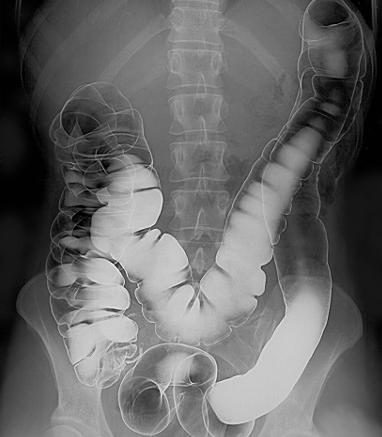
A barium enema is a rectal injection of barium contrast. This coats the lining of the colon and rectum and X-ray films are obtained under fluoroscopic control. Air introduced into the large bowel may be used to give a double-contrast technique. Barium enemas are performed much less often than in the past because of the increasing use of colonoscopy and CT colonography.
A small bowel barium enema refers to the use of a specially designed tube passed nasally and into the duodenojejunal flexure under fluoroscopic control, after which dilute barium is infused via the tube until it reaches the terminal ileum in continuous flow. It is used to investigate suspected small bowel disease (eg, morbo di Crohn, lymphoma) and malabsorption (eg, celiachia). It is an unpleasant procedure for the patient and is often now replaced by CT or ultrasound where possible.
This rest of this article refers to barium enema as used in the large bowel.
Intestinal tract barium enema
Indicazioni
To assess the anatomy of the large bowel and occasionally the terminal ileum.
Abnormalities detected include large bowel obstruction, tumours, ulcers, malattia diverticolare, inflammatory bowel disease, intussuscezione, Malattia di Hirschsprung and thickening of the lining of the colon or rectum.
A barium enema is not reliable for the diagnosis of rectal pathology.
Therapeutic uses
Conservative treatment with barium, air or saline enema is often effective in children who present with intussusception, unless diagnosis and treatment are delayed.
Barium enema may be effective in reducing large bowel volvulus in children but resection of the involved segment and primary anastomosis is the definitive treatment.
Refractory bleeding colonic diverticulae: high-dose barium enema is as effective as endoscopic haemostasis for the prevention of recurrent diverticular bleeding.1
Cautions and possible complications
Barium enema is uncomfortable for the patient and requires good patient mobility and co-operation. More patients find the procedure embarrassing than do patients having colonoscopy or CT colonography.2 It should not be requested for frail elderly patients unless there is a clear indication.
A rectal examination or sigmoidoscopy is essential to avoid missing abnormalities.
Radiation exposure is relatively low.
The barium enema is a relatively safe procedure. Rare complications include:3
Bowel perforation:
Occurs in between 2-4/10,000 patients, usually related to iatrogenic trauma from catheter placement.
Pre-existing diseased bowel is more likely to perforate than normal healthy bowel.4
The mortality rate associated with intraperitoneal perforation is high due to the combination of barium and bacterial load which causes acute peritonitis and shock.
Barium impaction - causes large bowel obstruction.
Water intoxication.
Reazioni allergiche.
Aritmie cardiache.
Prevention of endocarditis
Currently, antibacterial prophylaxis is fare affidamento recommended for the prevention of endocardite in those undergoing radiological procedures involving their lower gastrointestinal tract.5 Any infection in patients at risk of endocarditis should be investigated and treated promptly to reduce the risk of endocarditis. Patients at risk of endocarditis should be educated as to the signs of infective endocarditis and told to seek expert advice if these occur.
Controindicazioni
Allergy to the latex balloon on the tip of enema tube (rare).
Severe rectal inflammation or recent rectal biopsy (delay for seven days after a full-thickness biopsy). Patients with active colitis should not have a barium enema.
Acute gastrointestinal bleeding (precludes the use of angiography).
Pregnancy: X-rays of the abdomen and pelvis should be avoided.
Preparation and procedure
Low-residue diet for three days prior to the procedure and laxatives 24 hours before.
Nil by mouth after midnight.
Bowel washout immediately prior to procedure.
Antispasmodic (eg, hyoscine butylbromide) may be given to minimise spasm.
The patient lies on their side and an enema tube is inserted into the rectum.
Barium is run into the colon under gravity and radiographs are taken. Air is also then introduced into the rectum for a double-contrast barium enema.
Aggiornamenti esclusivi per i professionisti sanitari
Rimani informato con gli ultimi aggiornamenti clinici, approfondimenti professionali e linee guida basate su evidenze. La newsletter Patient Pro seleziona contenuti essenziali per i professionisti sanitari—consegnati direttamente nella tua casella di posta.
Abbonandoti accetti i nostri Informativa sulla Privacy. Puoi annullare l'iscrizione in qualsiasi momento. Non vendiamo mai i tuoi dati.
Ulteriori letture e riferimenti
- Fujimoto A, Sato S, Kurakata H, et al; Effectiveness of high-dose barium enema filling for colonic diverticular bleeding. Colorectal Dis. 2011 Aug;13(8):896-8. doi: 10.1111/j.1463-1318.2010.02350.x. Epub 2010 Jun 10.
- Von Wagner C, Knight K, Halligan S, et al; Patient experiences of colonoscopy, barium enema and CT colonography: a Br J Radiol. 2009 Jan;82(973):13-9. Epub 2008 Sep 29.
- de Feiter PW, Soeters PB, Dejong CH; Rectal perforations after barium enema: a review. Dis Colon Rectum. 2006 Feb;49(2):261-71.
- Yasar NF, Ihtiyar E; Colonic perforation during barium enema in a patient without known colonic Cases J. 2009 Aug 14;2:6716.
- Profilassi contro l'endocardite infettiva: Profilassi antimicrobica contro l'endocardite infettiva in adulti e bambini sottoposti a procedure interventistiche; Linee guida cliniche NICE (marzo 2008 - ultimo aggiornamento luglio 2016)
Informazioni sull'autoreVisualizza il profilo completo
Aggiornato da

Dr Colin Tidy, MRCGP
Medico di base, Autore medico
MBBS, MRCGP, MRCP (Paediatrics), DCH
Il Dr Colin Tidy è un medico del NHS, con sede nell'Oxfordshire.
Informazioni sul recensoreVisualizza il profilo completo

Dr Toni Hazell, FRCGP
MBBS, BSc, FRCGP, DFSRH, Dip GU med, DRCOG, DCH (London, UK, 2000)
La Dott.ssa Toni Hazell si è laureata presso la St. Mary’s Hospital Medical School e ha completato il suo VTS al Northwick Park Hospital.
Accesso semplice a trattamenti affidabili e servizi sanitari online.
Common conditions
Get help with common conditions through the NHS, without a GP appointment.
 Sinusite acuta
 Tonsillite batterica
 Impetigine
 Punture di insetti
 Fuoco di Sant'AntonioInfezioni delle vie urinarie (IVU)
Altro in gastroenterologia
- Acalasia
- Pancreatite acuta
- Campylobatteriosi
- Antigene carcinoembrionario
- Cirrosi
- Cancro colorettale
- Sindrome di Dubin-Johnson
- Malassorbimento gastrointestinale
- Epatite B
- Emocromatosi ereditaria
- Intussuscezione negli adulti
- Intolleranza al lattosio
- Mucopolisaccaridosi tipo I
- Ittero neonatale
- Norovirus
- Oesophageal spasm
- Stenosi esofagee, membrane e anelli
- Sindrome di Plummer-Vinson
- Proctalgia fugax e dolore anale
- Sanguinamento rettale nei bambini