Eritema multiforme
Revisione paritaria di Dr Doug McKechnie, MRCGPUltimo aggiornamento di Dr Philippa Vincent, MRCGPUltimo aggiornamento 14 Mar 2025
Rispetta le linee guida editoriali
- ScaricaScarica
- Condividi
- Language
- Discussione
- Ask Patient
- Versione audio
- Aggiungi alle fonti preferite su Google
Professionisti Medici
Gli articoli di riferimento professionale sono progettati per essere utilizzati dai professionisti della salute. Sono scritti da medici del Regno Unito e basati su prove di ricerca, linee guida del Regno Unito ed europee. Potresti trovare uno dei nostri articoli sulla salute più utile.
Contesto
Erythema multiforme (EM) is a skin condition due to an immune-mediated hypersensitivity reaction to infections or drugs.12 It presents as a dermatological eruption featuring iris or target lesions, although other forms of skin lesion can occur - hence the name. It is usually an acute, self-limiting disease that affects the skin. Mucosal lesions are present in 25% to 60% of patients with erythema multiforme.
EM must be distinguished from the rare but more serious and life-threatening conditions, sindrome di Stevens-Johnson (SJS) e necrolisi epidermica tossica (TEN).3
Epidemiologia2
Erythema multiforme can occur at any age but most commonly presents between the ages of 20 and 40. 20% of cases occur in children. Males are affected slightly more often than females with a ratio of 5:1. Erythema multiforme occurs equally in all ethnic groups. The prevalence is thought to be considerably lower than 1%.
Eziologia1 2
90% of cases of erythema multiforme are caused by infections.
Infezioni
Herpes simplex virus (HSV) 1 and 2 infections (account for >50% of cases).
Mycoplasma pneumonia infections.
Fungal infections.
Other viruses (varicella-zoster virus, cytomegalovirus, hepatitis C virus, and HIV).
Drug reactions
Barbiturates.
Penicillins.
Fenotiazine.
Sulfonamidi.
Anticonvulsivanti.
Farmaci antinfiammatori non steroidei.
Vaccinations (diphtheria-tetanus, hepatitis B, smallpox, covid-19).
Altre cause
Heavy metals.
Topical therapies.
Rimedi erboristici.
Poison ivy.
Presentazione1 2
Storia
There may be either no prodrome or a mild upper respiratory tract infection. The rash starts abruptly, usually within three days. It starts on the extremities, being symmetrical and spreading centrally.
There may be some mild burning or itching sensation but the skin is not tender.
Recurrent EM is thought to be usually due to reactivation of HSV.
Half of children with the rash have recent herpes labialis. It usually precedes the EM by 3 to 14 days but it can sometimes be present at the onset.
Esame
The iris or target lesion is the classical feature of the disease.
Initially, there is a dull red macule or urticarial plaque that enlarges slightly up to 2 cm over 24-48 hours. In the middle, a small papule, vesicle or bulla develops, flattens, and then may clear. The intermediate ring forms and becomes raised, pale and oedematous. The periphery slowly becomes violaceous and forms a typical concentric target lesion.
The lesions can expand to form plaques which are several centimetres in diameter.
Some lesions are atypical targets with only two concentric rings. Polycyclic or arcuate lesions may occur.
Eritema multiforme
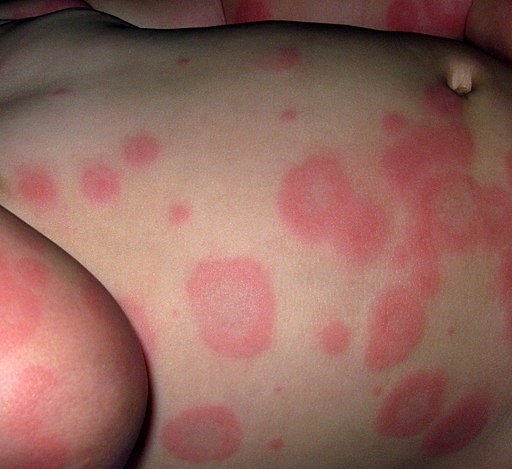
Eritema multiforme
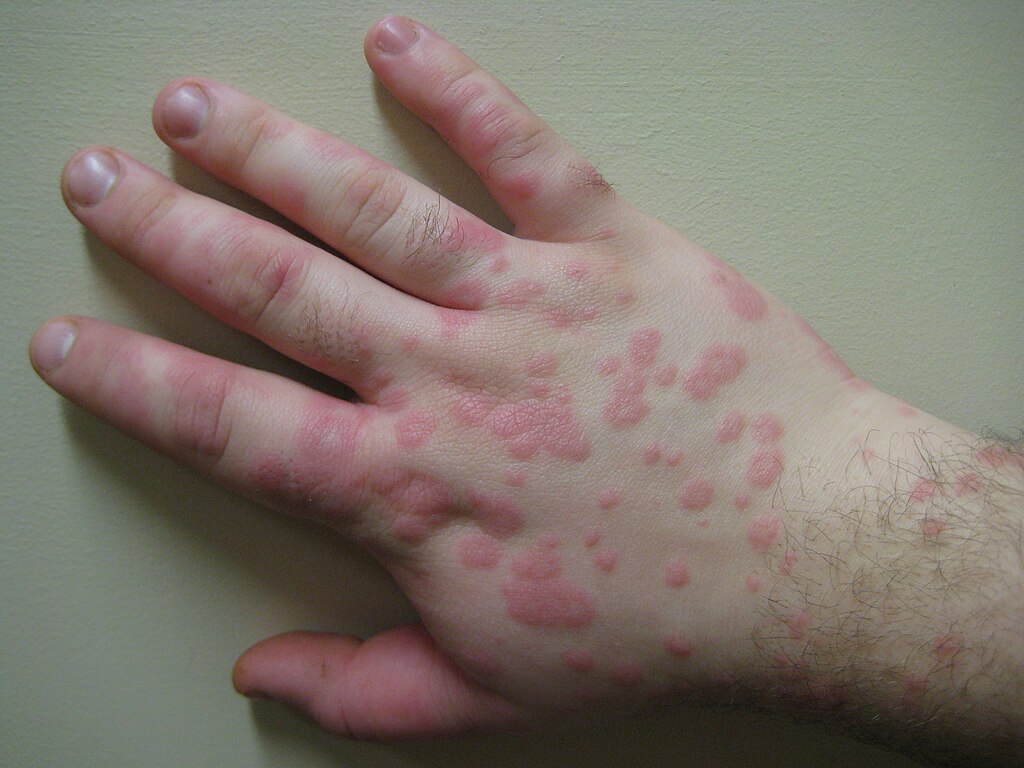
Köbner's phenomenon may occur. This lesion occurs along the line of previous skin trauma.
Lesions appear first on the extensor surfaces of the periphery and extend centrally. The palms, neck and face are often involved but the soles and flexures of the extremities less often.
There may be mucosal involvement. Whereas the skin lesions are painless, mucosal lesions are often painful. Oral lesions are most common with lips, palate and gingiva affected; urogenital and ocular membranes have also been known to have been affected.2
Occasionally the mucosal involvement is marked with few skin lesions.
Indagini
Usually, no specific investigations are indicated.
Skin biopsy can be indicated in an atypical presentation or where there is recurrent EM without an obvious trigger.
Investigations may be required to discover the underlying cause - eg, CXR, drug history, atypical pneumonia titres.
An FBC will often show moderate leukocytosis, eosinophilia, neutropenia, mild anaemia, and thrombocytopenia.
ESR may be elevated in severe cases.
CXR may show interstitial disease if the underlying cause is Mycoplasma pneumoniae.
If the diagnosis is unclear, a skin biopsy may be suggested.
Diagnosi differenziale4
SJS.
TEN.
Pemphigoid.
Gestione6
If a drug is thought to be responsible, it must be withdrawn. If an infection is suspected, it should be treated.
In recurrent disease due to HSV, antiviral therapy is beneficial.7
Symptomatic treatment may include analgesics, mouthwash and local skin care. Steroid creams may be used.
It may be helpful to emphasise to patients or parents that, although an underlying infection may be contagious, EM itself is not.
If the mouth is very sore, attention may have to be given to hydration and nutrition.
Dilute antiseptics, such as chlorhexidine, may help to prevent secondary infection. Lubricating drops for the eyes may be required.
Where erythema multiforme is severe and refractory, biologic agents such as thalidomide, anti-TNF, apremilast, rituximab, and JAK inhibitors have been shown to have some benefit.8
Complicazioni
Secondary infection of lesions may occur. Serious complications are unusual in an immunocompetent patient. A very sore mouth may lead to dehydration and poor nutrition. Genitourinary lesions may result in urinary retention. If the eye is involved it is important to prevent infection or conjunctival scarring.
Significant mucosal involvement indicates erythema multiforme major which is likely to required hospitalisation for supportive care.9
Prognosi1
Skin lesions usually heal without complication, but skin hyperpigmentation may occur. Some episodes of erythema multiforme have been documented to persist for up to five weeks, and recurrent and more persistent forms may occur. Mucosal lesions can lead to adhesions; in the case of ocular involvement this can result in blindness. 2
Aggiornamenti esclusivi per i professionisti sanitari
Rimani informato con gli ultimi aggiornamenti clinici, approfondimenti professionali e linee guida basate su evidenze. La newsletter Patient Pro seleziona contenuti essenziali per i professionisti sanitari—consegnati direttamente nella tua casella di posta.
Abbonandoti accetti i nostri Informativa sulla Privacy. Puoi annullare l'iscrizione in qualsiasi momento. Non vendiamo mai i tuoi dati.
Ulteriori letture e riferimenti
- Hafsi W, Badri T; Erythema Multiforme. StatPearls, 2021.
- Trayes KP, Love G, Studdiford JS; Erythema Multiforme: Recognition and Management. Am Fam Physician. 2019 Jul 15;100(2):82-88.
- Hafsi W, Badri T; Erythema Multiforme.
- Harr T, French LE; Necrolisi epidermica tossica e sindrome di Stevens-Johnson. Orphanet J Rare Dis. 2010 Dec 16;5:39.
- Trayes KP, Savage K, Studdiford JS; Annular Lesions: Diagnosis and Treatment. Am Fam Physician. 2018 Sep 1;98(5):283-291.
- Drug allergy: diagnosis and management of drug allergy in adults children and young people; NICE Clinical guideline (September 2014; updated November 2018).
- Soares A, Sokumbi O; Recent Updates in the Treatment of Erythema Multiforme. Medicina (Kaunas). 2021 Sep 1;57(9):921. doi: 10.3390/medicina57090921.
- Sladden MJ, Johnston GA; More common skin infections in children. BMJ. 2005 May 21;330(7501):1194-8.
- Eritema multiforme; E Kechichian et al, Science Direct
- Erythema Multiforme; DermNet
Informazioni sull'autoreVisualizza il profilo completo
Aggiornato da

Dr Philippa Vincent, MRCGP
Medico di base, Autore medico
MB BS, Bsc, MRCGP (2000), DCH, DFSRH, DRCOG
Dr Philippa Vincent è un medico di base del NHS che lavora nel nord di Londra.
Informazioni sul recensoreVisualizza il profilo completo

Dr Doug McKechnie, MRCGP
Scrittore Medico
MA, MBBS, MSc, DRCOG, MRCP(UK), MRCGP(2021), FHEA
Il dottor Doug McKechnie è un medico di base del NHS che lavora a Londra. Lavora a tempo pieno in ambito clinico ed è anche Vice Responsabile del modulo di Pratica Clinica e Professionale presso la Scuola di Medicina dell'University College London.
Accesso semplice a trattamenti affidabili e servizi sanitari online.
Common conditions
Get help with common conditions through the NHS, without a GP appointment.
 Sinusite acuta
 Tonsillite batterica
 Impetigine
 Punture di insetti
 Fuoco di Sant'AntonioInfezioni delle vie urinarie (IVU)
Altro in dermatologia
- Cheratosi attinica
- Balanite
- Cimici dei letti
- Dermatite artefattiva
- Dermatofitosi
- Herpes genitale simplex
- Punture e morsi di insetti
- Nevi intradermici e composti
- Lentigo
- Vivere con una malattia della pelle
- Filariasi linfatica
- Micetoma
- Disturbi e anomalie delle unghie
- Pompholyx
- Dermatite seborroica
- Fuoco di Sant'Antonio
- sindrome di Sturge-Weber
- Vene varicose
- Vasculite