Cimici dei letti
Revisione paritaria di Dr Hayley Willacy, FRCGP Ultimo aggiornamento di Dr Colin Tidy, MRCGPUltimo aggiornamento 17 Gen 2023
Rispetta le linee guida editoriali
- ScaricaScarica
- Condividi
- Language
- Discussione
- Versione audio
- Aggiungi alle fonti preferite su Google
Professionisti Medici
Gli articoli di riferimento professionale sono progettati per essere utilizzati dai professionisti della salute. Sono scritti da medici del Regno Unito e basati su prove di ricerca, linee guida del Regno Unito ed europee. Potresti trovare il Cimici dei letti articolo più utile, o uno dei nostri altri articoli sulla salute.
Bedbugs are blood-sucking insects which feed from humans. They often live in bedding, beds and in cracks and crevices of surrounding walls and furniture. They may cause skin reactions and psychological effects, but are not known to transmit disease.
Epidemiologia1
The increase in pyrethroid resistance, the ban of DDT, immigration and international travel, the increased population density in large cities, and a decrease in societal vigilance have led to an exponential rise in the incidence of bedbug infection.
Therefore, over the past decade or two, bedbugs have made a dramatic comeback and are increasingly common in homes, apartments, hotels, healthcare facilities and schools.
Eziologia2
The two main species of bedbugs are Cimex lectularius e Cimex hemipterus. Cimex lectularius are found in temperate areas. Cimex hemipterus are found in tropical zones.
Bedbugs are brownish, wingless, flattened insects, measuring around 2-5 mm in length.
They feed solely on the blood of animals. In addition to humans, they will also bite other warm-blooded animals (eg, dogs, cats and rodents).
They can actually survive for up to one year without eating. The ability to survive without a blood meal is longer at cooler temperatures. The adults can live for up to 18 months. They breed by laying eggs which hatch after around 10-20 days and take between 9-18 weeks to become adults. Females can lay around 300 eggs in their lifetime.
They are sometimes mistaken for ticks, cockroaches or carpet beetles. The immature bedbugs (nymphs) look much like the adults, other than being smaller and a lighter brown.
Bedbugs can crawl rapidly over floors, walls, ceilings and other surfaces. They cannot jump or fly. Bedbugs are inactive during the day, often hiding in dark places (eg, mattresses, bed frames, within plug sockets, in clothing or soft furnishings, in cracks and crevices of wooden furniture).
They live in both clean and dirty environments.
Bedbug on skin
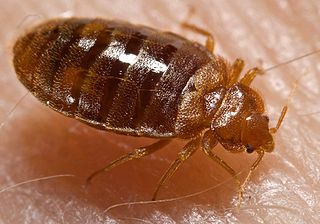
Presentazione2
As bedbugs feed at night and inject an anaesthetic when they bite, the initial bite is usually not felt and most patients have no reaction to them. The biting process takes up to ten minutes but the person being bitten is usually unaware of it. The symptoms following being bitten by bedbugs vary but include:
Little or no reaction. This is the case for most affected individuals.
Three to four bites forming a line or a curve on the body (usually areas exposed during sleeping such as face, neck, arms) are very suggestive of bedbug bites.
Isolated pruritus, papules or nodules can occur. Skin reactions most often start out as small macular lesions that can develop into wheals of around 5 cm in diameter. These are often intensely itchy.
Occasionally, bullous eruptions may occur.
Rarely, systemic reactions occur (eg, urticaria or even anaphylaxis).
The onset of symptoms may be delayed, due to delayed allergic reactions to the saliva of the bedbug (up to 11 days later).3
Bedbug bites on face
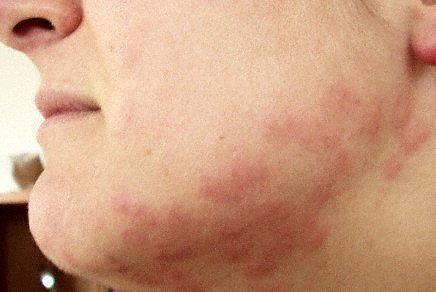
Diagnosi differenziale2
Bedbug bites may be mistaken for bites from fleas or bites from mosquitoes or other arthropods. Bites from fleas tend to be on lower legs or ankles.
Scabies. Scratching in patients with scabies is more often in the wrists, fingers and around the waistline.
Other dermatological conditions which may be similar include:
Eradication of bedbugs1
Control of infestation is difficult because of the ability of bedbugs to hide in furniture cracks and crevices, and their ability to survive long periods of time without feeding. The following non-chemical measures may be beneficial:4
Washing at 60°C or dry cleaning affected linen.
Tumble drying affected linen on a hot cycle for at least half an hour.
Freezing may also be effective; however, affected items must be kept frozen for at least one or two weeks.
Disposal of highly infested items, together with physical removal of bedbugs and mattress covers and vacuuming, are usually recommended.
Encasing mattresses in a protective covering (such as those used for people with allergies) may be an option; however, the seal needs to be tight, with no gaps in the encasement material.
Insecticides must be used only by professionals and it is recommended that expert guidance regarding eradication should always be sought.
Pyrethroids are the most commonly used insecticides for bedbug infestations.
Insect growth regulators and carbamates are also sometimes used. However, resistance to all types of insecticides has occurred. Therefore, a combination of insecticides is usually applied to all areas. Re-treatment may be indicated in some areas.
Carbon dioxide fumigation has been shown to be an effective alternative to conventional fumigants for eliminating bedbugs hiding in infested household items such as clothing, sofas, shoes and books.5 Fumigation for at least 24 hours is required.
Treatment of bedbug bites2
The symptoms of bedbug bites are often treated with topical steroids (such a hydrocortisone 1%) once or twice a day for up to seven days.
Antihistamines may be beneficial for those with pruritus.
Topical or systemic antibiotics may be necessary for those with secondary infection of their bites.
People with an infestation should be encouraged to contact a pest control expert as soon as the pest has been identified.
Patients should be instructed to avoid scratching to prevent infection.
Complicazioni
Secondary infection from scratching can occur.
Although bedbugs have been suspected of transmitting infectious agents (eg, hepatitis B, hepatitis C, HIV or meticillin-resistant Staphylococcus aureus (MRSA)), no report has yet actually demonstrated that they are infectious disease vectors.6
Sleep deprivation is common, with consequent social and health sequelae.7 In some individuals, psychological sequelae can result from bedbug biting events. These may include nightmares, flashbacks, hypervigilance (to keep the bugs away), insomnia and anxiety.8
Aggiornamenti esclusivi per i professionisti sanitari
Rimani informato con gli ultimi aggiornamenti clinici, approfondimenti professionali e linee guida basate su evidenze. La newsletter Patient Pro seleziona contenuti essenziali per i professionisti sanitari—consegnati direttamente nella tua casella di posta.
Abbonandoti accetti i nostri Informativa sulla Privacy. Puoi annullare l'iscrizione in qualsiasi momento. Non vendiamo mai i tuoi dati.
Ulteriori letture e riferimenti
- Goddard J, deShazo R; Bed bugs (Cimex lectularius) and clinical consequences of their bites. JAMA. 2009 Apr 1;301(13):1358-66. doi: 10.1001/jama.2009.405.
- Delaunay P; Human travel and traveling bedbugs. J Travel Med. 2012 Dec;19(6):373-9. doi: 10.1111/j.1708-8305.2012.00653.x. Epub 2012 Sep 24.
- Adelman ZN, Miller DM, Myles KM; Bed bugs and infectious disease: a case for the arboviruses. PLoS Pathog. 2013 Aug;9(8):e1003462. doi: 10.1371/journal.ppat.1003462. Epub 2013 Aug 15.
- Bed bugs; British Pest Control Association (BPCA)
- Ibrahim O, Syed UM, Tomecki KJ; Bedbugs: Helping your patient through an infestation. Cleve Clin J Med. 2017 Mar;84(3):207-211. doi: 10.3949/ccjm.84a.15024.
- Bernardeschi C, Le Cleach L, Delaunay P, et al; Bed bug infestation. BMJ. 2013 Jan 22;346:f138. doi: 10.1136/bmj.f138.
- Reinhardt K, Kempke D, Naylor RA, et al; Sensitivity to bites by the bedbug, Cimex lectularius. Med Vet Entomol. 2009 Jun;23(2):163-6. doi: 10.1111/j.1365-2915.2008.00793.x. Epub 2009 Mar 9.
- Naylor RA, Boase CJ; Practical solutions for treating laundry infested with Cimex lectularius (Hemiptera: Cimicidae). J Econ Entomol. 2010 Feb;103(1):136-9.
- Wang C, Lu L, Xu M; Carbon dioxide fumigation for controlling bed bugs. J Med Entomol. 2012 Sep;49(5):1076-83.
- Delaunay P, Blanc V, Del Giudice P, et al; Bedbugs and infectious diseases. Clin Infect Dis. 2011 Jan 15;52(2):200-10. doi: 10.1093/cid/ciq102.
- Doggett SL, Dwyer DE, Penas PF, et al; Bed bugs: clinical relevance and control options. Clin Microbiol Rev. 2012 Jan;25(1):164-92. doi: 10.1128/​CMR.05015-11.
- Goddard J, de Shazo R; Psychological effects of bed bug attacks (Cimex lectularius L.). Am J Med. 2012 Jan;125(1):101-3. doi: 10.1016/j.amjmed.2011.08.010.
Informazioni sull'autoreVisualizza il profilo completo
Aggiornato da

Dr Colin Tidy, MRCGP
Medico di base, Autore medico
MBBS, MRCGP, MRCP (Paediatrics), DCH
Il Dr Colin Tidy è un medico del NHS, con sede nell'Oxfordshire.
Autore

Dr Louise Newson, MRCGP
BSc (Hons) Pathology, MB, ChB (Hons), MRCP, MRCGP, DFFP, FRCGP
Louise si è laureata all'Università di Manchester nel 1994 ed è un medico di base ed esperta di menopausa a Solihull, West Midlands.
Informazioni sul recensoreVisualizza il profilo completo

Dr Hayley Willacy, FRCGP
Medico di base, Autore medico
MBChB (1992), DRCOG, DFFP, MRCOG (Part 1) MRCGP (2007), DFSRH (2013), MSc - medical education (2020)
La Dott.ssa Hayley Willacy era un medico di base del NHS che lavorava nel nord-ovest dell'Inghilterra, e si è ritirata dalla pratica clinica nel 2022 dopo 30 anni.
Storia dell'articolo
Articolo disponibile anche in Inglese, Tedesco, Spagnolo, Francese, Italiano, Portoghese, Hindi, Ebraico, Arabo, and Svedese.
Prossima revisione prevista: 16 Gen 2028
17 Gen 2023 | Ultima versione
21 Feb 2013 | Pubblicato originariamente
Autore:
Dr Louise Newson, MRCGP

Chiedi, condividi, connettiti.
Esplora le discussioni, fai domande e condividi esperienze su centinaia di argomenti di salute.

Non ti senti bene?
Valuta i tuoi sintomi online gratuitamente
Altro in dermatologia
- Farmaci antifungini
- Nevo di Becker
- Pemfigoide bolloso
- Varicella
- Pemfigo cicatriziale
- Filariasi cutanea
- Dermatite erpetiforme
- Erythema chronicum migrans
- Psoriasi pustolosa generalizzata
- Nevo di Halo
- Lichen simplex
- Necrobiosi lipoidica
- Lesioni pigmentate della pelle
- Malattia ungueale psoriasica
- Scarlattina
- Noduli cutanei e sottocutanei
- Porpora trombotica trombocitopenica
- Ippocratismo digitale
- Sindrome delle unghie gialle