Orecchie e volo
Aeroplane ear
Revisione paritaria di Dr Philippa Vincent, MRCGPUltimo aggiornamento di Dr Doug McKechnie, MRCGPUltimo aggiornamento 23 giu 2024
Rispetta le linee guida editoriali
- ScaricaScarica
- Condividi
- Language
- Discussione
- Versione audio
- Aggiungi alle fonti preferite su Google
In questa serie:Consigli sanitari per viaggi all'esteroViaggiare verso località remoteJet lagChinetosiMal di montagna
Aeroplane ear, or the feeling of blocked or painful ears while flying, is caused by pressure changes. Usually your ears will settle soon after landing. Occasionally pain or a feeling of blockage drags on; if it does, see your doctor.
A colpo d'occhio
Aeroplane ear is pain or discomfort when flying due to unequal air pressure in your ear.
It usually happens when the plane is descending and often improves after landing.
Eustachian tubes, which connect your middle ear and nose, help to equalise air pressure.
Swallowing, yawning, chewing, or gently blowing with a closed mouth can help to relieve symptoms.
Over-the-counter medicines or earplugs may also help if you are prone to aeroplane ear.
You should see a doctor if your ear pain or dulled hearing does not clear within a few days.
What is aeroplane ear?
Aeroplane ear refers to the pain and discomfort that some people experience when flying on an aeroplane. It occurs when the air pressure in your middle ear and the air pressure in the environment are out of balance.
This happens as the plane descends to land. The pain may get worse the lower the plane gets and can be quite severe on landing. The pain usually goes away soon after landing.
It's all due to pressure changes. As the plane starts to lose height, the pressure in the air around you changes. Until the pressure inside the tubes behind your eardrum adapts, the pressure inside and outside your ear is different. This pushes the eardrum in, stretching it and giving you pain.
Aeroplane ear is a mild and temporary form of ear barotrauma.
Does aeroplane ear happen to everyone?
The pressure change is happening to everyone, but in some people the pain or blockage is worse than others - some may not feel it at all. In particular, if you are congested (because of a cold or allergies such as hay fever), it is harder for your ears to adapt. If this is the case, you may be more aware of pain or blocked ears than the person sitting next to you.
What causes aeroplane ear?
The pain is caused by unequal pressure that develops between the air in the middle ear and the air outside the ear during takeoff and landing.
Ear cross-section diagram: pressure build-up during flying
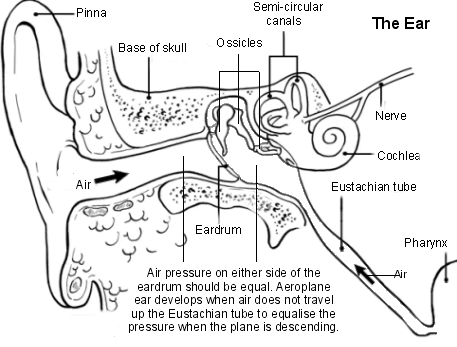
The small space in the middle ear behind the eardrum is normally filled with air. This air space is connected to the back of the nose by a tiny channel called the Eustachian tube. The air on either side of the eardrum should be at the same pressure.
Air pressure is highest nearer the ground. So as a plane descends, the air pressure becomes higher. This pushes the eardrum inwards which can be painful. To relieve this, the pressure in the middle ear has to rise quickly too. Air needs to travel up the Eustachian tube into the middle ear to equalise the pressure.
What is the treatment for aeroplane ear?
Ideally, anyone with an infezione all'orecchio, cold or respiratory infection, etc, should not fly. However, some people may feel that they need to fly anyway as the reason for the trip is so important.
The following may help people who develop ear pain when flying.
Suck sweets or chew chewing gum
Do this when the plane begins to descend. Air is more likely to flow up the Eustachian tube if you swallow, yawn or chew. For babies, it is a good idea to feed them or give them a drink or dummy at the time of descent to encourage them to swallow.
Valsalva manoeuvre
Try doing the following: take a breath in. Then, try to breathe out gently with your mouth closed and whilst pinching your nostrils shut (the Valsalva manoeuvre). In this way, no air is blown out but you are gently pushing air into the Eustachian tube.
If you do this you may feel your ears go 'pop' as air is pushed into the middle ear. This often cures the problem. Repeat this every few minutes until landing - whenever you feel any ear discomfort.
Stay awake when the plane is descending to land
Ask the air steward or stewardess to wake you when the plane starts to descend. If you are awake you can make sure that you suck and swallow to encourage air to get into the middle ear.
The above usually works for most people. However, if you are particularly prone to develop aeroplane ear, you may wish also to consider the following in addition to the tips above:
Compresse di antistaminico (available at pharmacies). Take the recommended dose the day before and the day of travel. This may help to limit the amount of mucus that you make.
Decongestant tablets or syrup. For example, a medication called pseudoephedrine. This can be obtained from a pharmacy, without a prescription. Take the dose recommended half an hour before take-off, and if necessary repeat according to the instructions.
Decongestant nasal sprays and drops are sometimes recommended, but there is little evidence that they are effective.
Air pressure-regulating ear plugs. These are cheap, reusable ear plugs that are often sold at airports and in many pharmacies. These ear plugs slow the rate of air pressure change on the eardrum.
Blowing up a special balloon. Products such as Otovent® are balloons which you blow up through your nose, by blocking off one nostril at a time and blowing through the other. These can be bought from pharmacies, and some people find they help stop the pain during flying or unblock ears afterwards.
Take paracetamol
If the measures above fail to help, although the pain may be severe, it normally goes quickly. If it does not settle, take painkillers such as paracetamolo until it does go.
You should see a doctor if the pain or dulled hearing does not clear within a few days.
How can I help my child?
Kids are also going to get these pressure changes in their ears, and there is invariably a baby bawling as the plane starts to descend and they notice their ears start to hurt.
You can help babies and young children by:
Feeding your baby with a bottle
This as the sucking and swallowing action will help equalise the pressures for them.
Encouraging them to suck a dummy
Sucking on a dummy (pacifier) may have the same effect as feeding a baby.
Give them a sweet to suck
Avoid boiled sweets in very young children because of the choking risk, but in older kids this may be a remedy which will make you a popular parent.
Have them drink from a straw sports bottle
A drink which has a straw or which is in a sports bottle might also be useful as it encourages the sucking action as with the other methods.
Give them paracetamol or ibuprofen
If your child has a cold and is therefore likely to have more of a problem on the flight, a dose of paracetamol or ibuprofene an hour before landing might make for a more peaceful flight.
Some of the measures described above may be helpful, but decongestants are not generally recommended for children.
Are there any complications of aeroplane ear?
Complications are extremely unusual, or millions of people wouldn't be flying on a regular basis. Very occasionally, the eardrum can be put under so much pressure that it bursts (perforates), leaving a hole in the eardrum. If this does happen, the pain usually goes away immediately. Perforated eardrums usually heal well without any treatment.
Can I fly with an ear infection?
It is advisable NOT to fly if you have an ear infection, such as otite media oppure otite esterna If you do fly, the pain in your ear may be worse and it may take longer to settle. You may be more likely to have a perforated eardrum.
If you absolutely do have to fly with an ear infection and cannot delay your travel or go by an alternative mode of transport, decongestant medicines may help prevent problems. (These are not suitable for children under the age of 6 years, and only with the advice of a pharmacist for children aged 6-12 years.) It may also be worth taking regular painkillers such as paracetamolo oppure ibuprofene during the flight.
Scelte del paziente per Travel related problems

Viaggi e vaccinazioni
Mal di montagna
Il mal di montagna può colpire le persone che scalano o viaggiano (ascendono) a più di 2500 metri (8.000 piedi) di altitudine, in particolare se ascendono troppo rapidamente.
di Dr Philippa Vincent, MRCGP

Viaggi e vaccinazioni
Chinetosi
Il mal di movimento (mal di viaggio) è comune, specialmente nei bambini. È causato da movimenti ripetuti durante il viaggio che inviano segnali forti (a volte confusi) ai sensori di equilibrio e posizione nel cervello.
di Dr Philippa Vincent, MRCGP
Domande frequenti
Can flying cause ear infections?
No, flying itself does not typically cause ear infections. However, the pressure changes during a flight can exacerbate existing conditions like colds or allergies, making aeroplane ear more noticeable and potentially more painful if you are already congested or have an underlying ear problem.
Can aeroplane ear lead to permanent hearing loss?
Aeroplane ear is a temporary condition, and complications are extremely rare. Permanent hearing loss is not a typical outcome. Very occasionally, severe pressure can cause the eardrum to burst, but these usually heal without long-term issues.
Are there any long-term effects if I frequently experience aeroplane ear?
The article does not suggest any long-term effects from frequently experiencing aeroplane ear. The condition is generally mild and temporary, with pain usually subsiding soon after landing.
Is it safe to fly with a blocked ear that isn't due to an infection?
If your ear is blocked due to congestion from a cold or allergies, flying can make the discomfort worse because it's harder for your ears to adapt to pressure changes. However, the article does not indicate that flying with uncongested but blocked ears is inherently unsafe, but rather that it can lead to more noticeable pain or blockage.
Ulteriori letture e riferimenti
- Wright T; Middle-ear pain and trauma during air travel. BMJ Clin Evid. 2015 Jan 19;2015. pii: 0501.
- Ryan P, Treble A, Patel N, et al; Prevention of Otic Barotrauma in Aviation: A Systematic Review. Otol Neurotol. 2018 Jun;39(5):539-549. doi: 10.1097/MAO.0000000000001779.
Informazioni sull'autoreVisualizza il profilo completo

Dr Doug McKechnie, MRCGP
Scrittore Medico
MA, MBBS, MSc, DRCOG, MRCP(UK), MRCGP(2021), FHEA
Il dottor Doug McKechnie è un medico di base del NHS che lavora a Londra. Lavora a tempo pieno in ambito clinico ed è anche Vice Responsabile del modulo di Pratica Clinica e Professionale presso la Scuola di Medicina dell'University College London.
Informazioni sul recensoreVisualizza il profilo completo

Dr Philippa Vincent, MRCGP
Medico di base, Autore medico
MB BS, Bsc, MRCGP (2000), DCH, DFSRH, DRCOG
Dr Philippa Vincent è un medico di base del NHS che lavora nel nord di Londra.
Storia dell'articolo
Le informazioni su questa pagina sono scritte e revisionate da clinici qualificati.
Articolo disponibile anche in Inglese, Tedesco, Spagnolo, Francese, Italiano, Portoghese, Hindi, Ebraico, Arabo, and Svedese.
Prossima revisione prevista: 22 giu 2027
23 giu 2024 | Ultima versione

Chiedi, condividi, connettiti.
Esplora le discussioni, fai domande e condividi esperienze su centinaia di argomenti di salute.

Non ti senti bene?
Valuta i tuoi sintomi online gratuitamente
Iscriviti alla newsletter di Patient
La tua dose settimanale di consigli sulla salute chiari e affidabili - scritti per aiutarti a sentirti informato, sicuro e in controllo.
Abbonandoti accetti i nostri Informativa sulla Privacy. Puoi annullare l'iscrizione in qualsiasi momento. Non vendiamo mai i tuoi dati.