Dermatite periorale
Revisione paritaria di Dr Toni Hazell, MRCGPUltimo aggiornamento di Dr Doug McKechnie, MRCGPUltimo aggiornamento 4 Ago 2024
Rispetta le linee guida editoriali
- ScaricaScarica
- Condividi
- Language
- Discussione
- Versione audio
La dermatite periorale è un'eruzione cutanea comune. Periorale significa 'intorno alla bocca' e dermatite si riferisce a un'infiammazione della pelle. Questo opuscolo illustra le cause potenziali, i sintomi e il trattamento della dermatite periorale.
In questo articolo:
Video picks for Cura orale e problemi
Continua a leggere sotto
What is perioral dermatitis?
Perioral dermatitis is a skin disorder that presents as a rash around the mouth - the word 'perioral' meaning 'around the mouth', and 'dermatitis' meaning 'inflammation of the skin'. Less commonly, it can affect the skin around the eyes and nose, which is sometimes called periorificial dermatitis. It is a type of dermatitis on the face only.
What does perioral dermatitis look like?
Torna ai contenutiTypically, small red or pink lumpy spots develop on the skin anywhere around the outside of the mouth. These bumps around the mouth can resemble acne spots but perioral dermatitis is not acne. They can also look like eczema around the mouth, or a rash next to the mouth.
The skin under and next to each spot is often red or pink. If there are a lot of spots next to each other then the area of affected skin can just look red and lumpy. Sometimes the skin surface can become dry and flaky.
Dermatite periorale
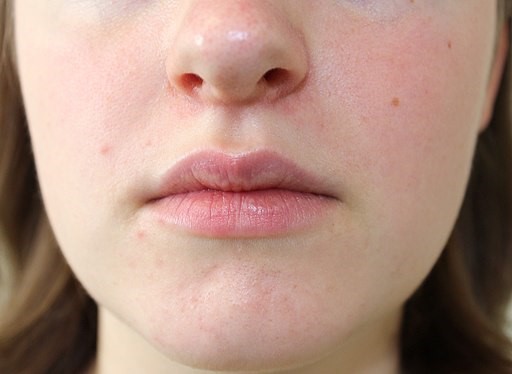
© Johannes Köhler, CC BY-SA 4.0, via Wikimedia Commons
The skin just next to the lips is often not affected, or is affected much less than, the skin just a little further away from the lips. In some cases it can look as though the rash almost forms a ring around the mouth, sparing a small border of skin next to the lips. Occasionally, the skin around the eyes is also affected.
The severity of the rash can vary from a few minor spots that are barely noticeable, to a definite and obvious lumpy rash that is around the mouth. The rash is not usually painful or itchy. However, some people report a mild burning sensation or itchy feeling. Others report that the affected skin feels tense. The rash is not serious and is not associated with any underlying disease. However, it can be unsightly.
Continua a leggere sotto
What causes perioral dermatitis?
Torna ai contenutiThe exact cause is not clear. However, in many cases the rash seems to be triggered by one or more of the following:
Steroid creams and ointments are a main trigger. See below for details.
Make-up, cleansers and cosmetics applied to the area affected on the face. It may be that certain ingredients of cosmetics may act as the trigger. For example, one study found that make-up foundation seemed to be a particular provoking factor.
Physical factors such as strong winds and UV light.
Fluoridated toothpaste and chewing gum have been suggested as possible triggers.
Yeasts and germs (bacteria) that live on the skin and in hair follicles have been suggested as a possible trigger. (However, perioral dermatitis is not just a simple skin infection.)
Hormone factors may play a part, as some women find that the rash becomes worse just before a period.
Il pillola contraccettiva orale may be a factor in some cases.
Recently, a study has found that some sun creams used on the face may be a trigger for perioral dermatitis in some children and adults. A liquid, gel or light milk sunscreen may be the best to use.
Lip-licking dermatitis
Torna ai contenutiLip-licking dermatitis is very similar to peri-oral dermatitis but tends not to spare any skin next to the lips so spreads out directly from the lips. It is more common in children, particularly those who habitually lick their lips. The mainstay of treatment is to avoid licking the lips and using bland lip balms such as Vaseline® to cover the skin. However, topical steroids can be used in lip-licking dermatitis and do have some benefit at times.
Lip-licking dermatitis
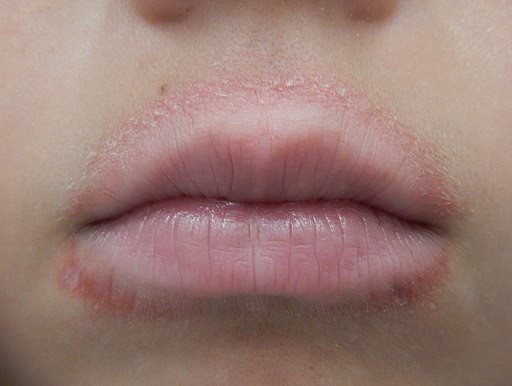
© James Heilman, MD, CC BY-SA 4.0, via Wikimedia Commons
Continua a leggere sotto
Who gets perioral dermatitis?
Torna ai contenutiThere are a number of risk factors for perioral dermatitis. Almost all cases occur in young women, most commonly between the ages of 15 and 45 years. It is thought to affect up to 1 in 100 women at some point in their lives. Perioral dermatitis is uncommon in men and children (although lip-licking dermatitis is much more common in children). However, as the number of men using facial skin products increases, the number of men with perioral dermatitis is increasing.
Is perioral dermatitis contagious?
Torna ai contenutiNo. Perioral dermatitis is not contagious.
Perioral dermatitis caused by steroid cream
Torna ai contenutiCrema steroidea
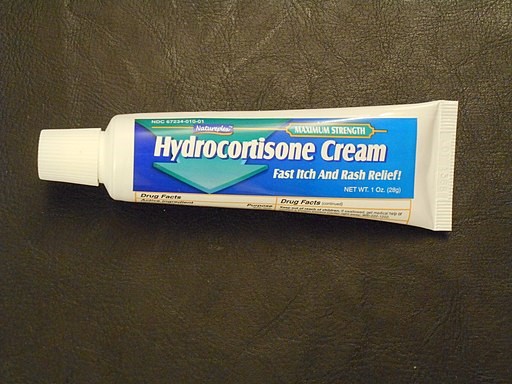
© Father Goose, CC BY-SA 4.0, via Wikimedia Commons
Using a steroide topico (steroid creams, gels, ointments, etc) on the face can cause people to develop perioral dermatitis. Many cases develop soon after using a topical steroid on the face for another condition, such as mild eczema.
It is also possible to rub some steroid onto the face without realising it - for example, after using steroid creams on another part of the body and then rubbing or scratching the face before washing the hands.
Topical steroids can temporarily clear a mild patch of perioral dermatitis. Some people will have tried a steroid cream, which can be bought at pharmacies, to treat what they think is mild eczema. However, as soon as the rash clears and the steroid is stopped, the rash reappears, only even worse. This can become a vicious cycle where more steroid cream is used to try to clear the new rash, which may clear again and then recur so the cream is started again. The rash tends to get worse each time.
How is perioral dermatitis diagnosed?
Torna ai contenutiLa diagnosi di dermatite periorale può di solito essere fatta da un medico osservando l'aspetto della pelle. Non ci sono molte altre condizioni che assomigliano a questa, ma ci sono alcune altre patologie con cui può essere confusa:
Lip-licking dermatitis.
Tests are usually not needed unless perioral dermatitis does not improve with treatment. If it is not improving or has unusual features, a referral to a dermatology specialist may be made who may consider other tests such as a skin biopsy.
Perioral dermatitis treatment
Torna ai contenutiWithout perioral dermatitis treatment, the condition may last for months or years. The following treatments can usually help to clear the rash. However, it may take some time for the treatment to work.
Stop using anything on your face
It is usually advised to stop using any cream, ointment, cosmetic, etc, on the face. It is particularly important to stop using any topical steroid - if one has been used then the rash will worsen for several days before it gets any better. There is nothing that can be done to help this. Whilst the rash is present, wash your face with warm water only. There is some evidence that toothpastes containing fluoride can make perioral dermatitis worse so these should be avoided too.
If using topical steroids on another part of the body or applying them to a child, it is important to wash hands thoroughly after using them to prevent perioral dermatitis.
Even when the rash has gone, it is better to try to avoid cosmetics or creams on the affected area as the rash can reappear. Using mild skincare products such as a fragrance free cleanser to wash the face, rather than soap, is also advised.
Medicinali antibiotici
In mild perioral dermatitis, topical antibiotics (antibiotics in a cream applied to the skin), such as metronidazolo oppure clindamycin, might be advised as part of the treatment plan.
Usually oral antibiotics, in the tetracycline group, are needed. The course of treatment is usually for six to twelve weeks and it may take several weeks to notice the benefit. Most cases do start to improve within two months of starting treatment so it is important to persevere.
The way antibiotics work in this condition is not clear. It is not a simple skin infection. However, tetracyclines and some other antibiotics have an action to reduce inflammation in addition to killing germs (bacteria) and this may be why they work.
Altri trattamenti
Other perioral dermatitis treatment is sometimes used. This includes crema di pimecrolimus. This cream works to reduce skin inflammation. It seems to be particularly effective in perioral dermatitis that has been caused by using topical steroids.
When should you see a doctor?
Torna ai contenutiWhere there is a suspicion of perioral dermatitis all ointments and creams on the face should be stopped. This alone may improve the condition. However, it's best to see a GP or other clinician in the practice to make a diagnosis of the condition if it does not settle or is very angry-looking.
Patient picks for Cura orale e problemi

Cura orale e dentale
Oral thrush
La candidosi orale è un'infezione nella bocca causata da un fungo lievito chiamato candida. Di solito non è grave e può essere eliminata facilmente con un trattamento.
di Dr Philippa Vincent, MRCGP

Cura orale e dentale
Cura della bocca
Questa brochure è rivolta a persone a rischio di sviluppare problemi alla bocca come secchezza, infezione da mughetto (mughetto orale), alito cattivo, infiammazione e ulcere orali. Ciò include persone malate di gravi malattie o che stanno ricevendo chemioterapia o radioterapia. Una buona cura della bocca può prevenire lo sviluppo di alcuni problemi o impedire che problemi minori peggiorino.
di Dr Toni Hazell, MRCGP
Ulteriori letture e riferimenti
- Dermatite periorale; DermNet NZ
- Perioral Dermatitis; Società di Dermatologia delle Cure Primarie
- Hall CS, Reichenberg J; Evidence based review of perioral dermatitis therapy. G Ital Dermatol Venereol. 2010 Aug;145(4):433-44.
- Perioral Dermatitis; DermIS (Sistema Informativo di Dermatologia)
- Tolaymat L, Hall MR; Perioral Dermatitis. StatPearls Publishing LLC; Last update: September 12,2020.
- Lip Licker's Dermatitis; DermNet
Continua a leggere sotto
Storia dell'articolo
Le informazioni su questa pagina sono scritte e revisionate da clinici qualificati.
Prossima revisione prevista: 3 ago 2027
4 Ago 2024 | Ultima versione

Chiedi, condividi, connettiti.
Esplora le discussioni, fai domande e condividi esperienze su centinaia di argomenti di salute.

Non ti senti bene?
Valuta i tuoi sintomi online gratuitamente
Iscriviti alla newsletter di Patient
La tua dose settimanale di consigli sulla salute chiari e affidabili - scritti per aiutarti a sentirti informato, sicuro e in controllo.
By subscribing you accept our Informativa sulla Privacy. Puoi annullare l'iscrizione in qualsiasi momento. Non vendiamo mai i tuoi dati.