Toxoplasmosi
Revisione paritaria di Dr Caroline Wiggins, MRCGP Ultimo aggiornamento di Dr Rachel Hudson, MRCGPUltimo aggiornamento 18 Feb 2025
Rispetta le linee guida editoriali
- ScaricaScarica
- Condividi
- Language
- Discussione
- Versione audio
Toxoplasmosi is an infection caused by a parasite called toxoplasma. A parasite is a living thing (organism) that lives in, or on, another organism. Cat litter is the main source of toxoplasma infection. You can catch it by coming into contact with infected cat droppings or infected meat or soil. It can also be passed from mother to baby in the womb (uterus).
If you are otherwise healthy you are unlikely to notice any ill effects. However, if you have an illness such as HIV infection or are taking an anti-cancer medicine (for example, ciclosporin) which prevents the immune system from working properly, it can cause complications. Complications can include eye disease, infection of the brain (encephalitis) and infection of other organs of the body.
People with a normal immune system usually get better without any treatment. Treatment is, however, often needed for people with immune deficiency or for women who are pregnant.
In questo articolo:
Video consigliati per Infezioni gastrointestinali
Continua a leggere sotto
What is a parasite?
A parasite is a general term for any living thing (organism) that lives in, or on, another living organism. It may feed off its host, or obtain shelter using its host. However, it contributes nothing to its host's well-being or welfare. Human parasites include fungi, protozoa and worms.
What is toxoplasmosis?
Torna ai contenutiToxoplasmosis is the term used for infection with toxoplasma. Toxoplasma is a living thing (organism) and, as it lives within another organism, it is known as a parasite). Most people have no ill effects but occasional complications include infection of the eyes, brain and other organs. It can also pass from a pregnant woman through the placenta. The placenta is the organ that provides nourishment and oxygen to the baby in the womb (uterus).
Toxoplasma is a protozoan parasite. A protozoan is a microscopic, single-celled organism. The main source of toxoplasma infection is cat droppings. Food contaminated with cat droppings can infect cattle, sheep, pigs, rodents and birds. The species which commonly causes illness in humans is called Toxoplasma gondii.
Continua a leggere sotto
Toxoplasmosis symptoms
Torna ai contenutiIf your immune system is working properly, the chances are that you will develop no symptoms at all.
About one in ten people notice swollen glands. These are usually at the sides of the neck or nape of the neck (the occipital region). The swellings usually disappear in about six weeks but can last longer.
Rarely, you can develop a more widespread infection involving the heart, lungs and other organs of the body.
If your immune system is not working properly (for example, because you are taking anti-cancer medicine or have HIV infection) you can become very ill.
If the infection involves your brain you may become confused, have fits, develop paralysis down one side of your body or have speech problems.
Your eyes can become infected (see below) and the infection can spread to your lungs and other organs of your body.
Pregnancy and toxoplasmosis
Torna ai contenutiIf you become infected in pregnancy you may notice no symptoms or you may feel under the weather and develop swollen glands or eye problems. If congenital infection occurs (that is, if the infection is passed to the baby) the results can be severe. Such complications are more likely if infection happens in the first ten weeks of pregnancy.
Miscarriage can occur or deformities may be picked up on an ultrasound scan.
Babies can be born with brain problems, eye conditions, epilepsy, growth delay or blood disorders. The baby may appear normal at birth and problems may only become obvious later on.
Toxoplasma can infect your eyes whether or not your immune system is working properly. It can also occur in congenitally infected babies. The most common eye problem caused by toxoplasmosis is called chorioretinitis. This infection involves the eye's middle layer (the choroid) and its inner lining (the retina).
Eye cross-section
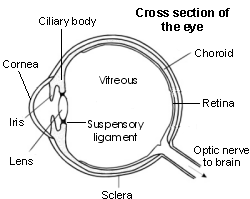
You may notice problems with your eyesight and floaters (specks appearing to float across your field of vision). Usually, only one eye is affected. You may have mild pain in the eye but most people do not have any discomfort.
Continua a leggere sotto
Toxoplasmosis treatment
Torna ai contenutiPyrimethamine and sulfadiazine. If your immune system is working properly the chances are that you will not need treatment. If your symptoms are severe or slow to clear up you may, however, need some antibiotic medication for 4-6 weeks. The combination usually used is pyrimethamine and sulfadiazine. These medicines can harm the bone marrow when given alone so folic acid is often added to reduce this risk.
Trimethoprim and sulfamethoxazole. This combination may also be used if your immune system is not working properly. However, you may also be offered alternatives such as trimethoprim plus sulfamethoxazole (co-trimoxazole), clindamycin or atovaquone, depending on your individual circumstances. After a 4 to 6 week course you will probably need to take a low dose of medicine for the rest of your life, unless the problem affecting your immune system is only temporary.
Antibiotics in pregnancy. If you become infected whilst you are pregnant you will be offered antibiotics. However, it is not certain how much good this does in terms of preventing infection of the baby. Many types of medicine are available. The choice depends on several factors, such as whether or not your immune system is working properly and whether the baby is already infected. Spiramycin appears to be the best option for protecting babies who have not yet been infected. If the baby is severely infected, you may be offered an abortion.
Antibiotic tablets and steroid eye drops for eye infection. If you develop a toxoplasma infection of the eye this usually needs no treatment, providing your immune system is working properly. However, you may need treatment if the infection is severe or likely to cause scarring that affects your vision. The usual treatment is antibiotic tablets, steroid eye drops and, in severe cases, steroid tablets.
If your immune system is not working properly you will almost certainly be offered antibiotics. If you are pregnant, spiromycin is the best option.
Common questions about toxoplasmosis
Torna ai contenutiDoes toxoplasmosis get better?
If your immune system is working properly it is very likely that you will get better and be left with no ill effects. If you have a long-term problem with your immune system, however, you stand more of a risk of developing complications. The prospects for people who are HIV-positive and have become infected with toxoplasma have improved considerably since the use of a treatment called antiretroviral therapy (ART), also called highly active antiretroviral therapy (HAART).
How is toxoplasmosis diagnosed?
If you are suspected of having toxoplasmosis, the first test you are likely to be offered is a blood test. This will show that the levels of proteins (immunoglobulins) produced by the immune system to fight infection will be high. There are various types of immunoglobulins. IgG level rises in the first 1-2 weeks of infection and stays positive for life. IgM levels rise in the first week and drop to normal after a few weeks, so this test is useful to detect recent infection. IgA levels are sometimes tested in babies.
Other body fluids are sometimes tested - for example, the amniotic fluid surrounding the baby in the womb (uterus).
A small piece of tissue may be removed surgically from the body. This is called a biopsy. It is tested when there continue to be doubts about the diagnosis.
You may need pictures of the brain, using risonanza magnetica (RM) o computed tomography (CT) scanning if brain infection is suspected.
Unborn babies may need an ultrasound scan if it is suspected that infection has been passed from the mother.
How do you catch toxoplasmosis?
Whilst many animals can become infected with toxoplasma, cats are the main host. When a cat becomes infected, the toxoplasma invades the gut lining and starts to reproduce immature forms called oocysts. These pass out in the cat's stools (faeces). You can then become infected by coming into contact with contaminated soil, water or food. You can, for example, become infected by:
Eating undercooked or raw meat - particularly pork or lamb.
Eating fruit or vegetables that have not been washed properly.
Handling contaminated soil whilst gardening or contaminated cat litter.
Expectant mothers can pass toxoplasma to their unborn baby through the placenta (the organ providing nourishment and oxygen to the baby). Rarely, toxoplasma can be passed from an infected organ donor to the person receiving the organ.
How common is toxoplasmosis and who catches it?
About 350 cases of toxoplasma infection are diagnosed in the UK every year. The actual number of infected people is likely to be higher, as toxoplasma often causes no symptoms and the person may be unaware that they have caught it. It is more common in hot damp countries where conditions are more favourable for the survival of the oocysts.
Anyone can become infected with toxoplasma - adults and children, men and women.
If your immune system is not working properly for some reason - for example, you are undergoing treatment for cancer or you have infezione da HIV - you are more likely to have serious infection.
Can toxoplasmosis be prevented?
All people should follow the advice below. However, the advice is particularly important for women who are pregnant and people who are HIV-positive:
Wash hands before handling food.
Thoroughly wash all fruit and vegetables, including ready-prepared salads, before eating them.
Thoroughly cook raw meats and ready-prepared chilled meals.
Wear gloves and thoroughly wash hands after handling soil and gardening.
Avoid cat droppings in cat litter or in soil.
In some countries (such as France), all pregnant women are tested for toxoplasma infection. This does not happen in the UK, because infection rates are much lower.
Scelte dei pazienti per Infezioni gastrointestinali

Infezioni
Giardia
Giardia intestinalis è un parassita (un organismo vivente che vive su o in un altro organismo vivente). Può infettare l'intestino e causare la giardiasi.
di Dr Philippa Vincent, MRCGP

Infezioni
Cryptosporidium
Cryptosporidium è un parassita. È un organismo vivente che vive in, o su, un altro organismo. Può infettare l'intestino e causare la criptosporidiosi. Questa è una forma di infezione intestinale chiamata gastroenterite, che porta a diarrea e vomito. L'infezione può verificarsi negli esseri umani e negli animali e si diffonde attraverso il contatto con terreno, acqua, cibo o superfici che sono state contaminate da feci infette contenenti il parassita. I bambini piccoli sono i più propensi a infettarsi. I sintomi di solito durano fino a due settimane, a volte di più. I sintomi possono essere molto gravi nelle persone il cui sistema immunitario non funziona correttamente. Non è necessario alcun trattamento specifico per la maggior parte delle persone, ma si dovrebbe bere molta acqua per evitare la disidratazione. Non si dovrebbe usare una piscina per 14 giorni dopo che l'infezione è stata eliminata.
di Dr Colin Tidy, MRCGP
Ulteriori letture e riferimenti
- Torgerson PR, Mastroiacovo P; The global burden of congenital toxoplasmosis: a systematic review. Bull World Health Organ. 2013 Jul 1;91(7):501-8. doi: 10.2471/BLT.12.111732. Epub 2013 May 3.
- Robert-Gangneux F, Darde ML; Epidemiology of and diagnostic strategies for toxoplasmosis. Clin Microbiol Rev. 2012 Apr;25(2):264-96. doi: 10.1128/CMR.05013-11.
- Toxoplasmosis screening in pregnancy; UK Antenatal Screening Programme.
- Soheilian M et al; How to Diagnose & Treat Ocular Toxoplasmosis, Review of Ophthalmology, 2011
- Flatt A, Shetty N; Seroprevalence and risk factors for toxoplasmosis among antenatal women in London: a re-examination of risk in an ethnically diverse population. Eur J Public Health. 2013 Aug;23(4):648-52. doi: 10.1093/eurpub/cks075. Epub 2012 Jun 13.
Continua a leggere sotto
Storia dell'articolo
Le informazioni su questa pagina sono scritte e revisionate da clinici qualificati.
Prossima revisione prevista: 17 Feb 2028
18 Feb 2025 | Ultima versione

Chiedi, condividi, connettiti.
Esplora le discussioni, fai domande e condividi esperienze su centinaia di argomenti di salute.

Non ti senti bene?
Valuta i tuoi sintomi online gratuitamente
Iscriviti alla newsletter di Patient
La tua dose settimanale di consigli sulla salute chiari e affidabili - scritti per aiutarti a sentirti informato, sicuro e in controllo.
Abbonandoti accetti il nostro Informativa sulla Privacy. Puoi annullare l'iscrizione in qualsiasi momento. Non vendiamo mai i tuoi dati.