Schistosomiasi
Revisione paritaria di Dr Philippa Vincent, MRCGPUltimo aggiornamento di Dr Surangi Mendis, MRCGPUltimo aggiornamento 28 Set 2023
Rispetta le linee guida editoriali
- ScaricaScarica
- Condividi
- Language
- Discussione
- Versione audio
Schistosomiasis is a tropical disease caused by an infection with parasitic worms. In the past it was more commonly known as Bilharzia. Many people do not develop symptoms of acute schistosomiasis, or their symptoms may be mild and go unrecognised. Diagnosis is usually made by testing the urine or poo (faeces) or through a blood test. Treatment is with a medicine called praziquantel. Many people recover completely following treatment.
In questo articolo:
Video consigliati per Infezioni legate ai viaggi
Continua a leggere sotto
What are the symptoms of schistosomiasis?
La schistosomiasi può essere 'acuta' o 'cronica'. Entro pochi giorni dall'infezione, alcune persone possono sviluppare un'eruzione cutanea o prurito alla pelle. Questo è noto come 'prurito del nuotatore'.
Acute schistosomiasis
This is also known as Katayama fever. Acute means 'sudden onset' or 'short duration'. Symptoms first develop some weeks after you have been in contact with the infested water. Symptoms can include:
Febbre.
Mal di testa.
Stanchezza.
Dolori articolari e muscolari.
Tosse.
Bloody diarrhoea.
Dolore addominale.
Nota: many people who are infected do not develop symptoms of acute schistosomiasis, or their symptoms may be mild and go unrecognised. Some may dismiss their symptoms, believing them to have been caused by a simple viral infection. However, they can go on to develop chronic schistosomiasis.
Chronic schistosomiasis
This is more common than acute schistosomiasis. Chronic means 'persistent'. If you have chronic schistosomiasis, you can develop symptoms many months or years after you were first infected. It can cause long-term ill health.
The symptoms depend on the species of schistosoma that you have and where this species produces most of its eggs. Schistosoma mansoni e Schistosoma japonicum tendono a deporre le uova nei vasi sanguigni intorno all'intestino. Schistosoma haematobium tends to produce eggs in the blood vessels around the bladder. The symptoms are caused by the body's immune system reacting against the eggs that the worms produce, not by the worms themselves. This reaction can cause inflammation and scarring of the tissues and organs of the body.
If eggs are mainly produced in the blood vessels around the bowel, symptoms can include bloody diarrhoea and tummy (abdominal) pain which tends to be cramping. If they are produced in the blood vessels around the bladder, symptoms can include blood in the urine and pain on urinating.
Eggs that have not been excreted by the body can also travel to other parts of the body and cause symptoms. For example, the liver, lungs, heart, brain or nervous system may be affected. Symptoms depend on the affected area but can include:
Affanno.
Tosse.
Palpitazioni.
Dolore al petto.
Insufficienza epatica.
Convulsioni.
Confusione.
Paralysis (if the spinal cord is involved).
Children who are repeatedly infected with schistosomiasis can develop anaemia, malnutrition and learning difficulties.
How do you get schistosomiasis?
Torna ai contenutiSchistosomiasis is a tropical disease caused by a parasitic infection with worms from the Schistosomatidae family. A parasite is an animal that lives on or in another animal and feeds from it.
Schistosoma parasite
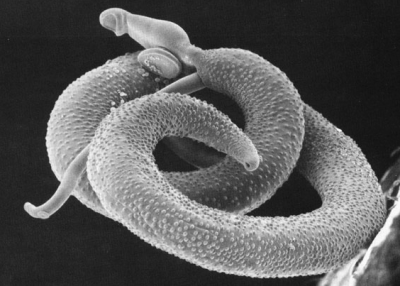
© Di Waisberg su Wikipedia in inglese [Pubblico dominio], tramite Wikimedia Commons
There are three main worm species that cause schistosomiasis in humans:
Schistosoma haematobium.
Schistosoma mansoni.
Schistosoma japonicum.
Eggs from the mature worms are passed out of the body (excreted) in the poo (faeces) or urine of an infected person. These eggs can get into fresh water if it is contaminated with human sewage. Once in the water, the eggs can infect snails living in the water and they then start to develop into larvae inside the snails. These freshwater snails are known as 'intermediate hosts' because they are needed for the worms to complete their life cycle.
The mature larvae are then released from the snails into the water. The larvae can swim around and can enter the skin of someone who bathes, wades or swims in the water. Once they have got through the skin, larvae then travel to the blood vessels where they mature into adult worms. The worms settle in the blood vessels around the intestine or the bladder (depending on the species). Here, the male and female worms mate and eggs are produced. These eggs can pass from the blood vessels through the wall of the bladder or the bowel so that they can be excreted in the urine or faeces. The life cycle of the worm is then able to start again. The worms can live inside the body of a human for three to five years, producing eggs.
Nota: not all eggs are excreted. Some stay in the body and are involved in the development of symptoms (see below).
Continua a leggere sotto
How common is schistosomiasis?
Torna ai contenutiThe World Health Organization (WHO) reports that over 250 million people are infected with schistosomiasis worldwide, 137 million of which are school-aged children.
Come si diffonde la schistosomiasi?
Torna ai contenutiColoro che vivono o viaggiano in un'area in cui si verifica la schistosomiasi sono a rischio di schistosomiasi, sebbene sia necessario anche il contatto con acqua dolce che contiene le lumache che fungono da ospite intermedio. Questo contatto può avvenire, ad esempio, attraverso:
Nuoto.
Boating.
Rafting.
Water skiing.
Fare il bagno.
Working on irrigation equipment.
Drinking from streams or irrigation ditches.
Children and teenagers are most often affected. In some areas of the world nearly all those aged 10-19 may be, or have been, infected. Re-infection is also common.
Continua a leggere sotto
Come viene diagnosticata la schistosomiasi?
Torna ai contenutiThere are a number of tests that can be used to help confirm the diagnosis, or that can be used to assess which parts of the body are affected by the infection. These include:
Urine and poo (faeces) samples
Schistosomiasis is usually diagnosed by testing urine e faeces samples. The test looks for schistosomal eggs in the urine or faeces, using a microscope.
Esami del sangue
An antibody or antigen esame del sangue can show if someone has, or has had, schistosomiasis. It can take some time for these tests to become positive (4-8 weeks). Other blood tests can check for anaemia and to see if the liver or kidneys are affected.
Radiografia del torace
A chest X-ray can sometimes show if the lungs are affected.
Scansioni
Un ecografia of the liver or the heart may be useful to show if schistosomiasis has affected these organs.
A volte Scansione TC o Risonanza magnetica is used, especially if the brain or spinal cord is affected.
Colonscopia o cistoscopia: a volte la schistosomiasi viene diagnosticata dopo aver prelevato campioni durante una delle seguenti procedure:
Schistosomiasis treatment
Torna ai contenutiA medication called praziquantel is the most common treatment for schistosomiasis. It is a tablet taken by mouth. It is considered to be safe and is effective in most cases. The treatment is usually just a single dose, or two doses taken on the same day. Farmaci steroidei is also sometimes given in acute schistosomiasis. Any complications (see below) will also need to be treated.
What are the complications of schistosomiasis?
Torna ai contenutiIn some people, if schistosomiasis is untreated, or if infection goes unrecognised, complications can sometimes occur. These can include:
Chronic liver damage and an enlarged spleen.
Colon (large intestine) inflammation.
Kidney and bladder obstruction.
Repeated blood infections can occur - germs (bacteria) can easily enter the bloodstream through an inflamed colon.
Insufficienza cardiaca.
Cancro alla vescica - your risk of bladder cancer is slightly increased if schistosomiasis affects your bladder.
Where is schistosomiasis found?
Torna ai contenutiCountry-specific information on the risk of schistosomiasis is available on our Pagina di consigli di viaggio per paese.
There are certain areas of the world where schistosomiasis occurs. If you travel to, or live in, the following areas you are at risk if you come into contact with contaminated fresh water:
Africa: all fresh water in southern and sub-Saharan Africa, including the great lakes and rivers as well as smaller bodies of water. Transmission also occurs in the Nile River valley in Egypt.
South America: including Brazil, Suriname, Venezuela.
Caribbean: Antigua, Dominican Republic, Guadalupe, Martinique, Montserrat, Saint Lucia (risk is low).
The Middle East: Iran, Iraq, Saudi Arabia, Yemen.
Southern China.
Southeast Asia: Philippines, the Lao People's Democratic Republic, Cambodia, central Indonesia, Mekong Delta.
However, trends in the movement of people and populations (from rural to urban areas and also migration to other countries) is introducing schistosomiasis to new areas.
Additionally, due to a rise in eco-tourism and travel to remote locations, increasing numbers of tourists are becoming infected with schistosomiasis.
Nota: chlorinated swimming pools and seawater are generally thought to be safe.
What is the outlook for schistosomiasis?
Torna ai contenutiAlmost all people who receive treatment for schistosomiasis will improve. There can be complete recovery in those who have not been infected for long, or those without complications.
Even if someone has developed complications such as liver damage, these can sometimes improve after treatment. However, for some people, complications cannot be reversed and they can develop chronic ill health; occasionally, death can occur. If someone is also infected with malaria, HIV o epatite, la prognosi tende ad essere peggiore.
È possibile prevenire la schistosomiasi?
Torna ai contenutiPeople who travel to areas affected by schistosomiasis should avoid exposure to fresh water that is likely to be contaminated. This means:
Avoiding swimming or wading in fresh water.
Drinking water that is safe. This means either drinking bottled water (ensuring that the bottle is sealed before opening), filtering water or boiling it for at least one minute.
Fare il bagno in acqua sicura. L'acqua del bagno dovrebbe essere riscaldata per cinque minuti a 150°F (circa 66°C). L'acqua conservata in un serbatoio per almeno 48 ore dovrebbe essere sicura per la doccia.
Various measures are being taken to help to reduce schistosomiasis infection in affected countries. These include:
Improved sanitation to decrease sewage contamination of fresh water.
Measures to help reduce occupational and recreational contact with contaminated water.
Treatment of water to help reduce the numbers of the snail 'intermediate hosts'.
Treatment of people in affected areas with medicines to 'kill off' the infection. The WHO uses a strategy involving medicines to help control schistosomiasis in a number of countries. However, in 2021, WHO reported that the COVID-19 pandemic, and work undertaken to reduce its impact, reduced the availability of resources available to treat and manage some neglected tropical diseases, including schistosomiasis.
Scelte dei pazienti per Infezioni legate ai viaggi

Viaggi e vaccinazioni
Ebola
Ebola è un'infezione virale, che si verifica principalmente in Africa occidentale ed equatoriale. Non esiste ancora un vaccino o una cura per l'Ebola, e circa 4 persone su 10 infette muoiono a causa della malattia. Il rischio di contrarre l'Ebola nel Regno Unito è molto basso. L'Ebola si diffonde attraverso il contatto stretto con una persona infetta. Le persone con Ebola diventano infettive quando presentano sintomi.
di Dr Mary Elisabeth Lowth, FRCGP

Viaggi e vaccinazioni
Febbre Chikungunya
La febbre chikungunya è una malattia causata da un virus. Il virus ti infetta quando vieni punto da un certo tipo di zanzara. Non puoi contrarre la febbre chikungunya nel Regno Unito, ma potresti essere a rischio di contrarla quando sei all'estero. Di solito provoca una temperatura elevata (la 'febbre') e dolori articolari. Nella maggior parte delle persone scompare completamente dopo una o due settimane. In alcune persone può essere una malattia più grave. Non esiste un trattamento specifico. Prima di viaggiare, controlla sempre la pagina dei consigli di viaggio per paese per ottenere le ultime informazioni sulle infezioni nell'area in cui stai andando. La chikungunya può essere prevenuta prendendo misure per evitare le punture di zanzara.
di Dr Hayley Willacy, FRCGP
Ulteriori letture e riferimenti
- Schistosomiasi; Organizzazione Mondiale della Sanità
- Schistosomiasi; DPDx, Centers for Disease Control and Prevention.
- Nelwan ML; Schistosomiasis: Life Cycle, Diagnosis, and Control. Curr Ther Res Clin Exp. 2019 Jun 22;91:5-9. doi: 10.1016/j.curtheres.2019.06.001. eCollection 2019.
- Lackey EK, Horrall S; Schistosomiasis.
- Carbonell C, Rodriguez-Alonso B, Lopez-Bernus A, et al; Spettro Clinico della Schistosomiasi: Un Aggiornamento. J Clin Med. 25 Nov 2021;10(23):5521. doi: 10.3390/jcm10235521.
Continua a leggere sotto
Storia dell'articolo
Le informazioni su questa pagina sono scritte e revisionate da clinici qualificati.
Prossima revisione prevista: 26 Set 2028
28 Set 2023 | Ultima versione

Chiedi, condividi, connettiti.
Esplora le discussioni, fai domande e condividi esperienze su centinaia di argomenti di salute.

Non ti senti bene?
Valuta i tuoi sintomi online gratuitamente
Iscriviti alla newsletter di Patient
La tua dose settimanale di consigli sulla salute chiari e affidabili - scritti per aiutarti a sentirti informato, sicuro e in controllo.
Abbonandoti accetti il nostro Informativa sulla Privacy. Puoi annullare l'iscrizione in qualsiasi momento. Non vendiamo mai i tuoi dati.