Ernie femorali
Revisione paritaria di Dr Toni Hazell, FRCGPUltimo aggiornamento di Dr Philippa Vincent, MRCGPUltimo aggiornamento 10 Sept 2026
Rispetta le linee guida editoriali
- ScaricaScarica
- Condividi
- Language
- Discussione
- Versione audio
- Aggiungi alle fonti preferite su Google
Professionisti Medici
Gli articoli di riferimento professionale sono progettati per essere utilizzati dai professionisti della salute. Sono scritti da medici del Regno Unito e basati su prove di ricerca, linee guida del Regno Unito ed europee. Potresti trovare il Ernia articolo più utile, o uno dei nostri altri articoli sulla salute.
Cosa sono le ernie femorali?
Hernias in the groin are either inguinal or, less commonly, femoral in origin.
Ernia inguinale
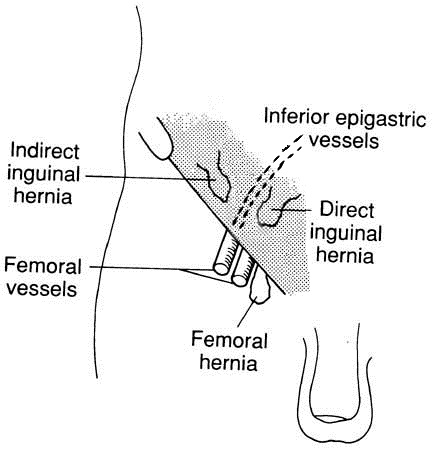
The femoral canal has the inguinal ligament as its anterior border, the pectineal ligament as its posterior border, the lacunar ligament as its medial border, and the femoral vein as its lateral border.
Epidemiologia1
Femoral hernias account for only around 3% of all groin hernias. The lifetime incidence of a groin hernia is 27% to 43% in men and 3% to 6% in women.
Femoral hernias are more common in women than in men, though inguinal hernias remain the most common groin hernias in women.
The prevalence of femoral hernias increases with age, as does the risk of complications.
10% of women with a femoral hernia and 50% of men with a femoral hernia will have a co-existing inguinal hernia.
Sintomi dell'ernia femorale (presentazione)
Presentation is as a lump in the groin, lateral and inferior to the pubic tubercle. A large hernia may bulge over the inguinal ligament.
The femoral hernia often bulges more on coughing or straining, and reduces in size or disappears when relaxed or supine.
Femoral hernias are more common on the right (due to a developmental delay in closure of the processus vaginalis).
Potrebbe esserci un impulso di tosse.
Femoral hernias are more likely to strangulate than inguinal hernias.
Indagine
Diagnosis is largely clinical but ultrasound confirmation is often required before making a referral.
Imaging techniques are helpful. Ultrasound scanning is most commonly used but CT scans can be helpful in patients with incarceration or strangulation.1
Diagnosi differenziale
Altre cause di noduli nell'inguine includono:
Idrocele (when differentiating from an inguinoscrotal hernia, note that it is possible to get above a hydrocele on examination).
Idrocele del funicolo spermatico.
Enlarged lymph node.
Ascesso del psoas o borsa.
Varice safena.
Ematoma.
Complicanze dell'ernia femorale
Femoral hernias are at a 12 times higher risk of strangulation than inguinal hernias.
The risk of strangulation in a femoral hernia is 22% at 3 months and 45% at 21 months.
Femoral hernias may not be noticed by the patient prior to strangulation, especially in those who have obesity.
One study reported that 45.9% of patients required femoral hernia repair as an emergency.2
If strangulation occurs, the lump may become red and tender as well as tense and irreducible. Other features include colicky abdominal pain, distension and vomiting, indicating bowel obstruction.
Trattamento e gestione dell'ernia femorale3
In view of the higher risk of strangulation, it is recommended that femoral hernias should be repaired; referral should be made for elective repair as soon as the diagnosis is made.4 In many parts of the UK, there is a hernia pathway which includes all femoral hernias (confirmed by ultrasound scan) but only includes other hernias that are symptomatic.
Femoral hernias may be repaired using a standard inguinal approach, an open preperitoneal approach, or a minimally invasive (laparoscopic or robotic-assisted laparoscopic) approach.15Laparoscopy does not appear to lead to more complications,67 but there is no consensus on the best approach, particularly as these often present in an acute situation and are therefore dealt with by junior surgeons.8
Emergency femoral hernia repair (for a strangulated hernia) is associated with a significantly higher risk of complications, including bowel resection, and a higher mortality than elective repairs.2
Prognosi
The mortality for elective hernia repair is low, regardless of age. However, after emergency surgery, mortality is increased seven-fold.9
Studies report that the overall operative mortality rate for strangulated hernias ranges from 1.4-13.4% but there is limited recent data.
Recurrence rates for femoral hernias are between 1 and 10%. They are more common in smokers and people with obesity, increased intra-abdominal pressure, coexisting infection, collagen tissue disorders, diabetes, and poor nutritional state.1
Chronic pain has been reported in up to 15% of people after femoral hernia repair.1
Aggiornamenti esclusivi per i professionisti sanitari
Rimani informato con gli ultimi aggiornamenti clinici, approfondimenti professionali e linee guida basate su evidenze. La newsletter Patient Pro seleziona contenuti essenziali per i professionisti sanitari—consegnati direttamente nella tua casella di posta.
Abbonandoti accetti i nostri Informativa sulla Privacy. Puoi annullare l'iscrizione in qualsiasi momento. Non vendiamo mai i tuoi dati.
Ulteriori letture e riferimenti
- Goethals A, Azmat CE, Patel PJ, et al; Femoral Hernia.
- Humes DJ, Radcliffe RS, Camm C, et al; Studio basato sulla popolazione della presentazione e degli esiti avversi dopo l'intervento di ernia femorale. Br J Surg. 2013 Dic;100(13):1827-32. doi: 10.1002/bjs.9336.
- Development of an Acute Femoral Hernia Treatment Algorithm: Insights From the ACHQC National Database; I Kim et al; The American Surgeon
- Femoral hernia: Treatment delay and cause of death – A case report and an integrative review; Y Hassan et al; Muller Journal of Medical Sciences and Research
- Open Surgical Repair of Adult Inguinal and Femoral Hernias: Contemporary Techniques and Clinical Outcomes; N Subhan; Journal of Society Medicine
- Coelho JCU, Hajar FN, Moreira GA, et al; FEMORAL HERNIA: UNCOMMON, BUT ASSOCIATED WITH POTENTIALLY SEVERE COMPLICATIONS. Arq Bras Cir Dig. 2021 Oct 15;34(2):e1603. doi: 10.1590/0102-672020210002e1603. eCollection 2021.
- Incarerated femoral hernia in women – A critical view on approach options; L Pietrogiovanna et al; International Journal of Surgery Case Reports
- An Update on the Management of Femoral Hernias: Narrative Review Article; H Kumar; SAR Journal of Surgery
- Nilsson H, Stylianidis G, Haapamaki M, et al; Mortalità dopo chirurgia dell'ernia inguinale. Ann Surg. 2007 Apr;245(4):656-60.
Informazioni sull'autoreVisualizza il profilo completo
Aggiornato da

Dr Philippa Vincent, MRCGP
Medico di base, Autore medico
MB BS, Bsc, MRCGP (2000), DCH, DFSRH, DRCOG
Dr Philippa Vincent è un medico di base del NHS che lavora nel nord di Londra.
Informazioni sul recensoreVisualizza il profilo completo

Dr Toni Hazell, FRCGP
MBBS, BSc, FRCGP, DFSRH, Dip GU med, DRCOG, DCH (London, UK, 2000)
La Dott.ssa Toni Hazell si è laureata presso la St. Mary’s Hospital Medical School e ha completato il suo VTS al Northwick Park Hospital.

Chiedi, condividi, connettiti.
Esplora le discussioni, fai domande e condividi esperienze su centinaia di argomenti di salute.

Non ti senti bene?
Valuta i tuoi sintomi online gratuitamente
Più in storia ed esame
- Masse addominali
- Andatura anomala
- Perdita di peso anomala
- Dolori articolari - valutazione, indagini e gestione nell'assistenza primaria
- Disturbo da uso di alcol: riconoscimento e valutazione
- Percussione dell'ascite
- Visione offuscata
- Storia e esame cardiovascolare
- Coma
- Esame della colonna vertebrale
- Malattia da alta quota
- Raccolta anamnestica
- Articolazioni calde e gonfie
- Pressione venosa giugulare
- registro del flusso di picco
- Malattia di Raynaud
- Sanguinamento rettale negli adulti
- Angioma a fragola
- Sindrome di Tourette e altri disturbi da tic
- Difficoltà di svuotamento