Paralisi di Bell
Revisione paritaria di Dr Philippa Vincent, MRCGPUltimo aggiornamento di Dr Toni Hazell, MRCGPUltimo aggiornamento 23 Ott 2023
Rispetta le linee guida editoriali
- ScaricaScarica
- Condividi
- Language
- Discussione
- Versione audio
- Add to preferred sources on Google
La paralisi di Bell è una debolezza (paralisi) che causa danni ai nervi; colpisce le fibre nervose che controllano i muscoli del viso. È dovuta a un problema con il nervo facciale. Si sviluppa improvvisamente, di solito su un lato del viso. La causa non è chiara, ma la maggior parte dei casi è probabilmente dovuta a un'infezione virale. La maggior parte delle persone guarisce completamente entro 2-3 mesi. Un ciclo di compresse di steroidi iniziato entro 72 ore dall'inizio migliora ulteriormente la possibilità di un recupero completo. Dovresti proteggere il tuo occhio se non riesci a chiudere completamente le palpebre.
At a glance
Bell's palsy is a sudden one-sided weakness or paralysis of the facial muscles.
Symptoms include facial drooping, difficulty closing an eye, and problems with chewing or speech.
It is thought to be caused by inflammation of the facial nerve, possibly due to a viral infection.
Most people recover fully, usually within a few months, even without treatment.
Steroid tablets may increase the chance of full recovery if started early.
Eye protection is important if you cannot close your eye fully to prevent damage.
In questo articolo:
Video picks for Problemi ai nervi
Continua a leggere sotto
What is Bell's palsy?
Bell's palsy is a sudden and unexplained weakness or paralysis of the facial muscles on one side of the face. In most cases, the weakness is temporary and improves within a few months.
Bell's palsy symptoms
Torna ai contenutiWeakness of the face, which is usually one-sided. The weakness normally develops quickly, over a few hours or so. You may first notice the weakness after getting up in the morning and so it may appear quite dramatic. It may gradually become worse over several days. The effects of the weakness vary, depending on whether the nerve is partially or fully affected. These include the following:
Your face may droop to one side. When you smile, only half of your face may move.
Chewing food on the affected side may be a problem. Food may become trapped between your gum and cheek. Drinks and saliva may escape from the side of your mouth.
You may not be able to close the eye on the affected side. This may cause a watery or dry eye.
You may not be able to wrinkle your forehead, whistle or blow out your cheek.
You may have some difficulty with speech, as the muscles in the side of the face help in forming some words. For example, words beginning with a P.
Most cases are painless or cause just a mild ache. However, some people develop some pain near the ear which can last for a few days.
You may have increased sensitivity to sounds, such that loud sounds may be uncomfortable and normal noises may sound louder than usual. This is because a tiny muscle in the ear may stop working.
You may lose the sense of taste on the side of the tongue that is affected.
Continua a leggere sotto
Who gets Bell's palsy?
Torna ai contenutiAnyone can develop Bell's palsy and it affects men and women equally. It most commonly occurs between the ages of 15 and 60 years. About 1 in 60 people have a Bell's palsy at some stage in their life.
What causes Bell's palsy?
Torna ai contenutiIt is thought that inflammation develops around the facial nerve as it passes through the skull from the brain. The nerve then partly, or fully, stops working until the inflammation goes. If the nerve stops working, the muscles that the nerve is connected to also stop working.
The cause of the inflammation is not known but, in most cases, it is probably due to a viral infection. Viruses linked to Bell's palsy include:
Most people have chickenpox at some stage (usually as a child) and many people have cold sores. The virus does not completely go after you have chickenpox or a cold sore. Some particles of virus remain dormant (inactive) in the nerve roots. They do no harm there and cause no symptoms.
For reasons that are not clear, the virus may begin to multiply again (re-activate). This is often many months or years later. In some cases, the re-activated virus is thought to cause inflammation around the facial nerve to cause Bell's palsy. It is more common in people with diabetes and also in women who are pregnant.
Continua a leggere sotto
Does Bell's palsy affect the brain or other parts of the body?
Torna ai contenutiNo. Bell's palsy is a local problem confined to the facial nerve and facial muscles. If you have other symptoms, such as weakness or numbness in other parts of your body, there will be another cause and you should tell your doctor.
Other conditions that may be confused with Bell's palsy
Torna ai contenutiBell's palsy is a common cause of a facial palsy. Less commonly, facial palsy is caused by other things that can damage or affect the facial nerve - for example:
Growths in the ear.
In some people who have a ictus, facial weakness can develop.
With these conditions you are likely to have other symptoms too. This helps doctors to tell the difference between a Bell's palsy and other causes of a facial palsy. For example:
With a stroke, the forehead muscles are not affected. Also, you are likely to have other nerves that are affected in addition to the facial nerve. If you think you are having a stroke, call 999/112/911. See the separate leaflet called Stroke for more details.
With tumours, the symptoms usually develop slowly - over weeks or months. This is unlike a Bell's palsy when symptoms develop quickly - often 'overnight'.
Conditions such as sarcoidosis and Lyme disease tend to cause various other symptoms in addition to nerve palsies.
In particular, Bell's palsy is uncommon in children under 10 years old. Other conditions should be carefully ruled out in children who develop facial weakness.
How does Bell's palsy progress?
Torna ai contenutiWithout treatment, full recovery is still likely and occurs in about 15 in 20 cases. With treatment, the chance of full recovery is improved (see below). In most people the function of the nerve gradually returns to normal.
Symptoms usually start to improve after about 2-3 weeks and have usually gone within two months. Sometimes it can take up to twelve months to recover fully.
Complications of Bell's palsy
Torna ai contenutiSome weakness may remain for good. However, it is often a slight weakness of part of the face and hardly noticeable. It is uncommon to have no improvement at all; however, some people are left with some degree of permanent facial weakness.
How is Bell's palsy diagnosed?
Torna ai contenutiWhen a doctor sees a patient with a sudden facial muscle weakness, he or she will aim to rule out other causes of the problem before diagnosing Bell's palsy. Most other causes can be ruled out by the absence of other symptoms and by a doctor's examination.
No tests may be needed. However, some tests are done in some situations. For example, in areas where Lyme disease is common (due to tick bites) then tests to rule out Lyme disease may be done. This is because a facial weakness is, rarely, the first indication of Lyme disease. Other tests may be advised if the diagnosis is not clear-cut.
Bell's palsy treatment
Torna ai contenutiAs mentioned, there is a good chance of full recovery without any treatment. However, treatment with medication is usually advised to improve the chance of full recovery even more. Also, you need to protect your eye if your eyelids cannot close (see below).
Compresse di steroidi
A course of compresse di steroidi is usually prescribed for about 10 days. The steroid tablet most commonly used is called prednisolone. Steroids help to reduce inflammation, which is probably the reason they help. Serious side-effects from the short course of steroids are very unlikely to occur.
Roughly, from the studies, it seems that if you do not take steroids you have about a 15 in 20 chance of full recovery of the nerve function. But, if you take a steroid medicine, you have about a 17 in 20 chance of full recovery.
So, taking a course of steroids does not guarantee full recovery of the nerve function. However, it can increase the chance of full recovery compared to no treatment. You should start the course of steroids as soon as possible after the onset of symptoms; ideally, within 72 hours of symptoms starting. They may not have much effect if they are taken after this. There is no strong evidence for the benefit of steroid treatment for children with Bell's palsy.
Medicinali antivirali
As most cases of Bell's palsy are probably due to a viral infection, it seems logical that antiviral medicines may help. Some medicines can stop the chickenpox and cold sore virus from multiplying.
It is possible that taking a course of steroids plus a course of antiviral medicine may work a little better than taking a course of steroids alone. However, the research trials give conflicting results about this. If there is any benefit from this combination, it is likely to be small and NICE suggest that specialist advice is sought if antiviral medicines are being considered.
Protezione degli occhi
If you cannot close your eyelids fully, the front of your eye is at risk of becoming damaged. Also, your tear glands may not work properly for a while and your eye may become dry. Dryness could cause damage, so treatment is needed to keep the eye moist.
Therefore, your doctor may advise one or more of the following until the eyelids and tear production recover:
An eye pad or goggles to protect the eye.
Eye drops to lubricate the eye during the day.
Eye ointment to lubricate the eye overnight.
An option of taping the upper and lower lid together when you are asleep. Other procedures are sometimes done to keep the eye shut until the eyelids recover.
If the facial weakness does not recover
For the small number of people where the facial weakness does not recover fully and remains unsightly, some techniques may be considered. For example:
Physiotherapy; a treatment called 'facial retraining' with facial exercises may help.
Injections of botulinum toxin (Botox®) may help if spasm develops in the facial muscles.
Various surgical techniques which can help with the cosmetic appearance.
Accadrà di nuovo?
Torna ai contenutiIn most cases, a Bell's palsy is a 'one-off'. About 1 in 14 people who have a Bell's palsy can have further episodes sometime in the future, often several years afterwards. This may be more likely if you have close relatives who have also had Bell's palsy.
What is the facial nerve?
Torna ai contenutiCross-section of the head showing the facial nerve
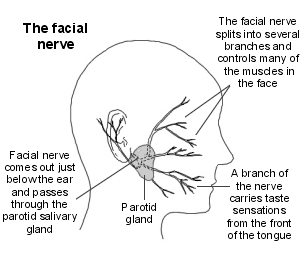
You have a facial nerve (also called the seventh cranial nerve) on each side of your face. Each facial nerve comes out from your brain, through a small tunnel in your skull just under your ear.
The nerve splits into many branches that supply the small muscles of the face that you use to smile, frown, etc. It also supplies the muscles that you use to close your eyelids.
Branches of the facial nerve also take taste sensations from your tongue to your brain.
Patient picks for Problemi ai nervi
Cervello e nervi
Sindrome del tunnel carpale
La sindrome del tunnel carpale è un insieme di sintomi che si ritiene siano causati dalla compressione del nervo mediano nel tunnel carpale.
di Dr Colin Tidy, MRCGP

Cervello e nervi
Neuropatia periferica
La neuropatia periferica significa danno a uno o più dei tuoi nervi periferici. Il danno significa che i messaggi che viaggiano tra il tuo sistema nervoso centrale e periferico sono interrotti. Ci sono molte condizioni diverse che possono portare alla neuropatia periferica. Il diabete è la causa più comune di neuropatia periferica persistente (cronica). I sintomi della neuropatia periferica dipendono da quale tipo di nervi periferici sono danneggiati (nervi sensoriali, motori o autonomi). La neuropatia può colpire qualsiasi tipo, o una combinazione di tutti e tre i tipi, di nervi. Gli obiettivi del trattamento per la neuropatia periferica sono trattare qualsiasi causa sottostante, controllare i tuoi sintomi e aiutarti a raggiungere la massima indipendenza.
di Dr Colin Tidy, MRCGP
Domande frequenti
What part of my body does Bell's palsy affect?
Bell's palsy specifically affects the facial nerve and the muscles it controls on one side of your face. It does not impact your brain or other parts of your body. If you experience weakness or numbness elsewhere, it would be due to a different condition.
How quickly do Bell's palsy symptoms appear?
Symptoms of Bell's palsy typically develop quite rapidly, often over just a few hours. You might notice the weakness upon waking in the morning, and it can sometimes worsen over several days.
Are there any long-term effects of Bell's palsy?
In most cases, Bell's palsy improves significantly, often with full recovery. However, a small number of people may experience some lasting facial weakness. This is usually slight and might not be very noticeable. It's uncommon for there to be no improvement at all.
What should I do if I can't fully close my eye due to Bell's palsy?
If you cannot fully close your eyelids, it's crucial to protect your eye to prevent damage, especially if your tear glands are also affected and your eye becomes dry. Your doctor might recommend using an eye pad or goggles, lubricating eye drops during the day, lubricating ointment overnight, or even taping your eyelids together while you sleep.
What other conditions might cause similar facial weakness to Bell's palsy?
While Bell's palsy is a common cause of facial weakness, other conditions can also affect the facial nerve. These include head injuries, sarcoidosis, Lyme disease, growths in the ear, tumours in the parotid gland, or brain tumours. A stroke can also cause facial weakness, but typically the forehead muscles are not affected in such cases, and other nerves are likely to be involved.
Is it possible for Bell's palsy to return after I've recovered?
For most people, Bell's palsy is a one-off event. However, about 1 in 14 individuals might experience it again at some point in the future, possibly many years later. This recurrence may be more likely if other family members have also had Bell's palsy.
Does having diabetes or being pregnant increase my risk of Bell's palsy?
Yes, Bell's palsy is more commonly observed in people with diabetes and in women who are pregnant. The exact reasons for this increased risk are not fully understood, but it is linked to the re-activation of dormant viruses in these groups.
Ulteriori letture e riferimenti
- Teixeira LJ, Valbuza JS, Prado GF; Physical therapy for Bell's palsy (idiopathic facial paralysis). Cochrane Database Syst Rev. 2011 Dec 7;(12):CD006283. doi: 10.1002/14651858.CD006283.pub3.
- Glass GE, Tzafetta K; Bell's palsy: a summary of current evidence and referral algorithm. Fam Pract. 2014 Dec;31(6):631-42. doi: 10.1093/fampra/cmu058. Epub 2014 Sep 10.
- Madhok VB, Gagyor I, Daly F, et al; Corticosteroids for Bell's palsy (idiopathic facial paralysis). Cochrane Database Syst Rev. 2016 Jul 18;7:CD001942. doi: 10.1002/14651858.CD001942.pub5.
- Paralisi di Bell; NICE CKS, February 2023 (UK access only).
- Gagyor I, Madhok VB, Daly F, et al; Antiviral treatment for Bell's palsy (idiopathic facial paralysis). Cochrane Database Syst Rev. 2019 Sep 5;9(9):CD001869. doi: 10.1002/14651858.CD001869.pub9.
Continua a leggere sotto
About the authorView full bio

Dr Toni Hazell, MRCGP
MBBS, BSc, MRCGP, DFSRH, Dip GU med, DRCOG, DCH (London, UK, 2000)
Dr. Toni Hazell qualified from St. Mary’s Hospital Medical School and did her VTS at Northwick Park Hospital.
About the reviewerView full bio

Dr Philippa Vincent, MRCGP
Medico di base, Autore medico
MB BS, Bsc, MRCGP (2000), DCH, DFSRH, DRCOG
Dr Philippa Vincent is an NHS GP working in North London.
Storia dell'articolo
Le informazioni su questa pagina sono scritte e revisionate da clinici qualificati.
Prossima revisione prevista: 21 Ott 2028
23 Ott 2023 | Ultima versione

Chiedi, condividi, connettiti.
Esplora le discussioni, fai domande e condividi esperienze su centinaia di argomenti di salute.

Non ti senti bene?
Valuta i tuoi sintomi online gratuitamente
Iscriviti alla newsletter di Patient
La tua dose settimanale di consigli sulla salute chiari e affidabili - scritti per aiutarti a sentirti informato, sicuro e in controllo.
By subscribing you accept our Informativa sulla Privacy. Puoi annullare l'iscrizione in qualsiasi momento. Non vendiamo mai i tuoi dati.