Sindrome del tunnel carpale
Revisione paritaria di Dr Hayley Willacy, FRCGP Ultimo aggiornamento di Dr Colin Tidy, MRCGPUltimo aggiornamento 14 Ott 2022
Rispetta le linee guida editoriali
- ScaricaScarica
- Condividi
- Language
- Discussione
- Versione audio
- Aggiungi alle fonti preferite su Google
La sindrome del tunnel carpale è un insieme di sintomi che si ritiene siano causati dalla compressione del nervo mediano nel tunnel carpale.
A colpo d'occhio
Carpal tunnel syndrome is caused by pressure on a nerve in your wrist.
Symptoms include pins and needles, pain, and numbness in your fingers or hand.
Symptoms often appear overnight, or when you use your hand.
Risk factors include obesity, pregnancy, family history, and repetitive hand movements.
Treatments include wrist splints, steroid injections, or surgery in severe cases.
See your doctor if you have constant numbness or thumb muscle weakness.
Carpal tunnel syndrome diagram
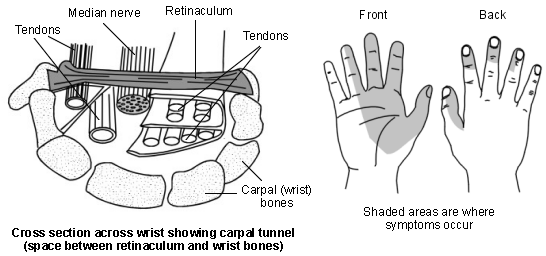
What is carpal tunnel syndrome?
This syndrome is a set of symptoms thought to be caused by squashing (compression) of the median nerve in the carpal tunnel. In terms of age, carpal tunnel syndrome is more common in:
People in their late 50s, particularly women.
People in their late 70s, when men and women are equally affected.
Carpal tunnel syndrome is more common in people who are obese and it often runs in families. It is more common in women who are pregnant.
What causes carpal tunnel syndrome?
In most cases it is not clear why it occurs. An increase in pressure going through the carpal tunnel is thought to squash (compress) and restrict the blood supply to the median nerve. As a result, the function of the median nerve is affected causing the symptoms.
Potential risk factors for carpal tunnel syndrome include:
There seems to be some inherited (genetic) factor. You have an increased risk of carpal tunnel syndrome if a close family member (father, mother, brother, sister) also has or had the condition.
Activities with repetitive hand/wrist movement, such as:
Gardening, assembly line work, and occupations requiring forceful or repetitive hand grip/exertion.
Use of vibrating hand tools.
There may be a link between carpal tunnel syndrome and using a computer, but the evidence for this is uncertain.
Gravidanza.
Osteoartrite of the joint at the base of the thumb (metacarpophalangeal joint). This is due to compression of the median nerve by bony lumps (osteophytes).
Inflammatory joint disease, such as artrite reumatoide.
Ganglion cysts, tumour, scar tissue.
What are the symptoms of carpal tunnel syndrome?
Formicolio. This is numbness and tingling in part or all of the shaded area (see diagram above). This is typically the first symptom to develop. The index and middle fingers are usually first to be affected.
Dolore in the same fingers may then develop. The pain may travel up the forearm and even to the shoulder.
Numbness of the same finger(s), or in part of the palm, may develop if the condition becomes worse.
Dryness of the skin may develop in the same fingers.
Weakness of some muscles in the fingers and/or thumb occurs in severe cases. This may cause poor grip and eventually lead to muscle wasting at the base of the thumb.
Symptoms tend to come and go at first, often after you use the hand. Typically, symptoms are worse at night and may wake you up.
The symptoms may be eased for a while by raising the hand up or hanging it down. Flicking the hand and wrist may also give relief. Symptoms persist all the time if the condition becomes severe.
Carpal tunnel syndrome is a collection of symptoms - with pain as the main problem - that result from squashing of the median nerve as it runs through the carpal tunnel.
What is carpal tunnel syndrome?
What is the carpal tunnel?
There are eight small bones called carpal bones in the wrist. A ligament (also called retinaculum) lies across the front of the wrist. Between this ligament and the carpal bones is a space called the carpal tunnel. The tendons that attach the forearm muscles to the fingers pass through the carpal tunnel. A main nerve (median nerve) to the hand also goes through this tunnel before dividing into smaller branches in the palm.
The median nerve gives feeling to the thumb, index and middle fingers, and half of the ring finger. It also controls the movement of the small muscles at the base of the thumb.
Do I need any tests for carpal tunnel syndrome?
Often the symptoms are so typical that no tests are needed to confirm the diagnosis.
If the diagnosis is not clear then a test to measure the speed of the nerve impulse through the carpal tunnel (nerve conduction test) may be advised. A slow speed of impulse down the median nerve will usually confirm the diagnosis. Some people may also be referred for an ultrasound scan or a magnetic resonance imaging (MRI) scan to look at their wrist in more detail.
How do you treat carpal tunnel syndrome?
In up to 1 in 3 cases the symptoms go without treatment within six months or so. Symptoms are most likely to go in younger people.
Misure generali
Try not to over-use your wrist by excessive squeezing, gripping, wringing, etc. If you are overweight, losing some weight may help. Painkillers may be prescribed to ease the pain. If the condition is part of a more general medical condition (such as arthritis) then treatment of that condition may help.
Non trattare potrebbe essere un'opzione
In about 2 in 3 cases that develop during pregnancy, the symptoms go after the baby is born. So, not treating is an option, particularly if symptoms are mild. The situation can be reviewed if symptoms become worse.
A wrist splint
A removable wrist splint (brace) is often advised as a first active treatment. The aim of the splint is to keep the wrist at a neutral angle without applying any force over the carpal tunnel so as to rest the nerve. This may cure the problem if used for a few weeks. However, it is common to wear a splint just at night, which is often sufficient to ease symptoms.
A steroid injection
An injection of steroid into, or near to, the carpal tunnel is an option. One research trial found that a single steroid injection eased symptoms in about 3 in 4 cases. In this trial the symptoms returned in some people over the following year. Other studies report variable success rates with steroid injections.
Surgery for carpal tunnel syndrome
Surgery is recommended for severe cases but the jury is still out as to whether it is better than injections for moderate symptoms. A large trial is being conducted to answer this question.
A small operation can cut the ligament over the front of the wrist and ease the pressure in the carpal tunnel to give your nerve more space. This usually cures the problem. It is usually done under local anaesthetic. There are two main types of surgery - open and keyhole. Your surgeon will discuss which technique is appropriate for you.
You will not be able to use your hand for work for a few weeks after the operation. A small scar on the front of the wrist will remain. There is a small risk factor of complications from surgery. For example, following surgery there is a very small risk of infection and damage to the nerve or blood vessels. Sometimes, the nerve can get caught up in the scar and become stretched when the wrist is moved: this is known as tethering.
Altri trattamenti
Over the years, a wide range of other treatments has been tried. For example, controlled cold therapy, ice therapy, laser therapy and exercises. None of these treatments has good research evidence to support its use and so they are not commonly advised. However, they can work for some people. There is some evidence that acupuncture may relieve symptoms in some people.
Steroid tablets may ease symptoms in some cases. However, there is a risk of serious side-effects from taking a long course of steroid tablets. Also, a local injection of a steroid (described above) probably works better. Therefore, steroid tablets are not usually advised.
Which is the best treatment for me?
A non-surgical option may be advised if your symptoms are mild - for example, if your symptoms come and go and mainly consist of tingling, pins and needles or mild discomfort. A wrist splint (brace) may work but a steroid injection is probably the most effective non-surgical treatment.
If you try a non-surgical treatment and it does not work, do return to your doctor. In particular, see your doctor if you have constant numbness in any part of your hand, or if you have any weakness of the muscles next to the thumb. These symptoms mean that the nerve is not working well and is at risk of permanent damage.
Surgery gives the best chance of long-term cure. It is quite a common operation. It is done if symptoms continue (persist) despite other treatments, or if symptoms are severe and the nerve is in danger of permanent damage.
Trattamento per sintomi gravi
If you have severe symptoms - in particular wasting of the muscles at the base of the thumb - then you will probably need surgery. This is to relieve pressure on (decompress) the trapped nerve quickly, which aims to prevent any permanent long-term nerve damage.
Carpal tunnel syndrome during pregnancy
Symptoms commonly go after the baby is born. Therefore, a non-surgical treatment, such as a splint, is usually advised at first. Surgery is an option if symptoms persist.
Scelte del paziente per Disturbi nervosi

Cervello e nervi
Disturbo neurologico funzionale
Il termine disturbo neurologico funzionale comprende un'ampia gamma di sintomi che sono spesso molto debilitanti. I medici tendono a categorizzare questi sintomi secondo il loro quadro di riferimento medico, ma spesso falliscono. I disturbi neurologici funzionali non hanno un modo formale di essere diagnosticati dai medici. Tuttavia, possono essere trattati.
di Dr Hayley Willacy, FRCGP

Cervello e nervi
Neuropatia post-erpetica
La nevralgia post-erpetica è un dolore che persiste in alcune persone che hanno avuto l'herpes zoster. Spesso si attenua e scompare col tempo. I farmaci possono spesso alleviare il dolore.
di Dr Philippa Vincent, MRCGP
Domande frequenti
What is the likelihood of carpal tunnel syndrome recurring after surgery?
The article states that surgery usually cures the problem. It does not provide specific statistics on recurrence rates after a successful operation, but the aim of surgery is a long-term cure by easing pressure on the nerve.
Are there any specific exercises that can help alleviate carpal tunnel syndrome symptoms?
The article mentions that a wide range of treatments has been tried over the years, including exercises. However, it states that none of these treatments have good research evidence to support their use and are therefore not commonly advised. While they might work for some people, there isn't scientific backing for their general recommendation.
How long does the recovery period typically last after carpal tunnel syndrome surgery?
After surgery, you will not be able to use your hand for work for a few weeks. The exact duration of recovery can vary depending on the individual and the type of surgery performed, but a few weeks is the stated general timeframe.
If I am experiencing mild symptoms, should I wait to see if they improve on their own before seeking treatment?
If symptoms are mild and come and go, particularly consisting of tingling, pins and needles or mild discomfort, a non-surgical option may be advised. The article also notes that in up to 1 in 3 cases, symptoms go away without treatment within six months, especially in younger people. For pregnant women, symptoms often resolve after childbirth, making 'not treating' a viable option for mild symptoms.
What are the potential negative effects of a steroid injection for carpal tunnel syndrome?
The article mentions that a single steroid injection can ease symptoms, but it also notes that symptoms returned in some people over the following year in one research trial. It doesn't detail specific negative effects or risks associated with the injection itself, beyond the potential for temporary relief rather than a permanent cure.
Ulteriori letture e riferimenti
- Vasiliadis HS, Georgoulas P, Shrier I, et al; Endoscopic release for carpal tunnel syndrome. Cochrane Database Syst Rev. 2014 Jan 31;1:CD008265. doi: 10.1002/14651858.CD008265.pub2.
- Sindrome del tunnel carpale; NICE CKS, agosto 2022 (accesso solo Regno Unito)
- Wipperman J, Goerl K; Carpal Tunnel Syndrome: Diagnosis and Management. Am Fam Physician. 2016 Dec 15;94(12):993-999.
- Wright AR, Atkinson RE; Carpal Tunnel Syndrome: An Update for the Primary Care Physician. Hawaii J Health Soc Welf. 2019 Nov;78(11 Suppl 2):6-10.
- Petrover D, Richette P; Treatment of carpal tunnel syndrome : from ultrasonography to ultrasound guided carpal tunnel release. Joint Bone Spine. 2018 Oct;85(5):545-552. doi: 10.1016/j.jbspin.2017.11.003. Epub 2017 Nov 16.
- Burton C, Chesterton LS, Davenport G; Diagnosing and managing carpal tunnel syndrome in primary care. Br J Gen Pract. 2014 May;64(622):262-3. doi: 10.3399/bjgp14X679903.
Informazioni sull'autoreVisualizza il profilo completo

Dr Colin Tidy, MRCGP
Medico di base, Autore medico
MBBS, MRCGP, MRCP (Paediatrics), DCH
Il Dr Colin Tidy è un medico del NHS, con sede nell'Oxfordshire.
Informazioni sul recensoreVisualizza il profilo completo

Dr Hayley Willacy, FRCGP
Medico di base, Autore medico
MBChB (1992), DRCOG, DFFP, MRCOG (Part 1) MRCGP (2007), DFSRH (2013), MSc - medical education (2020)
La Dott.ssa Hayley Willacy era un medico di base del NHS che lavorava nel nord-ovest dell'Inghilterra, e si è ritirata dalla pratica clinica nel 2022 dopo 30 anni.
Storia dell'articolo
Le informazioni su questa pagina sono scritte e revisionate da clinici qualificati.
Articolo disponibile anche in Inglese, Tedesco, Spagnolo, Francese, Italiano, Portoghese, Hindi, Ebraico, Arabo, and Svedese.
Prossima revisione prevista: 13 Ott 2027
14 Ott 2022 | Ultima versione

Chiedi, condividi, connettiti.
Esplora le discussioni, fai domande e condividi esperienze su centinaia di argomenti di salute.

Non ti senti bene?
Valuta i tuoi sintomi online gratuitamente
Iscriviti alla newsletter di Patient
La tua dose settimanale di consigli sulla salute chiari e affidabili - scritti per aiutarti a sentirti informato, sicuro e in controllo.
Abbonandoti accetti i nostri Informativa sulla Privacy. Puoi annullare l'iscrizione in qualsiasi momento. Non vendiamo mai i tuoi dati.
Più su cervello e nervi
- Afasia
- Paralisi di Bell
- Paralisi cerebrale
- Costola cervicale
- Commozione cerebrale
- Morte o danni cerebrali da anestesia
- Amiotrofia diabetica
- Neuropatia diabetica
- Disprassia
- Encefalite
- Epilessia
- Epilessia e pianificazione della gravidanza
- Meralgia parestesica
- Debolezza muscolare
- Sindrome delle gambe senza riposo
- Fuoco di Sant'Antonio
- Balbuzie
- Sindrome di Tourette
- Neuralgia del trigemino
- la malattia di Wilson