Botox
Botulinum toxin injections
Peer reviewed by Dr Colin Tidy, MRCGPLast updated by Dr Hayley Willacy, FRCGP Last updated 19 Jul 2023
Meets Patient’s editorial guidelines
- DownloadDownload
- Share
- Language
- Discussion
- Audio Version
- Add to preferred sources on Google
In this series:Lip enhancement
This leaflet is provided by the British Association of Aesthetic Plastic Surgeons, the professional body responsible for the advancement of education and safety in aesthetic plastic surgery.
At a glance
Botox is a toxin that temporarily weakens muscles.
It is used to reduce wrinkles caused by facial muscle contractions and to treat excessive sweating.
Botox is injected directly into the muscles and takes 24-72 hours to work, lasting 3-4 months.
It cannot treat all types of wrinkles, such as those from sun damage or sagging skin.
You should not have Botox if you are pregnant, breastfeeding, or have certain medical conditions.
Botulinum toxin is commercially available as Botox® or Dysport®. However, these injections are commonly referred to as 'Botox' whichever product is actually used. This leaflet will therefore refer only to 'Botox'.
What is Botox?
Botox® and Dysport® are the trade names for Botulinum toxin, produced by a bacterium called Clostridium botulinum. Several types of toxins have been identified, but type A, which is used commercially, is the most potent.
Botox was first used in 1978 to weaken overactive muscles in the eye, followed by other neurological conditions such as dystonia and hemifacial spasm with good effects and few little side effects. Botox was first used cosmetically in 1990, to reduce facial wrinkles arising from muscle contraction.
What are wrinkles?
Wrinkles are part of the ageing process. They can be attributed to sun damage, effects of gravity and muscle contraction resulting from facial expressions such as frowning and laughing.
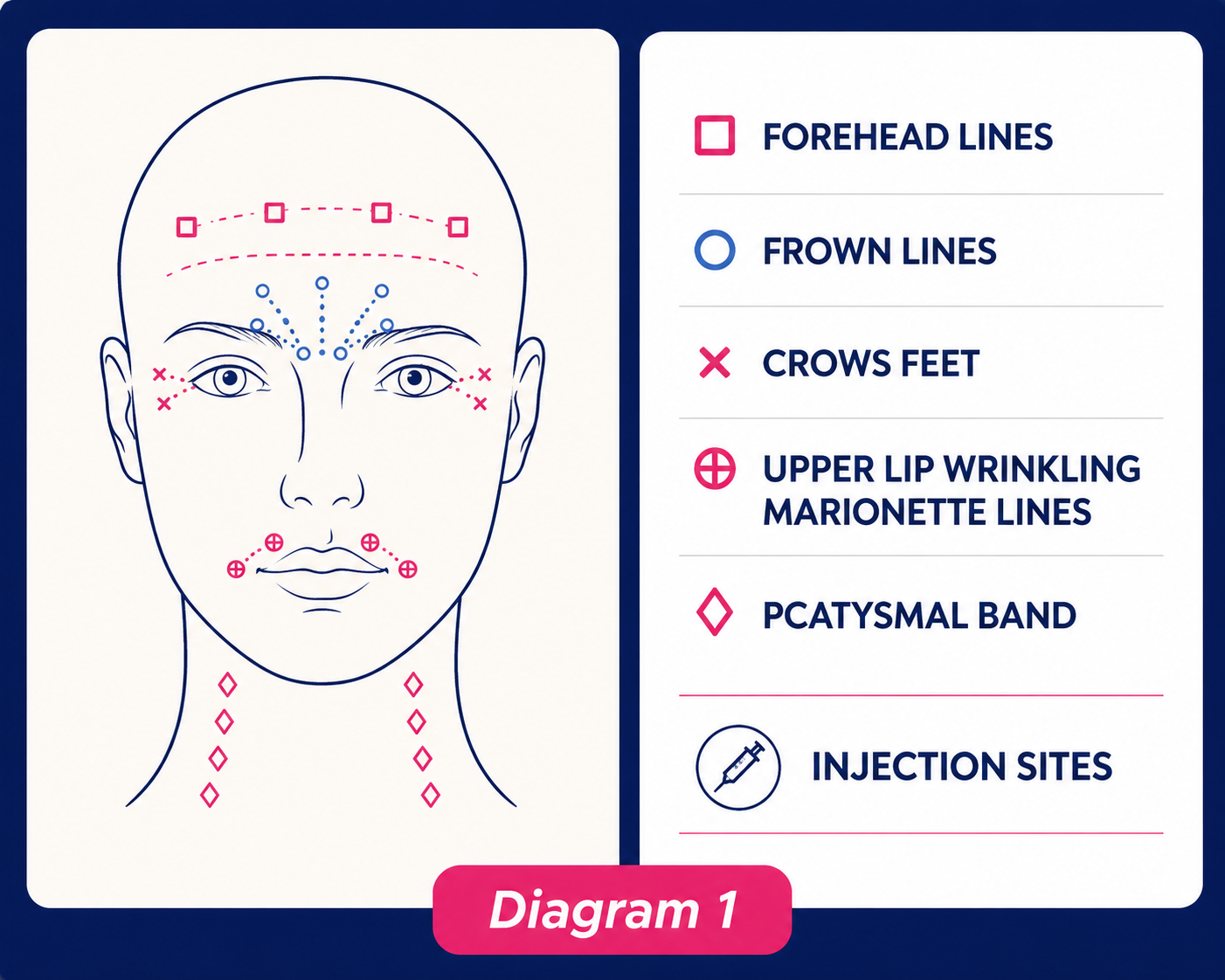
Wrinkles due to the effects of gravity represent natural sagging of tissue with age and are generally only improved by surgical tightening procedures. Wrinkles caused by muscle contraction such as frown lines between the eyebrows, forehead lines and crow's feet, can be improved by Botox treatment.
The various wrinkles caused by facial muscle contraction are illustrated on diagram 1. Botox can also be used to treat excessive sweating of the armpits and palms of the hands.
Botox injections
How does botox work?
Botox acts by blocking acetylcholine, a chemical that is responsible for transmitting electrical impulses that cause muscle contractions. This results in muscle paralysis which is temporary, because new growth of nerves will re-innervate the muscles.
How long does botox take to work?
Botox usually takes effect 24-72 hours after injection, with maximum effect at about 1 to 2 weeks. Its effects generally last for approximately 3-4 months. When injected into the muscles that are responsible for expression wrinkles, it gives the face a more relaxed and smoother appearance.
Sometimes longer lasting effects (9-12 months) are seen after treatment of excessive sweating. When a gradual fading of treatment effect is noticed you may return to have another treatment.
What can you expect at the time of your procedure?
Botox is injected directly into the muscles that cause the wrinkles, using a very small needle. Several injections are usually needed at specific injection sites, depending on the area treated (see diagram 1). When used to treat excessive sweating in the armpits, Botox is injected directed into the axillary skin. Localised discomfort and bruises can occur, but no sedation or local anaesthesia is generally required. Normal activities can be resumed immediately.
What are the limitations?
Whilst Botox can be very safe and effective way to reduce wrinkles due to muscle contractions, it has no effect in reducing the fine lines on the face caused by sun damage, and lines due to sagging of facial skin. In those patients with very heavy lines, repeated treatments may be needed for maximum effect.
Too frequent or excessive dosing of Botox may lead to a patient's resistance to treatment due to antibody formation. Botox treatment may also exaggerate any facial asymmetry and make the face look more lop-sided.
Who should not have botox?
The use of Botox is not recommended for:
People with neuromuscular disorders such as myasthenia gravis.
Those who are taking certain medications; muscle relaxants, antibiotics such as aminoglycosides (eg, gentamicin).
Pregnant or breastfeeding women.
Those with infection or inflammation at the proposed site of injections.
People who have bleeding disorders.
Is botox safe?
No severe complications after cosmetic use of Botox have been reported in the literature. Very rarely excessive weakening of the target muscles and paresis of adjacent muscles can occur, resulting in facial weakness. This is self-limiting. When injecting above the eyebrows, upper eyelid ptosis or slight drooping may occur but only 1:100. This can be corrected with eyedrops but will also improve as the effects of the Botox wear off.
Content used with permission from the British Association of Aesthetic Plastic Surgeons website: Botulinum toxin injections. Copyright for this leaflet is with the BAAPS.
Disclaimer
This leaflet is designed to supply useful information but is not to be regarded as advice specific to any particular case. It does not replace the need for a thorough consultation and all prospective patients should seek the advice of a suitably qualified medical practitioner. The BAAPS accepts no liability for any decision taken by the reader in respect of the treatment they decide to undertake.
Leaflet originally written by British Association of Aesthetic Plastic Surgeons.
Patient picks for Cosmetic surgery
Surgery and procedures
Facelifts
This leaflet is provided by the British Association of Aesthetic Plastic Surgeons, the professional body responsible for the advancement of education and safety in aesthetic plastic surgery.
by The British Association of Plastic Surgeons (BAAPS)
Surgery and procedures
Breast augmentation
This leaflet is provided by the British Association of Aesthetic Plastic Surgeons, the professional body responsible for the advancement of education and safety in aesthetic plastic surgery.
by The British Association of Plastic Surgeons (BAAPS)
Frequently asked questions
Does Botox help with all types of wrinkles?
Botox specifically targets wrinkles caused by muscle contractions from facial expressions, such as frown lines, forehead lines, and crow's feet. It does not reduce fine lines caused by sun damage or sagging skin, which are generally improved by surgical procedures.
Can Botox be used for any other conditions besides wrinkles?
Yes, in addition to treating wrinkles caused by muscle contractions, Botox is also used to treat excessive sweating, particularly in the armpits and palms of the hands.
What happens if I have Botox treatments too frequently?
Having Botox treatments too frequently or with excessive dosing can potentially lead to the patient developing a resistance to the treatment. This can happen due to the formation of antibodies against the toxin, making future treatments less effective.
Are there any temporary side effects noticeable immediately after the injections?
Immediately after the injections, you might experience localised discomfort and bruising at the injection sites. However, normal activities can usually be resumed straight away.
Can Botox make my face look uneven?
In some cases, Botox treatment might exaggerate any existing facial asymmetry or make the face appear more lop-sided. This is one of the potential limitations to be aware of.
Further reading and references
- Manufacturer's PIL, Botox® 50, 100 and 200 Allergan Units; AbbVie Ltd, The electronic Medicines Compendium. Dated April 2023.
- Borba A, Matayoshi S, Rodrigues M; Avoiding Complications on the Upper Face Treatment With Botulinum Toxin: A Practical Guide. Aesthetic Plast Surg. 2022 Feb;46(1):385-394. doi: 10.1007/s00266-021-02483-1. Epub 2021 Aug 2.
- Sundaram H, Signorini M, Liew S, et al; Global Aesthetics Consensus: Botulinum Toxin Type A--Evidence-Based Review, Emerging Concepts, and Consensus Recommendations for Aesthetic Use, Including Updates on Complications. Plast Reconstr Surg. 2016 Mar;137(3):518e-529e. doi: 10.1097/01.prs.0000475758.63709.23.
About the authorView full bio

Dr Hayley Willacy, FRCGP
General Practitioner, Medical Author
MBChB (1992), DRCOG, DFFP, MRCOG (Part 1) MRCGP (2007), DFSRH (2013), MSc - medical education (2020)
Dr Hayley Willacy was an NHS GP working in northwest England, who retired from clinical practice in 2022 after 30 years.
About the reviewerView full bio

Dr Colin Tidy, MRCGP
General Practitioner, Medical Author
MBBS, MRCGP, MRCP (Paediatrics), DCH
Dr Colin Tidy is an NHS Doctor, based in Oxfordshire.
Article history
Article also available in English, German, Spanish, French, Italian, Portuguese, Hindi, Hebrew, Arabic, and Swedish.
Next review due: 17 Jul 2028
19 Jul 2023 | Latest version
Join the conversation
Share your thoughts or experiences with others in our patient communities.

Ask, share, connect.
Browse discussions, ask questions, and share experiences across hundreds of health topics.

Feeling unwell?
Assess your symptoms online for free
Sign up to the Patient newsletter
Your weekly dose of clear, trustworthy health advice - written to help you feel informed, confident and in control.
By subscribing you accept our Privacy Policy. You can unsubscribe at any time. We never sell your data.
More in surgery and procedures
- Anaesthesia
- Colonoscopy
- Colposcopy and cervical treatments
- Coronary artery bypass graft
- Hysterectomy
- Laser eye surgery
- Laser hair removal
- Lip enhancement
- Menorrhagia surgery
- Nerve damage after epidural injection
- Nose reduction surgery (rhinoplasty)
- Post-operative chest infection
- Preventing infection after splenectomy
- Sigmoidoscopy
- Spinal anaesthetic
- Sterilisation
- Surgical drains
- Tummy tuck
- Vasectomy
- Video-assisted thoracoscopic surgery