Dieta mediterranea
Revisione paritaria di Dr Doug McKechnie, MRCGPUltimo aggiornamento di Dr Colin Tidy, MRCGPUltimo aggiornamento 8 Gen 2025
Rispetta le linee guida editoriali
- ScaricaScarica
- Condividi
- Language
- Discussione
- Versione audio
- Aggiungi alle fonti preferite su Google
Il termine 'Dieta Mediterranea' descrive una specifica combinazione di ingredienti alimentari dietetici, dimostrata per promuovere la salute e la longevità nelle persone.
A colpo d'occhio
The Mediterranean diet is a healthy eating pattern, not a strict diet plan.
It is rich in vegetables, fruit, peas, beans, and grains, with moderate amounts of chicken and fish.
Most fats come from unsaturated sources like olive oil and nuts, with little red meat.
This diet can reduce your risk of heart disease, type 2 diabetes, high blood pressure, and some cancers.
It focuses on whole foods, using herbs instead of salt, and limiting processed foods, red meat, and sugary sweets.
What is the Mediterranean diet?
The word Mediterranean refers to the origins of the diet, rather than to specific foods such as Greek or Italian foods.
Using a wide range of fruits and vegetables gives the body maximum access to sources of vitamins, minerals and other trace nutrients. There are individual foods within the Mediterranean Diet which are particularly beneficial to health, such as olive oil, garlic and some fruits and vegetables. However, overall it is the combination of foods within a healthy lifestyle which is linked to improved health.
The overuse of salt in flavouring Western-style meals and fast foods has been linked with increased blood pressure. The healthy alternative is to replace the excess salt with herbs and also garlic, as Mediterranean people have done for many years. This can also add new flavours to quite simple pasta dishes, rice dishes and stews.
The Mediterranean Diet is rich in vegetables, fruit, peas and beans (legumes) and grains. It also contains moderate amounts of chicken and fish. There is little red meat and most fat is unsaturated and comes from olive oil and nuts. Having a small amount of red wine has been shown to increase the health benefits.
In combination with moderate opzioni di esercizio and not fumare, the Mediterranean Diet offers a scientifically researched, affordable, balanced and health-promoting lifestyle choice.
Health benefits of the Mediterranean diet
The typical Western diet is high in animal fats, sugar and preservatives but low in fruit and vegetables. Scientific research has shown that this food combination is partially responsible for triggering many chronic diseases and cancers.
Research has also shown that following a Mediterranean diet can reduce the chance of developing conditions such as:
Some cancers.
It can also be useful for people wishing to lose weight as it is rich in fruit and vegetables and lower in sugars and saturated fats than a typical Western diet.
Switching from a Western to a Mediterranean diet represents a healthy lifestyle choice. It can reduce the risk of a premature death and increase the chance of a healthy retirement, free from long-term medication.
Principi generali
The Mediterranean Diet is not about quick fix superfoods. Nor is it a strict list of what you should not eat. Rather, the Mediterranean Diet is a formula for healthy day-to-day eating over the long term. Here's a quick guide for those who would like to try it:
Maximise your intake of vegetables, peas and beans (legumes), fruits and wholegrain cereals.
Limit your red meat intake - fish and poultry are healthier substitutes.
Where possible, use mono-unsaturated olive oil or rapeseed oil in place of animal fat such as butter or lard.
Limit your intake of highly processed fast foods and ready meals, which may be high in salt and saturated fat.
Eat no more than moderate amounts of dairy products.
Do not add salt to your food at the table - there is already plenty in the food.
Snack on fruit, dried fruit and unsalted nuts rather than cakes, crisps and biscuits.
Drink (red) wine during meals but no more than two small glasses per day.
Water is the best 'non-alcoholic beverage' (as opposed to sugary drinks), although health benefits have also been claimed for various teas and coffee.
Mediterranean Diet ingredients
Vegetables and fruits
The World Health Organization (WHO) - and the UK Government's Change4Life campaign - recommend we eat five portions of fruit and vegetables a day. A portion is 80 g. This guidance is partly based on research into the Mediterranean Diet. Other governments recommend higher levels of fruit and vegetables, such as seven or even ten portions daily.
A wide variety of fresh vegetables and fruits is an important part of the Mediterranean Diet. Tinned, dried and frozen fruit or vegetables are also valuable in the diet.
They are high in fibre, antioxidants and vitamins, especially vitamin C.
They help to reduce the risk of heart disease, cancers and bowel problems.
Cereali
Cereals should be wholegrain where possible, such as wholemeal bread or brown rice or pasta.
Examples are wheat, barley, oats, millet, corn and rice. They are found in cereal flakes, pasta, bread, couscous and crackers.
They provide carbohydrate, protein, fibre, vitamins and minerals.
They help to reduce bowel problems, including cancers; they help to lower cholesterol, which can reduce the risk of heart disease.
Pesce
Various types of fish are important in the Mediterranean Diet. White fish such as cod, plaice, haddock, hake and halibut are a good source of protein which is low in fat.
Shellfish such as prawns, crab, lobster and mussels contain protein and some trace minerals
Oily fish also contains omega-3 fatty acids and vitamins A and D. Omega-3 fatty acids may reduce the risk of heart disease, some cancers and dementia; they are also thought to be helpful for brain development and in the treatment of depression.
Nota: some oily fish contain low levels of toxic heavy metals. Pregnant women and those trying for a baby should limit their intake of tuna, shark and swordfish.
Legumi
These are vegetables which grow in pods. They include peas, beans, lentils, chickpeas and peanuts.
They form quite an important part of the Mediterranean Diet and are a useful base for soups and stews, as well as being found in hummus and eaten on their own - for example, as baked beans.
They provide protein, carbohydrate, fibre and vitamins. They are associated with a reduced risk of heart disease.
Grassi e oli
When cooking Mediterranean-style meals, mono-unsaturated oils are used to replace saturated animal fats, such as butter and lard.
Olive oil is the traditional oil used in the Mediterranean region but rapeseed oil produced in the UK has similar uses and benefits.
Healthier mono-unsaturated oils are also found in olives, nuts, seeds and avocados.
Vegetables can be roasted with small amounts of olive oil. Olive oil is often used in dressings for salads. You can also dip bread into it as an alternative to using butter.
Overall, although typical Western and Mediterranean diets can have a similar total fat content, the Mediterranean Diet is high in health-protective mono-unsaturated fat. However, consuming too much fat of any type can contribute to obesity.
Frutta secca e semi
Nuts such as almonds, chestnuts, walnuts, cashews and Brazil nuts, and also seeds such as pumpkin, sunflower, sesame and poppy, provide protein, fibre, vitamins and minerals, as well as being high in 'good' unsaturated fats.
Try to avoid salted nuts, as salt can raise blood pressure. As with all high-fat foods, consuming too much can contribute to obesity.
White meat
Lean chicken, turkey and other poultry are high in protein, vitamins and minerals. It is best to remove the skin and any visible fat.
When white meat is served in processed foods such as pies, burgers and fried chicken it is generally much higher in animal fat and so is not a healthy choice.
Foods to eat in smaller quantities
Wine
Wine, particularly red wine, is often consumed as part of a traditional Mediterranean diet. It contains antioxidants and anti-inflammatory chemicals and can help to protect against heart disease.
However, alcohol in excess is not healthy and current health guidelines for men and women recommend no more than two small glasses of wine daily, preferably with a couple of alcohol-free days during the week. Wine is also quite high in calories and can therefore contribute to obesity.
Pregnant women should not drink any alcohol.
Dairy produce
Milk, yoghurt, cheese, butter and cream are consumed in smaller quantities in a Mediterranean diet than in a Western diet.
Dairy products contain protein, vitamins A and B12 and calcium. However, some are also high in saturated fat, especially cream and butter.
Choosing lower-fat cheeses such as cottage cheese, mozzarella or feta rather than cream cheese or cheddar will reduce your saturated fat intake. Choosing semi-skimmed or skimmed milk rather than full-cream milk is also a lower-fat option.
La carne rossa
Red meat such as beef, pork or lamb is eaten in smaller quantities in the Mediterranean Diet than in the Western diet.
Meat is high in protein, vitamins and minerals (especially iron) but tends to be higher in fat (particularly saturated fat) compared with the fat content of poultry.
When found in processed foods such as pies and sausages, it is likely to be higher in fat and lower in nutritional value.
Red meat can form part of a healthy diet but it may be better to keep it as a treat, such as Sunday dinner, or to make it into a stew or casserole with lots of vegetables. In this way, you are consuming less red meat overall.
Patate
Potatoes can be a healthy choice, depending on the cooking method. They contain fibre, vitamins B and C and potassium.
However, they also contain a lot of starch which is rapidly converted to glucose. High available starch content can be associated with an increased risk of type 2 diabetes.
Potatoes do not have the same health benefits as other vegetables so are listed separately.
Simpler cooking methods such as boiling, baking or mashing (without butter) are healthier choices than chips, roast potatoes or crisps.
Sweets and desserts
Sweet foods such as cakes, biscuits and sweets should only be eaten in small quantities, perhaps as an occasional treat.
As well as sugar which is a major contributor to type 2 diabetes and tooth decay, they often contain high levels of saturated fat.
They may have some nutritional value.For example, milk-based desserts contain calcium, and many desserts contain fruit, although supermarket desserts rarely contain enough fruit to count as a portion.
In general, sweet foods should be eaten only in small quantities.
Adopting a strict Mediterranean diet
Scientific research has shown that the closer we can get to the ideal Mediterranean diet, outlined in the pyramid chart below, the greater the health advantage. The benefits of adopting the whole dietary pattern are greater than the health-giving properties of each type of food.
Mediterranean diet food pyramid
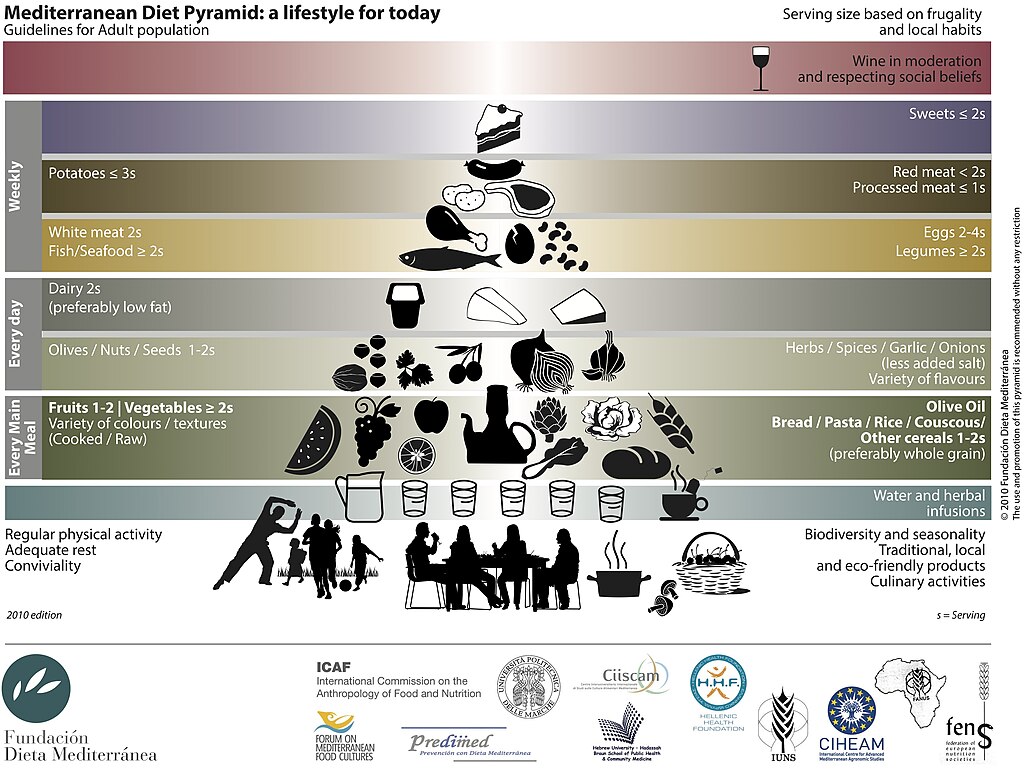
© Fundación Dieta Mediterránea (Mediterranean Diet Foundation, FDM), CC0, via Wikimedia Commons
A guide to portions or servings described in the pyramid is as follows:
Verdure: a cup of raw leafy vegetables or half a cup of other vegetables (at least 6 servings a day).
Patate: 100 g.
Legumi: one cup (100 g) of cooked dry beans.
Noci: 30 g. Eat as a snack or sprinkle on food for added taste.
Fruit: one apple, banana, one orange, 200 g of melon or watermelon, 30 g of grapes.
Carne: 60 g of cooked lean meat or fish.
Grains: half a cup (50-60 g) of cooked pasta or rice; one slice of bread (25 g).
Latticini: one cup of milk or yoghurt; 30 g of cheese.
Uova: one egg.
Wine: 125 ml glass of average-strength red wine.
In sintesi
The strict Mediterranean Diet has been assessed and found to contain all the essential nutrients required for normal health. It also avoids excessive consumption of ingredients linked to ill health. Try it for yourself.
Scelte del paziente per Dieta e nutrizione

Vita sana
Cibi ricchi di calcio
Calcium is an important nutrient with many functions. It's necessary for nerve function, to help muscles contract and to assist with normal blood clotting. Our primary source of calcium is from food.
di Dr Hayley Willacy, FRCGP

Vita sana
Carenza di vitamina C
La vitamina C non può essere prodotta dal corpo umano ed è quindi un componente essenziale della dieta. È necessaria per la salute e la riparazione di vari tessuti nel corpo, tra cui pelle, ossa, denti e cartilagine. Una carenza persistente di vitamina C nella dieta può portare a una condizione chiamata scorbuto. I sintomi dello scorbuto includono facile formazione di lividi, sanguinamenti facili e dolori articolari e muscolari. La carenza di vitamina C può essere trattata con integratori di vitamina C e una dieta ricca di vitamina C.
di Dr Philippa Vincent, MRCGP
Domande frequenti
What kind of cereals are recommended on the Mediterranean diet?
Cereals on the Mediterranean diet should primarily be wholegrain options like wholemeal bread, brown rice, or whole wheat pasta. Examples include wheat, barley, oats, millet, corn, and rice, found in various forms such as flakes, bread, couscous, and crackers. These provide important carbohydrates, protein, fibre, vitamins, and minerals, and can help reduce bowel problems and lower cholesterol.
How much dairy is appropriate in a Mediterranean diet?
Dairy products like milk, yoghurt, and cheese are consumed in smaller quantities in a Mediterranean diet compared to a typical Western diet. While they offer protein, vitamins A and B12, and calcium, some dairy, especially cream and butter, can be high in saturated fat. It's recommended to choose lower-fat options such as cottage cheese, mozzarella, feta, semi-skimmed or skimmed milk.
Are potatoes considered a healthy part of the Mediterranean diet?
Potatoes can be a healthy choice depending on how they are prepared, offering fibre, vitamins B and C, and potassium. However, they contain a lot of starch, which quickly converts to glucose, and a high starch content can be linked to an increased risk of type 2 diabetes. They don't offer the same health benefits as other vegetables. Healthier cooking methods include boiling, baking, or mashing without butter, avoiding options like chips or roast potatoes.
What is considered a portion size for fruit and vegetables on this diet?
A portion of fruit or vegetables is typically 80g. For example, specific portion sizes include one apple, banana, or orange, 200g of melon or watermelon, or 30g of grapes for fruit. For vegetables, it's a cup of raw leafy greens or half a cup of other vegetables. The diet recommends at least six servings of vegetables per day.
What kind of fats are used for cooking in the Mediterranean diet?
The Mediterranean diet primarily uses mono-unsaturated oils, such as olive oil and rapeseed oil, for cooking, replacing saturated animal fats like butter or lard found in Western diets. These healthier fats are also present in olives, nuts, seeds, and avocados. Olive oil is often used in dressings, for roasting vegetables, or as a dip for bread.
Are all types of fish equally recommended on the Mediterranean diet?
Various types of fish are important. White fish like cod, plaice, and haddock provide low-fat protein. Shellfish such as prawns and mussels offer protein and trace minerals. Oily fish like salmon also provide omega-3 fatty acids and vitamins A and D, which may reduce the risk of heart disease, some cancers, and dementia. However, pregnant women and those trying for a baby should limit their intake of certain oily fish like tuna, shark, and swordfish due to low levels of toxic heavy metals.
Ulteriori letture e riferimenti
- Cardiovascular disease prevention; NICE Public Health Guideline (June 2010)
- Linee guida europee 2021 sulla prevenzione delle malattie cardiovascolari nella pratica clinica; Società Europea di Cardiologia (2021)
- Risk estimation and the prevention of cardiovascular disease; Scottish Intercollegiate Guidelines Network - SIGN (2017)
- Malattie cardiovascolari: valutazione e riduzione del rischio, inclusa la modifica dei lipidi; NICE Guidance (July 2014 - last updated February 2023)
- CVD risk assessment and management; NICE CKS, maggio 2023 (accesso solo Regno Unito)
- Lacatusu CM, Grigorescu ED, Floria M, et al; The Mediterranean Diet: From an Environment-Driven Food Culture to an Emerging Medical Prescription. Int J Environ Res Public Health. 2019 Mar 15;16(6). pii: ijerph16060942. doi: 10.3390/ijerph16060942.
Informazioni sull'autoreVisualizza il profilo completo

Dr Colin Tidy, MRCGP
Medico di base, Autore medico
MBBS, MRCGP, MRCP (Paediatrics), DCH
Il Dr Colin Tidy è un medico del NHS, con sede nell'Oxfordshire.
Informazioni sul recensoreVisualizza il profilo completo

Dr Doug McKechnie, MRCGP
Scrittore Medico
MA, MBBS, MSc, DRCOG, MRCP(UK), MRCGP(2021), FHEA
Il dottor Doug McKechnie è un medico di base del NHS che lavora a Londra. Lavora a tempo pieno in ambito clinico ed è anche Vice Responsabile del modulo di Pratica Clinica e Professionale presso la Scuola di Medicina dell'University College London.
Storia dell'articolo
Le informazioni su questa pagina sono scritte e revisionate da clinici qualificati.
Articolo disponibile anche in Inglese, Tedesco, Spagnolo, Francese, Italiano, Portoghese, Hindi, Ebraico, Arabo, and Svedese.
Prossima revisione prevista: 7 Gen 2028
8 Gen 2025 | Ultima versione

Chiedi, condividi, connettiti.
Esplora le discussioni, fai domande e condividi esperienze su centinaia di argomenti di salute.

Non ti senti bene?
Valuta i tuoi sintomi online gratuitamente
Iscriviti alla newsletter di Patient
La tua dose settimanale di consigli sulla salute chiari e affidabili - scritti per aiutarti a sentirti informato, sicuro e in controllo.
Abbonandoti accetti i nostri Informativa sulla Privacy. Puoi annullare l'iscrizione in qualsiasi momento. Non vendiamo mai i tuoi dati.
Più su uno stile di vita sano
- Astinenza da alcol e disintossicazione da alcol
- Sostituzione della buprenorfina per l'eroina
- Diete adatte per persone con anemia
- Esercizio e attività fisica
- Quanta sodio dovresti assumere?
- Insonnia
- Malattie del fegato e alcol
- Sostituzione della metadone per l'eroina
- Terapia sostitutiva della nicotina
- Orlistat
- Dieta paleolitica (dieta paleo)
- Sindrome da refeeding
- Calcolatore del debito di sonno
- Russare
- Antidolorifici forti
- Carenza di vitamina A
- Calcolatore del rapporto Vita-Fianchi
- Chirurgia per la perdita di peso
- Riduzione del peso
- Carenza, eccesso e integrazione di zinco