Emorragia sottocongiuntivale
Revisione paritaria di Dr Doug McKechnie, MRCGPUltimo aggiornamento di Dr Toni Hazell, FRCGPUltimo aggiornamento 27 Apr 2025
Rispetta le linee guida editoriali
- ScaricaScarica
- Condividi
- Language
- Discussione
- Ask Patient
- Versione audio
- Aggiungi alle fonti preferite su Google
In questa serie:Problemi agli occhicongiuntivite infettivaCongiuntivite allergicaOcchi secchiEpisclerite e scleriteUveite
Un'emorragia sottocongiuntivale è una causa comune di occhio rosso. È causata da un piccolo sanguinamento dietro la copertura dell'occhio. Può sembrare allarmante ma di solito non provoca sintomi ed è generalmente innocua. Il rossore di solito scompare entro due settimane.
A colpo d'occhio
A subconjunctival haemorrhage is bleeding under the thin 'skin' on the front of the eyeball.
It often appears as a bright red patch on the white of the eye but usually has no symptoms.
Most cases have no apparent cause, but injuries or certain medical conditions can contribute.
No treatment is normally needed as the bleed fades and disappears within two weeks.
See your doctor if you suspect an eye injury or have other unusual bleeding or bruising.
Scelte video per Lesioni oculariVideo library
Cos'è un'emorragia sottocongiuntivale?
Emorragia sottocongiuntivale: "Occhio rosso"
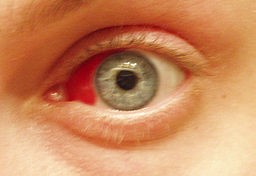
La congiuntiva è come una sottile 'pelle' sulla parte anteriore del bulbo oculare. Copre la parte bianca dell'occhio (la sclera) ma non copre la parte centrale dell'occhio (la cornea).
Tra la congiuntiva e la sclera scorrono piccoli vasi sanguigni. Se guardi attentamente la sclera, potresti riuscire a vedere alcuni piccoli vasi sanguigni.
Se uno di questi piccoli vasi sanguigni si rompe, sanguina tra la congiuntiva e la sclera. Questo sanguinamento è chiamato emorragia sottocongiuntivale.
Cosa causa un'emorragia sottocongiuntivale?
Nella stragrande maggioranza dei casi non c'è una causa apparente. Si verificano più spesso nelle persone anziane e accadono frequentemente anche nei neonati sani.
Occasionally, a subconjunctival haemorrhage can be caused by an injury to the eye or a head injury. Sometimes they occur after a bout of coughing or being sick (vomiting). They are associated with other medical conditions such as pressione alta (ipertensione),diabete mellito and coronary heart disease. If you have a bleeding disorder, such as haemophilia, or if you take farmaci anticoagulanti (blood thinners such as warfarin), you may be more prone to getting a subconjunctival haemorrhage (or other bleeding such as nosebleeds or easy bruising).
Quali sono i sintomi di un'emorragia sottocongiuntivale?
Di solito nessuno. Spesso non te ne accorgi finché qualcuno non te lo fa notare, o lo vedi in uno specchio. Può essere allarmante, poiché a volte una grande parte del bianco dell'occhio (sclera) appare rosso vivo. Questo perché il piccolo sanguinamento (emorragia) si diffonde tra la sottile 'pelle' sulla parte anteriore del bulbo oculare (la congiuntiva) e la sclera in un sottile film. Sembra molto peggio di quanto non sia in realtà! Il tuo occhio potrebbe sentirsi leggermente irritato, ma la tua visione dovrebbe essere completamente normale. Non è raro che accada di nuovo in un secondo momento.
Qual è il trattamento per un'emorragia sottocongiuntivale?
A meno che non ci sia un problema medico sottostante, non è necessario alcun trattamento. Di solito svanirà e scomparirà entro due settimane. (Come qualsiasi altro livido, il colore rosso diventerà giallo/marrone prima di svanire.) Se il tuo occhio si sente irritato, puoi usare lacrime artificiali. È meglio evitare farmaci come l'ibuprofene, che possono peggiorare il sanguinamento. Informi il suo medico se:
Non hai controllato la tua pressione sanguigna di recente.
Sospetti che una lesione all'occhio sia la causa (ad esempio, un piccolo frammento di metallo volante da un martello, scalpello, ecc).
Hai notato altri sanguinamenti o lividi insoliti sul tuo corpo senza una ragione apparente.
Come prevenire un'emorragia sottocongiuntivale
There are some steps you can take to help prevent subconjunctival haemorrhage or indeed, lesioni oculari. Questi includono:
Indossa occhiali protettivi durante lo sport o il fai-da-te dove detriti potrebbero entrare nei tuoi occhi.
Inserisci e rimuovi correttamente le tue lenti a contatto e mantienile pulite.
Chiedi consiglio medico al tuo dottore se sospetti di avere un disturbo emorragico.
Avoid rubbing your eyes.
Scelte del paziente per Lesioni oculari

Salute degli occhi
Gestire le lesioni oculari
Questo opuscolo è creato dai consigli di pronto soccorso forniti da St John Ambulance, la principale organizzazione benefica di pronto soccorso del paese. Questi consigli non sostituiscono un corso di pronto soccorso - trova un corso di formazione vicino a te. Le lesioni agli occhi variano da qualcosa di molto lieve, come avere dello shampoo nell'occhio, a qualcosa di piuttosto serio, come un taglio, che potrebbe causare una perdita permanente della vista.
da St John Ambulance

Salute degli occhi
Lesione corneale e corpi estranei
Minor scratches or abrasions to the cornea are common. They can be extremely sore but usually heal in 24-48 hours. A course of antibiotic eye drops or ointment is commonly prescribed to prevent an eye infection from developing. More serious injuries to the eye may occur from sharp objects and from small flying particles hitting the eye at high speed. Serious injury can also result from chemical burns. Always see a doctor for a proper eye examination if you suspect that your eye has been injured from a small flying particle, or from a chemical.
di Dr Mary Elisabeth Lowth, FRCGP
Domande frequenti
Can a subconjunctival haemorrhage affect both eyes at the same time?
The article describes a subconjunctival haemorrhage as a burst blood vessel in one eye, leaving the impression that it typically affects one eye at a time. It does not mention simultaneous occurrence in both eyes.
If I wear contact lenses, can they cause a subconjunctival haemorrhage?
The article suggests that improper insertion or removal of contact lenses, or not keeping them clean, could contribute to eye injury. While it doesn't explicitly state that contact lenses directly cause a subconjunctival haemorrhage, it advises proper management of contact lenses as a preventative measure.
Should I be concerned if I get repeated subconjunctival haemorrhages?
The article mentions that it is not uncommon for a subconjunctival haemorrhage to happen again at a later date. If you experience repeated instances, it might be worth mentioning to your doctor, particularly if you also have other symptoms like unusual bleeding or bruising elsewhere on your body, or if you haven't had your blood pressure checked recently, as these can be associated conditions.
Is it possible for a subconjunctival haemorrhage to lead to blindness or long-term vision problems?
The article states that your vision should be entirely normal with a subconjunctival haemorrhage and that it looks a lot worse than it really is. It does not suggest any risk of blindness or long-term vision problems as a result of this condition itself.
Can certain medications other than blood thinners make me more susceptible to a subconjunctival haemorrhage?
The article highlights that anticoagulant medication (blood thinners like warfarin) can make you more prone to bleeding, including subconjunctival haemorrhage. However, it does not mention other specific medications as increasing susceptibility to this condition beyond those that affect blood clotting.
How can I tell the difference between a subconjunctival haemorrhage and another type of 'red eye' condition?
The article describes a subconjunctival haemorrhage as a bright red patch on the white of the eye, often without symptoms other than mild irritation, and with normal vision. It does not provide information on how to distinguish it from other causes of 'red eye'.
Ulteriori letture e riferimenti
- Cronau H, Kankanala RR, Mauger T; Diagnosi e gestione dell'occhio rosso nelle cure primarie. Am Fam Physician. 15 gennaio 2010;81(2):137-44.
- Tarlan B, Kiratli H; Emorragia sottocongiuntivale: fattori di rischio e indicatori potenziali. Clin Ophthalmol. 2013;7:1163-70. doi: 10.2147/OPTH.S35062. Pubblicato online il 12 giugno 2013.
- Doshi R, Noohani T; Emorragia Sottocongiuntivale. StatPearls, Gen 2023.
Informazioni sull'autoreVisualizza il profilo completo
Aggiornato da

Dr Toni Hazell, FRCGP
MBBS, BSc, FRCGP, DFSRH, Dip GU med, DRCOG, DCH (London, UK, 2000)
La Dott.ssa Toni Hazell si è laureata presso la St. Mary’s Hospital Medical School e ha completato il suo VTS al Northwick Park Hospital.
Informazioni sul recensoreVisualizza il profilo completo

Dr Doug McKechnie, MRCGP
Scrittore Medico
MA, MBBS, MSc, DRCOG, MRCP(UK), MRCGP(2021), FHEA
Il dottor Doug McKechnie è un medico di base del NHS che lavora a Londra. Lavora a tempo pieno in ambito clinico ed è anche Vice Responsabile del modulo di Pratica Clinica e Professionale presso la Scuola di Medicina dell'University College London.
Professionisti Medici
Looking for more in-depth clinical detail? Our Professional Reference articles are written for doctors, nurses and other healthcare professionals. They include comprehensive clinical guidance, diagnostic information and UK/European evidence summaries. If you need the clinical version, you can read the Professional Reference article on this topic.
Condividi i tuoi pensieri o esperienze con gli altri nel nostro comunità di pazienti.
Accesso semplice a trattamenti affidabili e servizi sanitari online.
Common conditions
Get help with common conditions through the NHS, without a GP appointment.
 Sinusite acuta
 Tonsillite batterica
 Impetigine
 Punture di insetti
 Fuoco di Sant'AntonioInfezioni delle vie urinarie (IVU)
Iscriviti alla newsletter di Patient
La tua dose settimanale di consigli sulla salute chiari e affidabili - scritti per aiutarti a sentirti informato, sicuro e in controllo.
Abbonandoti accetti i nostri Informativa sulla Privacy. Puoi annullare l'iscrizione in qualsiasi momento. Non vendiamo mai i tuoi dati.