Cancro alla gola
Cancro laringeo
Revisione paritaria di Dr Colin Tidy, MRCGPUltimo aggiornamento di Dr Hayley Willacy, FRCGP Ultimo aggiornamento 15 giu 2023
Rispetta le linee guida editoriali
- ScaricaScarica
- Condividi
- Language
- Discussione
- Ask Patient
- Versione audio
- Aggiungi alle fonti preferite su Google
La maggior parte dei casi di cancro della laringe si verifica in persone di età superiore ai 60 anni. Il sintomo precoce comune è una voce rauca persistente. Molti casi vengono diagnosticati in una fase iniziale quando c'è una buona possibilità di guarigione. In generale, più il cancro è avanzato (più è cresciuto e si è diffuso), minori sono le possibilità che il trattamento sia curativo.
A colpo d'occhio
Il cancro alla gola è un termine generico per i tumori che colpiscono la gola, incluso il cancro laringeo.
Il carcinoma a cellule squamose della laringe è il tipo più comune, colpendo oltre 9 casi su 10.
Una voce rauca persistente per 2-4 settimane dovrebbe essere controllata da un medico.
Fumare e bere grandi quantità di alcol aumentano il rischio.
Le opzioni di trattamento includono radioterapia, chirurgia e chemioterapia.
La diagnosi precoce e il trattamento offrono una buona possibilità di guarigione.
What is throat cancer?
Throat cancer is a general term used to describe cancers of the throat. It is sometimes called laryngeal cancer (cancer of the larynx). However, the throat includes other nearby structures as well as the voice box (larynx).
Laryngeal cancer is just one type of cancer that can occur in the throat. Throat cancers and cancers that affect the mouth, are together all called oropharyngeal cancers.
How common is throat cancer?
Throat (laryngeal) cancer is uncommon in the UK with around 2,000 cases developing each year. It is twice as common in men as in women. Although it is increasing in younger people it is still rare in people aged under 40 years. It is most common in people aged over 70 years. Cancer of the larynx occurs in people all over the world but is more common is some countries than in others, probably due to exposure to known risk factors (see below).
Types of throat cancer
There are different types of throat (laryngeal) cancer:
Squamous cell carcinoma of the larynx occurs in more than 9 in 10 cases. This type arises from cells which are on the inside lining of the larynx.
Altri tipi. There are some rare types of cancer which arise from other types of cells within the larynx. For example, adenocarcinoma of the larynx arises from cells in the tiny glands in the wall of the larynx that make mucus. There are some other very rare types.
Vedi l'opuscolo separato intitolato Cancro per ulteriori informazioni generali sul cancro
The rest of this leaflet is about squamous cell carcinoma of the larynx.
Che cos'è la laringe?
Testa e collo che mostrano la laringe
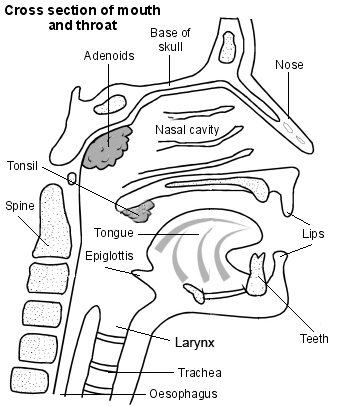
The larynx makes up part of the throat and is located at the top part of the windpipe (trachea). It is about 5 cm long and is sometimes called the voice box. You can see and feel the front part of the larynx as the Adam's apple on the front of the neck, just below the chin.
The larynx contains the vocal cords. These are V-shaped ridges of muscle tissue on the inside lining of the larynx. They vibrate when air passes between them to produce speech. This is why the larynx is also called the voice box.
When you breathe in, air passes into the larynx and down the trachea towards the lungs. When you swallow, the larynx moves upwards slightly and a flap of cartilage tissue at the back of the tongue, called the epiglottis, closes over the entrance to the larynx. This ensures that food or drink goes down the gullet (oesophagus) and not down the trachea.
Throat cancer symptoms
A hoarse voice is often the first symptom because most cancers of the larynx first start on, or close by, a vocal cord. The problem is a hoarse voice is a common symptom of a viral infection of the larynx (laringite). Most people with hoarseness do not have cancer. However, laryngitis usually clears within a week or so. Therefore, see a doctor if you develop a hoarse voice which does not go within 2-4 weeks.
Altri sintomi that may occur as the tumour grows in the larynx include: a lump in the throat, a sore throat when swallowing, and difficulty with breathing. These symptoms may occur before a hoarse voice develops if the tumour does not start next to the vocal cords.
If the cancer spreads to local lymph glands (lymph nodes) then the nearby glands in the neck will swell.
If the cancer spreads to other parts of the body, various symptoms can develop.
Perdita di peso inspiegabile.
All the symptoms can be due to other conditions, so tests are needed to confirm the diagnosis
Causes of throat cancer
A cancerous (malignant) tumour starts from one cell behaving abnormally. The exact reason why a cell does this is unclear. It is thought that something damages or changes certain genes in the cell. This makes the cell multiply out of control and become cancerous. See the separate leaflet called Causes of Cancer for more details.
Some people develop throat (laryngeal) cancer for no apparent reason. However, certain risk factors increase the chance that cancer of the larynx may develop. These include:
Fumare. The damaging smoke passes through the larynx on its way to the lungs. The more you smoke, the greater the risk:
Smoking at all makes you 10 to 15 times more likely to develop throat (laryngeal) cancer than a non-smoker.
If you smoke heavily (20 cigarettes or more a day) you are 30 times more likely to develop throat (laryngeal) cancer.
Regularly drinking large amounts of alcol. The more you drink, the more likely you are to develop throat (laryngeal) cancer:
Drinking alcohol makes you about two and a half times more likely to develop throat (laryngeal) cancer, if you don't also smoke. It is much more likely if you smoke too.
Invecchiamento. It is more common in older people. Most cases are in people over 70.
Virus del papilloma umano (HPV) is associated with cancer of the larynx:
People who develop HPV-associated cancer of the larynx tend to be younger and also tend to have a better outlook (prognosis).
Most people with HPV will fare affidamento develop throat (laryngeal) or any other cancer.
There is an immunisation against HPV which may reduce the risk of developing cancer of the larynx. You can find out more about this in the separate leaflet called Human Papillomavirus Immunisation (HPV).
A poor diet may be a risk factor, especially a diet lacking in certain vitamins and minerals.
Long-term exposure to certain chemicals, fumes or pollutants may irritate the larynx if you breathe them in and may increase the risk.
Throat cancer diagnosis
Valutazione iniziale
If a doctor suspects that you may have throat (laryngeal) cancer, they will refer you to an ear, nose and throat (ENT) specialist. The specialist will examine the inside of your throat by using a small mirror and light. They may also use a thin, flexible, telescope (a nasal endoscope).
This is passed into your nose and down the back of your throat. The nasal endoscope contains fibre-optic channels, allowing light to shine down so the doctor can see inside. (The throat is usually sprayed with a local anaesthetic before use of a nasal endoscope, so that the procedure is not too uncomfortable.)
Nota dell'editore
Dr Krishna Vakharia, 16th October 2023
L'Istituto Nazionale per la Salute e l'Eccellenza delle Cure (NICE) ha raccomandato che una persona dovrebbe ricevere una diagnosi o l'esclusione del cancro entro 28 giorni dal rinvio urgente da parte del proprio medico di base per sospetto cancro.
Per confermare la diagnosi
If anything suspicious is seen by the examination or with the nasal endoscope, you will usually need a biopsy. Una biopsia is a procedure involving a small sample of tissue being removed from a part of the body. The sample is then looked at under the microscope to look for abnormal cells.
The biopsy sample is obtained by a thin, flexible grabbing instrument which is passed through your nose into the larynx. The same instrument has a light source similar to a nasal endoscope. Therefore, the specialist will also examine the windpipe (trachea) and the gullet (oesophagus) to see the extent of any tumour.
Valutazione dell'estensione e della diffusione (stadiazione)
In addition to the above tests, if you are confirmed to have throat (laryngeal) cancer then further tests may be done; for example, biopsy samples may be taken from the nearby lymph glands by using a fine needle. This helps to assess if any cancer cells have spread to the lymph glands.
Other tests may be arranged to see if the cancer has spread to other parts of the body. For example, a computerised tomography (CT) scan, a magnetic resonance imaging (MRI) scan, a positron emission tomography (PET) scan or other tests. (You can read more about these tests in the separate leaflets called CT scan, Risonanza magnetica e Scansione PET.)
Questa valutazione è chiamata stadiazione del cancro. L'obiettivo della stadiazione è scoprire:
How much the tumour in the larynx has grown.
Se il cancro si è diffuso ai linfonodi locali.
Se il cancro si è diffuso ad altre aree del corpo (metastatizzato).
Grade of the cancer
The biopsy samples are looked at under the microscope to assess the cancer cells. By looking at certain features of the cells the cancer can be graded.
The common grading system used for throat (laryngeal) cancer is:
Grado 1 (low grade). The cells look reasonably similar to normal cells in the larynx. The cancer cells are said to be well differentiated. The cancer cells tend to grow and multiply quite slowly and are not so aggressive.
Grado 2 (intermediate grade).
Grado 3 (high grade). The cells look very abnormal and are said to be poorly differentiated. The cancer cells tend to grow and multiply quite quickly and are more aggressive.
By finding out the stage and grade of the cancer it helps doctors to advise on the best treatment options. It also gives a reasonable indication of outlook (prognosis). However, for throat (laryngeal) cancer, it may not be possible to give an accurate staging until after an operation to remove the tumour. Vedi l'opuscolo separato intitolato Stadi del Cancro per maggiori dettagli.
Throat cancer treatment
Treatment options which may be considered include radiotherapy, surgery and chemotherapy. The treatment advised for you depends on various factors such as the exact site of the primary tumour in the larynx, the stage of the cancer (how large the cancer is and whether it has spread), the grade of the cancerous cells and your general health.
You should have a full discussion with a specialist who knows your case. They will be able to give the pros and cons, likely success rate, possible side-effects and other details about the possible treatment options for your type of cancer.
Dovresti anche discutere con il tuo specialista gli obiettivi del trattamento. Ad esempio:
In some cases, treatment aims to cure the cancer. There is a good chance of a cure if it is treated in the early stages. Many cases are diagnosed at an early stage. This is because tests are usually done if you develop a persistent hoarse voice which often develops when the cancer is still at an early stage. (Doctors tend to use the word remission rather than the word cured. Remission means there is no evidence of cancer following treatment. If you are in remission, you may be cured. However, in some cases a cancer returns months or years later. This is why doctors are sometimes reluctant to use the word cured.)
In some cases, treatment aims to control the cancer. If a cure is not realistic, with treatment it is often possible to limit the growth or spread of the cancer so that it progresses less rapidly. This may keep you free of symptoms for some time.
In some cases, treatment aims to ease symptoms. For example, if a cancer is advanced then you may require painkillers or other treatments to help keep you free of pain or other symptoms. Some treatments may be used to reduce the size of a cancer, which may ease symptoms such as pain or difficulty with swallowing.
Radioterapia
This is the common treatment if the cancer is small and has not spread from the larynx (early stage). Radiotherapy is a treatment which uses high-energy beams of radiation which are focused on cancerous tissue. This kills cancer cells, or stops cancer cells from multiplying. Vedi l'opuscolo separato chiamato Radioterapia per maggiori dettagli.
Radiotherapy alone gives a good chance of a cure if the cancer is at an early stage. Radiotherapy is also sometimes used in addition to surgery or chemotherapy in certain situations. For example, radiotherapy may be used to shrink a large tumour prior to surgery. This may give a better chance of success with surgery. It is sometimes used following surgery, to kill any cancer cells which may have been left behind following the operation.
Chirurgia
Tumours which are larger tend to require surgery. Sometimes surgery is aimed at curing the cancer by removing it all. Sometimes surgery is used to relieve symptoms if the cancer is at an advanced stage (palliative surgery). The operations are all done whilst you are asleep under a general anaesthetic.
The type of operation done depends on the size of the tumour, the exact site of the tumour in the larynx and whether the cancer has spread to nearby structures or lymph glands. For example:
Endoscopic resection. This is a technique which can remove a small tumour in the larynx. Instruments which cut out a tumour are passed down the inside of the larynx. Sometimes a laser is used to burn out the tumour. This technique does not involve a cut from the outside. It is sometimes called transoral laser microscopic (TLM) surgery. It is only suitable for tumours that are small and still confined to the inner lining of the larynx.
Partial laryngectomy. This is an operation where the affected part of the larynx is cut out. A cut is made in the front of the neck to get at the larynx. If only part of the larynx is removed you should not need a permanent hole in the neck (stoma) to breathe and speech may be preserved. A temporary stoma may be required whilst the wound is healing.
A total laryngectomy. This is an operation where the entire larynx is removed. To be able to breathe after the operation, the top part of the windpipe (trachea) is attached to the front of the neck. You will then have a permanent stoma in the front of the neck. The vocal cords will have been removed so you will not be able to speak normally again. However, there are various techniques that you can be taught by a speech therapist which can enable you to make sounds and speak in a different way.
If the cancer has spread, the surgeon may also remove lymph glands and other structures near to the larynx in addition to removing the larynx. The amount of tissue removed depends on the extent of local spread of the cancer.
Chemioterapia
Chemotherapy is a treatment which uses anti-cancer drugs to kill cancer cells, or to stop them from multiplying. Chemotherapy used in conjunction with radiotherapy is sometimes used as an alternative to surgery. It aims to preserve the larynx and normal speech. Your specialist will advise when this may be an option. Chemotherapy may also be advised if the cancer has spread to other areas of the body.
Altri trattamenti
Cetuximab is a fairly new treatment for throat (laryngeal) cancer. It is a type of monoclonal antibody which means that it can recognise and bind to specific proteins (receptors) that are found in the cancer cells. These proteins are epidermal growth factor receptors (EGFRs) which stimulate the cancer cell to grow and divide. Cetuximab locks on to the EGFR and can prevent the cancer cells from growing and dividing.
At the moment, cetuximab is a treatment that is usually given at the same time as radiotherapy in people who are unable to have chemotherapy.
Preventing throat cancer
Some of the risk factors that make laryngeal cancer more likely can be avoided. Reducing the number of risk factors you have will reduce the risk. Strategies include:
Reduce the amount of alcol you drink.
Have a balanced diet.
Avoid exposure to chemicals, fumes or pollutants where possible.
What is the outlook of throat cancer?
If a throat (laryngeal) cancer is diagnosed and treated at an early stage then there is a good chance of a cure. A cure is less likely if the cancer has spread. Voice problems are extremely common after treatment for laryngeal cancer and speech therapy should be offered to anyone affected.
The treatment of cancer is an area of medicine that is developing quickly. New treatments are constantly being developed and the information on outlook (prognosis) above is very general. The specialist who knows you and your disease can give you more accurate information about your particular outlook and how your stage and grade of cancer is likely to behave with treatment.
Scelte del paziente per Altri tipi di cancro

Cancro
Cancro alla bocca
Il cancro della bocca può colpire qualsiasi parte della bocca, inclusi la lingua e le labbra. I sintomi più comuni sono avere una piaga o un'ulcera per più di tre settimane. Dovresti consultare il tuo dentista o medico se hai sintomi insoliti nella bocca. La prognosi per le persone con cancro della bocca è buona se viene diagnosticato precocemente.
di Dr Hayley Willacy, FRCGP

Cancro
Cancro primario delle ossa
Il cancro osseo primario si verifica quando un tumore ha origine in un osso. È un tipo di cancro raro. Esistono diversi tipi. I trattamenti che possono essere considerati includono la chirurgia, la chemioterapia e la radioterapia. Il tipo di trattamento utilizzato e la prognosi dipendono da vari fattori, tra cui il tipo, il sito e lo stadio del cancro.
di Dott.ssa Rosalyn Adleman, MRCGP
Domande frequenti
Qual è la differenza tra diagnosticare e stadiare il cancro alla gola?
La diagnosi del cancro alla gola comporta un esame iniziale da parte di uno specialista ORL, spesso utilizzando un piccolo specchio e una luce o un endoscopio nasale. Se viene trovato qualcosa di sospetto, viene eseguita una biopsia per confermare la presenza di cellule cancerose. La stadiazione, invece, determina l'estensione e la diffusione del cancro confermato. Questo può comportare test aggiuntivi come scansioni TC, RM o PET, e talvolta biopsie delle ghiandole linfatiche vicine, per valutare la dimensione del tumore, la diffusione ai linfonodi o ad altre parti del corpo.
Se mi viene diagnosticato un cancro alla gola, quanto rapidamente può iniziare il trattamento?
L'Istituto Nazionale per la Salute e l'Eccellenza delle Cure (NICE) raccomanda che una persona riceva una diagnosi o l'esclusione del cancro entro 28 giorni dal rinvio urgente da parte del proprio medico di base per sospetto cancro. Una volta diagnosticato, si terrà una discussione completa con uno specialista per determinare le migliori opzioni di trattamento in base al tuo caso specifico.
Cosa succede dopo una laringectomia totale se le corde vocali vengono rimosse?
Se viene eseguita una laringectomia totale, l'intera laringe, comprese le corde vocali, viene rimossa. Ciò significa che non sarai in grado di parlare normalmente di nuovo. Tuttavia, un logopedista può insegnarti varie tecniche per permetterti di emettere suoni e parlare in modo diverso.
Qual è il ruolo del Cetuximab nel trattamento del cancro alla gola?
Il Cetuximab è un trattamento relativamente nuovo per il cancro alla gola (laringe). È un tipo di anticorpo monoclonale che mira specificamente e si lega ai recettori del fattore di crescita epidermico (EGFR) sulle cellule tumorali, che sono proteine che stimolano la crescita cellulare. Bloccando questi recettori, il Cetuximab può impedire alle cellule tumorali di crescere e dividersi. Viene tipicamente utilizzato in combinazione con la radioterapia per le persone che non possono sottoporsi a chemioterapia.
Posso prevenire il cancro alla gola vaccinandomi contro l'HPV?
Sì, esiste un'immunizzazione contro il Papillomavirus Umano (HPV) che può ridurre il rischio di sviluppare il cancro alla laringe. L'HPV è associato ad alcuni casi di cancro alla laringe, e questi casi spesso hanno una prognosi migliore. Sebbene la maggior parte delle persone con HPV non sviluppi il cancro, la vaccinazione può essere una strategia per aiutare a ridurre il rischio.
Ulteriori letture e riferimenti
- Cancer of the upper aerodigestive tract: assessment and management in people aged 16 and over; NICE Guidance (February 2016 - last updated November 2018)
- Oral cancer incidence statistics; Ricerca sul Cancro UK
- Syrjanen S, Rautava J, Syrjanen K; HPV in Head and Neck Cancer-30 Years of History. Recent Results Cancer Res. 2017;206:3-25. doi: 10.1007/978-3-319-43580-0_1.
- Koroulakis A, Agarwal M; Laryngeal Cancer.
- Cetuximab for treating recurrent or metastatic squamous cell cancer of the head and neck; NICE Technology appraisal guidance [TA473]. Published August 2017.
- Blomkvist R, Marklund L, Hammarstedt-Nordenvall L, et al; Treatment and outcome among patients with laryngeal squamous cell carcinoma in Stockholm-A population-based study. Laryngoscope Investig Otolaryngol. 2023 Mar 6;8(2):441-449. doi: 10.1002/lio2.1034. eCollection 2023 Apr.
- Andaloro C, Widrich J; Total Laryngectomy.
Informazioni sull'autoreVisualizza il profilo completo
Aggiornato da

Dr Hayley Willacy, FRCGP
Medico di base, Autore medico
MBChB (1992), DRCOG, DFFP, MRCOG (Part 1) MRCGP (2007), DFSRH (2013), MSc - medical education (2020)
La Dott.ssa Hayley Willacy era un medico di base del NHS che lavorava nel nord-ovest dell'Inghilterra, e si è ritirata dalla pratica clinica nel 2022 dopo 30 anni.
Informazioni sul recensoreVisualizza il profilo completo

Dr Colin Tidy, MRCGP
Medico di base, Autore medico
MBBS, MRCGP, MRCP (Paediatrics), DCH
Il Dr Colin Tidy è un medico del NHS, con sede nell'Oxfordshire.
Storia dell'articolo
Articolo disponibile anche in Inglese, Tedesco, Spagnolo, Francese, Italiano, Portoghese, Hindi, Ebraico, Arabo, and Svedese.
Prossima revisione prevista: 12 maggio 2028
15 giu 2023 | Ultima versione
Condividi i tuoi pensieri o esperienze con gli altri nel nostro comunità di pazienti.
Accesso semplice a trattamenti affidabili e servizi sanitari online.
Common conditions
Get help with common conditions through the NHS, without a GP appointment.
 Sinusite acuta
 Tonsillite batterica
 Impetigine
 Punture di insetti
 Fuoco di Sant'AntonioInfezioni delle vie urinarie (IVU)
Iscriviti alla newsletter di Patient
La tua dose settimanale di consigli sulla salute chiari e affidabili - scritti per aiutarti a sentirti informato, sicuro e in controllo.
Abbonandoti accetti i nostri Informativa sulla Privacy. Puoi annullare l'iscrizione in qualsiasi momento. Non vendiamo mai i tuoi dati.