Raynaud's phenomenon
Peer reviewed by Dr Colin Tidy, MRCGPLast updated by Dr Hayley Willacy, FRCGP Last updated 17 Nov 2024
Meets Patient’s editorial guidelines
- DownloadDownload
- Share
- Language
- Discussion
- Audio Version
- Add to preferred sources on Google
Raynaud's phenomenon (often just called Raynaud's), is a condition where the small blood vessels of the fingers become narrow (constrict). This happens most often when they are in a cool environment. Blood vessels to other extremities such as the toes, ears and nose may also be affected. It is named after Dr Maurice Raynaud, the man who first described it in 1862.
At a glance
Raynaud's phenomenon causes fingers and toes to change colour and become painful.
It is due to small blood vessels narrowing, often triggered by cold or stress.
Keep warm, especially hands and feet, to help manage symptoms.
Most cases (primary Raynaud's) have no known cause and are usually mild.
Secondary Raynaud's is a symptom of an underlying condition.
See your doctor if symptoms start after age 30, are severe, or affect only one side.
For severe symptoms, medication like nifedipine may be prescribed.
What is Raynaud's phenomenon?
Raynaud's phenomenon occurs when the extremities of the body, usually the fingers and toes, change colour and may become painful. It is due to a narrowing (constriction) of the small blood vessels on exposure to the cold, or to a change in temperature, or to emotional stress. In most cases, the cause is not known. In some cases, it is a symptom of an underlying condition such as scleroderma, lupus, or rheumatoid arthritis.
Symptoms of Raynaud's phenomenon
Typically, symptoms develop in fingers when you become cool - for example, in cold weather.
At first the fingers go white and cool. This happens because the small blood vessels in the fingers narrow (constrict).
The fingers then go a bluish colour (or even purple or black in severe cases). This happens because the oxygen is used up quickly from the blood in the narrowed blood vessels.
The fingers then go bright red. This happens because blood vessels open up again (dilate) and the blood flow returns. This may cause tingling, throbbing, numbness and pain (which can be severe in some cases).
Hands in Raynaud's disease
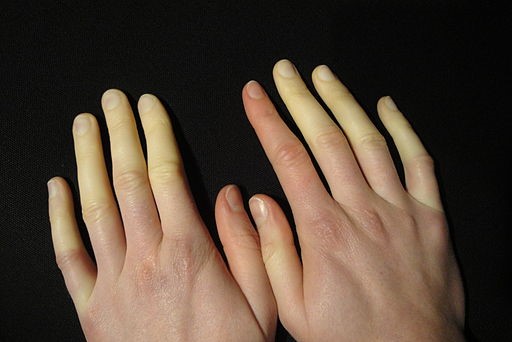
© Niklas D, CC BY-SA 3.0, via Wikimedia Commons
Many people with Raynaud's do not have the full classic colour changes but develop bouts of uncomfortable, pale, cold fingers. Only the fingers are affected in most cases. In some cases the toes are also affected. Less commonly other extremities of the body are affected, such as the earlobes, nose, nipples or tongue. Each bout of symptoms can last from minutes to hours.
Raynaud's is usually mild, with infrequent, brief bouts of symptoms that last just a few minutes. Sometimes it is moderate with more frequent bouts of symptoms that last longer. Rarely, it is severe with repeated frequent bouts, with each bout lasting longer periods of time.
Causes of Raynaud's phenomenon
Primary Raynaud's - when the cause is not known
In most cases there is no known cause (more than 9 in 10 cases). This is called primary Raynaud's. The small blood vessels in the fingers, toes, etc, just appear to be more sensitive than normal to cool temperatures. There is no other underlying disease. Symptoms are triggered more easily in some people than in others. Even mildly cool weather, or getting something out of the freezer, can trigger symptoms in some people. Strong emotion may also trigger symptoms in some cases.
Usually, all fingers on both hands are affected in primary Raynaud's. It also tends to run in some families. Women are affected much more often than men. It usually first develops before the age of 30. There are no other symptoms apart from those described above, and symptoms go completely after each bout.
Secondary Raynaud's - due to an underlying cause
There is an underlying cause in fewer than 1 in 10 cases. This is called secondary Raynaud's. Various conditions of blood vessels, joints, muscles, nerves or skin can cause secondary Raynaud's. For example, scleroderma, rheumatoid arthritis, multiple sclerosis, systemic lupus erythematosus (SLE or lupus) and other 'connective tissue' diseases.
If you have secondary Raynaud's you will normally have other symptoms in addition to the symptoms of Raynaud's. The Raynaud's is just one feature of the condition. For example, you may also have joint pains, rashes, joint swelling, etc.
Often, the underlying condition is already present and you may develop Raynaud's as a complication. Sometimes the symptoms of Raynaud's occur first and other symptoms of the underlying condition develop weeks, months or even years later.
In secondary Raynaud's, symptoms may first begin in just one or two fingers on one hand. This is in contrast to primary Raynaud's when all fingers on both hands are typically affected. Certain medicines may also cause secondary Raynaud's as a side-effect (see below).
Hand-arm vibration syndrome (vibration white finger) is another common cause of secondary Raynaud's. This is caused by using vibrating tools regularly over a long time. For example, it occurs in some shipyard workers, mine workers, road diggers, etc. It is thought that repeated vibrations over time may damage the small blood vessels or their nerve supply.
How common is Raynaud's?
Raynaud's is a common disorder. About 1 in 20 people develop Raynaud's phenomenon. Up to 9 in 10 cases are primary Raynaud's.
Primary Raynaud's usually first develops in teenagers and young adults, but it can develop at any age. Secondary Raynaud's can develop at any age when the underlying condition develops.
Do I need any tests to confirm the diagnosis?
Not in most cases. There is no test that confirms primary Raynaud's. The diagnosis of primary Raynaud's is made on the basis of the typical symptoms (described above) and there is no abnormality found that may suggest a secondary cause when a doctor examines you.
Features that may suggest secondary Raynaud's include:
Onset of symptoms after 30 years of age.
Abrupt onset with rapid progression and worsening of symptoms.
Severe symptoms that may include an ulcer or gangrene of part of a finger or toe.
Symptoms that only affect one hand or foot, or the symptoms are not the same or as severe on both hands and feet.
Joint pains or arthritis.
Skin rashes.
Dry eyes or mouth.
Muscle weakness or pain.
Swallowing difficulties.
Breathlessness.
Mouth ulcers.
Previous work with vibrating tools.
Blood tests and other tests may be done if secondary Raynaud's is suspected. Sometimes the diagnosis of an underlying cause is already known (for example, rheumatoid arthritis) and the development of Raynaud's is not a surprising feature.
Possible complications
Primary Raynaud's - complications seldom occur.
Secondary Raynaud's - complications occur in a small number of cases and include ulcers developing on affected fingers and toes; scarring of tips of fingers and toes; tissue death (gangrene) of parts of affected fingers and toes.
What can I do to help?
Smoking can make symptoms worse. The chemicals in tobacco can cause the small blood vessels to narrow. If you smoke, stopping smoking may ease or even cure the problem.
Some medicines that are used to treat other conditions sometimes trigger symptoms or make them worse. The medicine may cause the blood vessels to narrow. Such medicines include beta-blockers, some anti-migraine medicines, decongestants and, very occasionally, the contraceptive pill. Don't stop a prescribed medicine if you suspect it may be making symptoms worse. See your doctor to discuss possible alternatives.
Other drugs. Caffeine (in tea, coffee, cola and in some painkillers) triggers symptoms in some people. Try cutting out caffeine for a few weeks to see if it helps. Amphetamines and cocaine may also be a trigger.
Try to keep warm in cool weather or in cool environments:
Keep your hands and feet warm. Warm gloves, socks and shoes are essential when you are out in cool weather.
Keep your whole body warm, not just your hands and feet. Although your hands and feet are the most important, symptoms are less likely to occur if you keep your entire body warm. So, wrap up warmly before going into cooler areas, such as outside on cold days. For example, wear hats and scarves in addition to warm clothes.
It is best to put gloves on when you are warm, before going into colder areas. Ideally, keep gloves, socks and headgear in an airing cupboard or near a radiator so they will be warm when put on.
If you have severe symptoms, or symptoms that are easily triggered then portable heat packs and battery-heated gloves and socks are useful. The charity Scleroderma & Raynaud's UK has a list of suppliers - see below for their details. Your pharmacist or local medical supplier may also be able to advise.
Try not to touch cold objects. For example, use a towel or gloves when removing food from the freezer or working with cold food.
Regular exercise is recommended by many experts. Exercise your hands and feet frequently to improve the circulation.
When a bout of symptoms develops, warm the affected hands or feet as soon as possible. Soaking the hands or feet in warm running water is a good way to get warm (but take care that the water does not become too hot, or lose its heat and become cool).
Treatment for Raynaud's phenomenon
Keeping warm is the main treatment. Symptoms are much less likely to occur, and be less severe, if you keep warm (described above). Other treatments are needed only in some cases.
Medication
A calcium-channel blocker called nifedipine may be advised if symptoms are severe. It works by 'opening up' (dilating) the small blood vessels. Some people take nifedipine regularly, each day, to prevent symptoms.
Various other medicines may be tried if nifedipine is not helpful, or causes side-effects. In particular, various medicines have been tried to some effect for people with secondary Raynaud's due to certain conditions.
Stress counselling or relaxation techniques
These may be helpful if you have primary Raynaud's and the symptoms are triggered by stress or emotion.
'Nerve blocks' or other hospital-based treatments
May be tried if you have severe Raynaud's which is not helped by other treatments.
What is the outlook (prognosis)?
Primary Raynaud's
The outlook for people with primary Raynaud's is usually good. Most people have mild symptoms that do not interfere much with daily life. People with more severe symptoms often respond well to treatment with nifedipine. In some cases the condition goes away (remits) in time. In one study that followed up people with primary Raynaud's over seven years, the condition had gone away in nearly two in three cases at some point over the study period.
Sometimes, someone who is thought to have primary Raynaud's develops other symptoms several months or years later and the diagnosis is changed to secondary Raynaud's. This is thought to occur in about 1 in 10 people who are initially diagnosed with primary Raynaud's.
Secondary Raynaud's
There are various underlying conditions that can cause secondary Raynaud's and their severity can vary. In general, symptoms are often more severe than with primary Raynaud's, and tend to respond less well to treatment. In some situations, treating an underlying condition will ease the symptoms of Raynaud's.
Patient picks for Blood vessel disorders
Heart health and blood vessels
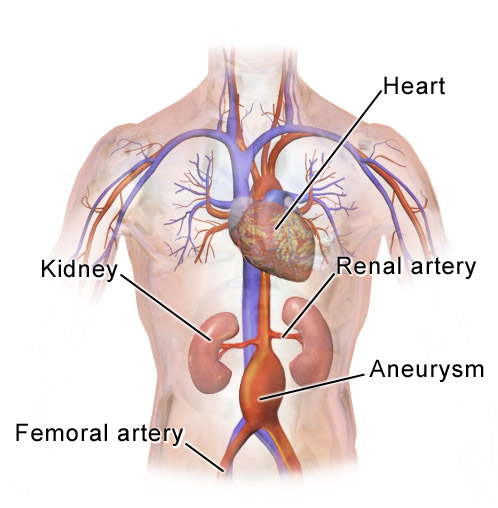
Abdominal aortic aneurysm
The aorta is the main blood vessel in the abdomen, running down from your heart. It is normally about the diameter of a garden hose. In older people, particularly those who smoke, part of it can enlarge and balloon up. This is called an abdominal aortic aneurysm (often abbreviated to AAA, pronounced 'triple-A'). This doesn't cause any symptoms and the person is usually unaware they have it, until it leaks or bursts. The medical term for this is rupture. If the aneurysm ruptures, it can be fatal. In the UK there is a screening programme for men over the age of 65, to see if they have a triple-A. An operation to repair the aneurysm may be advised if it is larger than 5.5 cm, as above this size the risk of rupture increases significantly.
by Dr Doug McKechnie, MRCGP
Heart health and blood vessels
Coarctation of the aorta
Coarctation of the aorta is a type of congenital heart disease where there is a narrowing in part of the aorta, the main artery that leaves the left side of the heart.
by Dr Toni Hazell, FRCGP
Frequently asked questions
Can Raynaud's affect just one finger or one hand?
Yes, depending on the type of Raynaud's. In secondary Raynaud's, symptoms might initially appear in just one or two fingers on one hand. This is often an indicator that further investigation for an underlying condition may be needed. In contrast, primary Raynaud's typically affects all fingers on both hands.
Can Raynaud's phenomenon go away?
Primary Raynaud's can sometimes go away over time. Studies have shown that for some individuals, the condition may remit, meaning the symptoms disappear. However, in some cases, what was initially thought to be primary Raynaud's can later be re-diagnosed as secondary Raynaud's if other symptoms develop.
Can Raynaud's develop later in life?
Primary Raynaud's typically first develops in teenagers and young adults, though it can appear at any age. Secondary Raynaud's can develop at any point in life, as its onset is linked to the development of an underlying condition or exposure to specific triggers like vibrating tools.
Does Raynaud's get worse with age?
The article does not explicitly state that Raynaud's gets worse with age. However, secondary Raynaud's can involve more severe symptoms than primary Raynaud's and may respond less well to treatment. The progression of symptoms in secondary Raynaud's is often related to the underlying condition rather than age itself.
Further reading and references
- Musa R, Qurie A; Raynaud Disease.
- Raynaud's phenomenon; NICE CKS, November 2022 (UK access only)
- Ennis H, Hughes M, Anderson ME, et al; Calcium channel blockers for primary Raynaud's phenomenon. Cochrane Database Syst Rev. 2016 Feb 25;2:CD002069. doi: 10.1002/14651858.CD002069.pub5.
- Garner R, Kumari R, Lanyon P, et al; Prevalence, risk factors and associations of primary Raynaud's phenomenon: systematic review and meta-analysis of observational studies. BMJ Open. 2015 Mar 16;5(3):e006389. doi: 10.1136/bmjopen-2014-006389.
- Belch J, Carlizza A, Carpentier PH, et al; ESVM guidelines - the diagnosis and management of Raynaud's phenomenon. Vasa. 2017 Oct;46(6):413-423. doi: 10.1024/0301-1526/a000661. Epub 2017 Sep 12.
- Scleroderma & Raynaud's UK (SRUK)
About the authorView full bio

Dr Hayley Willacy, FRCGP
General Practitioner, Medical Author
MBChB (1992), DRCOG, DFFP, MRCOG (Part 1) MRCGP (2007), DFSRH (2013), MSc - medical education (2020)
Dr Hayley Willacy was an NHS GP working in northwest England, who retired from clinical practice in 2022 after 30 years.
About the reviewerView full bio

Dr Colin Tidy, MRCGP
General Practitioner, Medical Author
MBBS, MRCGP, MRCP (Paediatrics), DCH
Dr Colin Tidy is an NHS Doctor, based in Oxfordshire.
Article history
Article also available in English, German, Spanish, French, Italian, Portuguese, Hindi, Hebrew, Arabic, and Swedish.
Next review due: 16 Nov 2027
17 Nov 2024 | Latest version
Join the conversation
Share your thoughts or experiences with others in our patient communities.

Ask, share, connect.
Browse discussions, ask questions, and share experiences across hundreds of health topics.

Feeling unwell?
Assess your symptoms online for free
Sign up to the Patient newsletter
Your weekly dose of clear, trustworthy health advice - written to help you feel informed, confident and in control.
By subscribing you accept our Privacy Policy. You can unsubscribe at any time. We never sell your data.
More in heart health and blood vessels
- Abdominal aortic aneurysm
- Abnormal heart rhythms
- Aortic stenosis
- Atrial fibrillation and stroke prevention
- Beta-blockers
- Bradycardia
- Calcium channel blockers
- Cardiovascular health risk assessment
- Congenital heart disease
- Diabetes and high blood pressure
- Electrocardiogram
- Fluid overload
- Giant Cell Arteritis
- High blood pressure
- Living with high blood pressure
- Mitral regurgitation
- Peripheral vasodilators
- Postural tachycardia syndrome
- Superficial thrombophlebitis
- Wolff-Parkinson-White syndrome