Calcoli delle ghiandole salivari
Salivary calculi
Revisione paritaria di Dr Philippa Vincent, MRCGPUltimo aggiornamento di Dr Toni Hazell, MRCGPUltimo aggiornamento 10 Apr 2025
Rispetta le linee guida editoriali
- ScaricaScarica
- Condividi
- Language
- Discussione
- Versione audio
In questa serie:Disturbi delle ghiandole salivari
I calcoli delle ghiandole salivari a volte si formano in una delle ghiandole salivari. Questi calcoli sono piccoli e si formano da sostanze chimiche nella saliva. Un calcolo può causare un blocco del flusso di saliva, il che può portare a dolore e gonfiore della ghiandola salivare colpita. La ragione per cui si formano questi calcoli non è nota. A volte un calcolo esce in bocca da solo, o con un leggero massaggio. Tuttavia, potrebbe essere necessario un piccolo intervento per rimuovere il calcolo.
In questo articolo:
Video consigliati per Ghiandole salivari
Continua a leggere sotto
What are the salivary glands?
Parotid glands
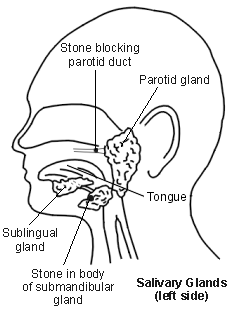
The salivary glands make spit (also called saliva). Saliva is important in breaking down the food that you eat as part of digestion. It contains chemical substances (enzymes) which break down some of the starch and fat in your food. It also makes food moist, lubricating it as it passes from the mouth to the gullet.
There are three pairs of glands that make saliva. Saliva drains into the mouth from these glands down short tubes (ducts).
The submandibular glands are under the floor of your mouth - one on each side - and drain saliva up into the floor of your mouth.
The parotid glands lie just below and in front of your ears. Saliva passes down the parotid duct into the inside of your cheeks.
The sublingual glands are just beneath your tongue.
You make small amounts of saliva all the time to keep your mouth moist. When you eat, you normally make much more saliva which flows into your mouth.
What causes salivary gland stones?
Torna ai contenutiThe chemicals in spit (saliva) can sometimes crystallise into a stone that can then block the salivary ducts. Some people form one or more small stones in a salivary gland. This occurs most commonly in people between the ages of 30 and 60 years, although it can occur at any age. It is more common in men than in women.
The reason why a stone forms is not known. A salivary gland stone is sometimes called a sialolith or a salivary calculus. Most salivary stones are mainly made of calcium. However, there is no abnormality of the blood calcium level or any other problem with calcium in your body. Salivary gland stones are not usually associated with any other diseases.
Some research suggests that changes in the flow of saliva through the gland are connected with the formation of stones.
Continua a leggere sotto
Where do salivary gland stones occur?
Torna ai contenutiMost (about 8-9 in 10) salivary stones form in one of the submandibular glands. The submandibular duct is a tube, which runs from under the front of the tongue to the submandibular gland. The larger parotid glands make spit (saliva) that is thinner than that produced by the submandibular glands. This means that stones less commonly form in parotid glands. It is rare for a stone to form in a sublingual gland.
What are the symptoms of salivary gland stones?
Torna ai contenutiThe size of the stone can vary from less than 1 mm to a few centimetres in diameter and about 9 in 10 stones are less than 10 mm in size. The larger size stones will be large enough to block the duct. When spit (saliva) cannot exit a blocked tube (duct), it backs up into the gland, causing pain and swelling of the gland.
The most common symptoms of a salivary gland stone are pain and swelling of the affected gland at mealtimes. This occurs if the stone completely blocks a duct. The saliva cannot pass into your mouth if the duct is blocked by a stone. The pain can be sudden and intense just after starting a meal and swelling soon follows. The pain and swelling ease over about 1-2 hours after a meal.
However, most stones do not block a duct completely. A stone may only partially block saliva flow or not block the flow at all if it is embedded in the body of the gland. In these situations the symptoms can vary and include one or more of the following:
Dull pain from time to time over the affected gland.
Swelling of the gland. Swelling may be persistent or vary in size from time to time.
Salivary gland infection may occur causing redness and pain. This may develop into a ball of infection and pus (an ascesso) and make you feel quite unwell.
Some people with salivary gland stones have no symptoms at all. A stone may be found by chance on an X-ray picture taken for another reason.
Continua a leggere sotto
Sono necessari dei test?
Torna ai contenutiSymptoms of salivary gland stones are often typical and the diagnosis and treatments are usually clear. A doctor can sometimes feel or see a stone at the opening of a tube (duct). Usually un'ecografia is helpful. In some cases, other tests may be needed. The test done may be one of the following:
A different type of scan such as a tomografia computerizzata o Risonanza magnetica.
Sialography (sialogram). This is a special X-ray test. It helps to show up the gland, the duct and any abnormalities of the duct, such as a stone. For this test a small plastic tube is passed into the affected duct. A dye is then injected into the salivary gland. The tube is removed and X-ray pictures are taken. The X-ray pictures show up the dye within the gland and duct. This gives a good outline of the structures and shows up any abnormalities.
Sialendoscopy. In this test a very thin tube (endoscope) with a tiny light and camera at the tip is inserted into the salivary duct. The doctor can then see directly into the duct and gland to see if a stone is present.
How to treat a salivary gland stone
Torna ai contenutiMost salivary gland stones that cause symptoms will not go away unless they come out or are removed. Sometimes a small stone comes out into the mouth by itself.
How to massage out a salivary gland stone
In mild cases with few symptoms, you may be able to dislodge a salivary gland stone yourself. You can do this by helping to increase saliva production in your mouth. You can do this by:
Drinking lots of water.
Sucking on lemons or lemon drops.
Gently massaging around the stone so it loosens.
Medical procedures to remove a salivary gland stone
If a salivary gland stone does not fall out by itself, medical advice may be needed. Possible treatment options and procedures include the following:
Gentle probing into the tube (duct) from inside the mouth with a thin blunt instrument can sometimes free a stone which then falls into the mouth. This is done by a doctor.
Therapeutic sialendoscopy. This is a similar procedure to that described above. It also uses a very thin tube (endoscope) with a camera and light at the tip. The tube is pushed into the duct. If a stone is seen, then a tiny basket or pair of grabbers attached to the tube is used to grab the stone and pull it out. This technique can successfully remove about 17 in 20 stones. Local anaesthetic is usually injected into the duct first to make this procedure painless. In some cases, where the stone is rather large, the stone is broken up first and the fragments are then pulled out.
A small operation to cut out the stone is the traditional treatment but is done less and less, as therapeutic sialendoscopy has become available. It may still be needed if therapeutic sialendoscopy is not an available option, or if it fails.
Shock wave treatment (lithotripsy) may be an option. This uses ultrasound waves to break up stones. The broken fragments then pass out along the duct. This is a relatively new treatment for salivary stones (although it has been used for many years to treat kidney stones). However, it is not done commonly. Sometimes shock waves are used to break up a large stone when therapeutic sialendoscopy is done to make smaller fragments which can be more easily removed.
A salivary stone is usually a one-off event. After it is removed there are usually no further problems. However, some people may develop one or more further stones at some later time. Sometimes several stones form in the same gland. An operation to remove the whole gland may be an option for people who develop recurring or multiple stones. Please be aware that you will still make enough spit (saliva) from your remaining glands if one is removed.
Can recurrent stones be prevented?
Torna ai contenutiAs the exact cause of salivary stones is not known, there is no clear way to prevent them. However, it is important to drink plenty of fluids, especially if you exercise frequently or live in a warm climate.
Scelte dei pazienti per Ghiandole salivari

Salute dei bambini
Parotite
La parotite è un'infezione causata da un virus. Colpisce principalmente le ghiandole salivari, che si trovano intorno al viso. A volte vengono colpite anche altre parti del corpo. La parotite colpisce normalmente i bambini, ma può verificarsi a qualsiasi età. La parotite è ora rara nel Regno Unito poiché i bambini vengono regolarmente vaccinati contro la parotite.
di Dr Philippa Vincent, MRCGP

Cura orale e dentale
Disturbi delle ghiandole salivari
Abbiamo un certo numero di ghiandole salivari e sono tutte situate intorno alla bocca. Producono saliva o sputo e possono causare problemi quando si infiammano, si infettano o si bloccano.
di Dr Toni Hazell, MRCGP
Ulteriori letture e riferimenti
- Therapeutic sialendoscopy; NICE Interventional Procedure Guideline, May 2007
- Nodulo al collo; NICE CKS, ottobre 2020 (accesso solo Regno Unito)
- Adhikari R, Soni A; Submandibular Sialadenitis And Sialadenosis
Continua a leggere sotto
Storia dell'articolo
Le informazioni su questa pagina sono scritte e revisionate da clinici qualificati.
Prossima revisione prevista: 9 Apr 2028
10 Apr 2025 | Ultima versione

Chiedi, condividi, connettiti.
Esplora le discussioni, fai domande e condividi esperienze su centinaia di argomenti di salute.

Non ti senti bene?
Valuta i tuoi sintomi online gratuitamente
Iscriviti alla newsletter di Patient
La tua dose settimanale di consigli sulla salute chiari e affidabili - scritti per aiutarti a sentirti informato, sicuro e in controllo.
Abbonandoti accetti il nostro Informativa sulla Privacy. Puoi annullare l'iscrizione in qualsiasi momento. Non vendiamo mai i tuoi dati.