Head lice
Peer reviewed by Dr Krishna Vakharia, MRCGPLast updated by Dr Colin Tidy, MRCGPLast updated 15 Dec 2022
Meets Patient’s editorial guidelines
- DownloadDownload
- Share
- Language
- Discussion
- Audio Version
- Add to preferred sources on Google
Medical Professionals
Professional Reference articles are designed for health professionals to use. They are written by UK doctors and based on research evidence, UK and European Guidelines. You may find the Head lice and nits article more useful, or one of our other health articles.
See the separate Pubic and Body Lice article.
What are head lice?
Head lice infestation (pediculosis capitis) is caused by the parasitic insect Pediculus humanus capitis, which lives on and among the hair of the scalp and neck of humans. The adult louse feeds on blood.
Life cycle of head lice1 2
Male and female head lice size comparison
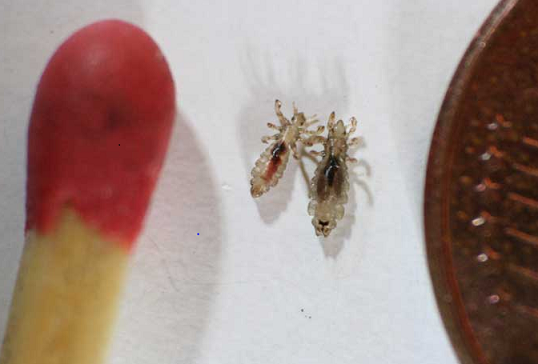
© Pediculosis, CC BY-SA 3.0, via Wikimedia Commons
Louse eggs (ova or nits) are small, oval and yellowish white and are attached to the hair shafts. They usually take 7-10 days to hatch.
Immature lice (nymphs) take 7-10 days to mature into adults.
Adult lice are up to 3 mm in length, said to be approximately the size of a sesame seed. They have six legs (which have hook-like claws to hold on to the hair) and are grey-white to black in colour. They do not have wings and cannot jump or fly. The female louse lays up to eight eggs per day.
Adult lice survive by taking a feed of blood from their host several times a day. They can live for about 30 days.
Transmission of head lice usually requires head-to-head contact. Head lice can only live on humans and the lifespan is very short (several days) once detached from a human head.
How common are head lice? (Epidemiology)1
There is little information on the current prevalence of head lice infestation in the UK. In a survey of 31 primary schools in Wales, live head lice were detected in 8.3% of children.
Head lice can affect any age, but is most common in children aged 4-11 years (peak age is 7-8 years), and is more common in girls than in boys.
A 2020 systematic review to determine the worldwide prevalence of head lice in school children found a total prevalence of 19%, with male prevalence 7%, and female prevalence 19%. The highest prevalence countries were Central and South America (33%) and the lowest prevalence countries were in Europe (5%).
Risk factors
Risk factors include age (3-12 years), sex (female) and ethnicity (any other than black). There is no evidence that head lice have a preference for either clean or dirty hair.
Head lice symptoms1 3
Many infestations are totally asymptomatic. Presentation is usually when adult lice or nits have been seen. Others present with itching.
Itching of the scalp is not sufficient to diagnose active infestation. Itching may not develop for several weeks or months after becoming infested and may persist for days to weeks after successful eradication of head lice.
Nits alone are not sufficient to diagnose active head lice infestation because it is difficult to distinguish between dead and live eggs with the naked eye.
A diagnosis of active head lice infestation can only be made if a live head louse is found. Detection combing (systematic combing of wet or dry hair with a detection comb) should be used to confirm the presence of lice:
A fine-toothed (teeth 0.2-0.3 mm apart) detection comb should be used. This is different to a nit removal comb, which has narrower gaps. Some nit combs can be prescribed on an FP10; the Bug Buster® comb is the only one of these which has been assessed through clinical trials.
Wet combing takes 10-15 minutes per head; lice are immobilised by hair conditioner, so are easy to see on the comb.
Dry combing takes at least 3-5 minutes per head. Using a comb on dry hair may produce static electricity; when a louse is spotted on the comb, placing a thumb on it before drawing the comb out of the hair prevents the louse being flicked off the comb by the static electricity in the hair.
Differential diagnosis1
Itching may also be due to:
Psychogenic itch on hearing that there are head lice within the school.
Other itchy scalp conditions, such as eczema.
Successfully treated head lice infestation but with persisting itch, which may last for weeks.
Nits can be confused with:
Hair muffs (secretions from the hair follicle that are wrapped round the hair shaft).
Hairspray.
Nits can usually be differentiated, as they stick firmly to the hair even after vigorous brushing.
How to treat head lice1
General advice
Treat the person only if a live head louse is found. Treat all affected household members simultaneously.
There is no need to wash clothing or bedding that has been in contact with lice.
Children who are being treated for head lice can still attend school.4
Treatment options
Wet combing:
Systematic combing of wet hair with a louse detection comb to remove head lice.
The Bug Buster® kit is the only head lice removal (and detection) method that has been evaluated in controlled trials. It is available on the NHS.
Other nit combs include Nitty Gritty NitFree comb®, Nitcomb-S1®, Nitcomb-M2® and Portia® head louse comb.
The recommended regimen is four sessions spaced over two weeks (on days 1, 5, 9, and 13).
Insecticides:
Physical insecticide:
Silicone or fatty acid ester-based products kill the lice by physically coating their surfaces and suffocating them, so resistance is unlikely to develop.
They include dimeticone 4% gel, lotion, or spray, dimeticone 92% spray, dimeticone >95% lotion, isopropyl myristate and cyclomethicone solution, and isopropyl myristrate and isopropyl alcohol aerosol.
Chemical or traditional insecticide:
Poison the lice by chemical means.
The only chemical insecticide that is currently recommended in the UK is Malathion 0.5% aqueous liquid, but resistance has been reported.
Treatment should be applied to all areas of the scalp and to all the hairs, from their roots to their tips. It is generally recommended that insecticides be applied twice, at least seven days apart, in order to treat any lice hatching from eggs before they lay more eggs themselves.
Treatment is successful if no living lice are found on the scalp. Nits may be present (they can remain attached for up to eight months) but no further treatment is necessary. A further examination is recommended 10 days later.
Wet combing or dimeticone 4% lotion is recommended first-line for pregnant or breastfeeding women, young children aged 6 months to 2 years, and people with asthma or eczema.
Shampoos are generally not recommended because they are diluted too much and have an insufficient contact time to kill eggs.
All affected family members should be treated on the same day to avoid re-infection.
Management of treatment failure1 3
Household members, close family and close friends (both adults and children) should be assessed using detection combing to identify possible sources of re-infestation.
Check whether the treatment was used correctly and that if it was an insecticide it was repeated after seven days..
Repeat the same treatment or switch to a different treatment: the choice will depend on the preference of the person or child's parent and whether resistance to a traditional insecticide is suspected.
Ensure that all affected household contacts are again treated simultaneously.
Advice should be sought from local laboratories if resistance appears to be a problem. The policy of rotating treatments over a complete district is no longer used.
Complications1
Pruritic rash on the back of the neck and behind the ears, caused by a hypersensitivity reaction to louse faeces.
Excoriation, skin infection and impetigo may occasionally occur.
Loss of sleep caused by continuous itching is occasionally a problem.
Anxiety and distress for children and parents.
Prognosis1
If left untreated, infestation with head lice may persist for long periods, often for more than one year.
In those where infestations are recurring or persistent: extra vigilance for possible signs of neglect and other safeguarding factors should be carried out along with further assessment if needed.
How to prevent head lice
It is very difficult to control the spread of head lice in children, due to the close contact that children normally have with each other. There is no evidence for any benefit of head lice repellents, or using head lice treatments prophylactically. There is also no evidence that measures beyond normal personal hygiene, housekeeping and laundry can prevent re-infestation.
If a head lice infestation is noted in a school, vigilance amongst the parents and treatment of affected children will help to prevent a cycle of re-infestation.
Exclusive updates for healthcare professionals
Stay informed with the latest clinical updates, professional insights, and evidence-based guidance. The Patient Pro newsletter curates essential content for healthcare professionals—delivered straight to your inbox.
By subscribing you accept our Privacy Policy. You can unsubscribe at any time. We never sell your data.
Further reading and references
- Burgess IF; Head lice. BMJ Clin Evid. 2011 May 16;2011. pii: 1703.
- Gunning K, Kiraly B, Pippitt K; Lice and Scabies: Treatment Update. Am Fam Physician. 2019 May 15;99(10):635-642.
- Meister L, Ochsendorf F; Head Lice. Dtsch Arztebl Int. 2016 Nov 11;113(45):763-772. doi: 10.3238/arztebl.2016.0763.
- Head lice; NICE CKS, November 2021 (UK access only)
- Head lice (Pediculosis); Public Health England. April 2013, last updated January 2018.
- Head Lice: Questions and Answers for Healthcare Professionals; NHS Wales January 2014
- Guidance on infection control in schools and other childcare settings; UK Health Security Agency (September 2017 - last updated February 2023)
About the authorView full bio

Dr Colin Tidy, MRCGP
General Practitioner, Medical Author
MBBS, MRCGP, MRCP (Paediatrics), DCH
Dr Colin Tidy is an NHS Doctor, based in Oxfordshire.
About the reviewerView full bio

Dr Krishna Vakharia, MRCGP
Chief Medical Officer for Health, Optum UK
MBChB, MRCGP(2013), BMedSci (hons), DFSRH, DRCOG, PGDipDerm (Distn)
Dr Krishna Vakharia is an NHS GP. She is also a regular examiner for the postgraduate Diploma in Practical Dermatology at Cardiff University as well as being the Chief Medical Officer for health at Optum UK.
Article history
Article also available in English, German, Spanish, French, Italian, Portuguese, Hindi, Hebrew, Arabic, and Swedish.
Next review due: 14 Nov 2027
15 Dec 2022 | Latest version

Ask, share, connect.
Browse discussions, ask questions, and share experiences across hundreds of health topics.

Feeling unwell?
Assess your symptoms online for free
More in dermatology
- Allergic phenomena
- Balanitis
- Becker's naevus
- Bedbugs
- Boils and carbuncles
- Bowen's disease
- Chickenpox
- Cicatricial pemphigoid
- Dermatological descriptive terms
- Generalised pustular psoriasis
- Intradermal and compound naevi
- Keratosis pilaris
- Lentigo
- Lichen sclerosus
- Molluscum contagiosum
- Oral herpes simplex
- Parkes Weber's syndrome
- Psoriatic arthritis
- Toxocariasis
- Zinc deficiency, excess and supplementation