Verruche
Plantar warts and myrmecia verrucae
Revisione paritaria di Dr Toni Hazell, FRCGPUltimo aggiornamento di Dr Rosalyn Adleman, MRCGPUltimo aggiornamento 6 Ago 2025
Rispetta le linee guida editoriali
- ScaricaScarica
- Condividi
- Language
- Discussione
- Versione audio
- Aggiungi alle fonti preferite su Google
Professionisti Medici
Gli articoli di riferimento professionale sono progettati per essere utilizzati dai professionisti della salute. Sono scritti da medici del Regno Unito e basati su prove di ricerca, linee guida del Regno Unito ed europee. Potresti trovare il Verruche e porri articolo più utile, o uno dei nostri altri articoli sulla salute.
Synonym: myrmecia
What are verrucae?
Verrucae are hyperkeratotic lesions found particularly over the pressure areas of the feet (heel and ball). They are also known as verrucae plantaris, or plantar warts. They are usually self-limiting but may be treated if symptomatic.
Plantar wart
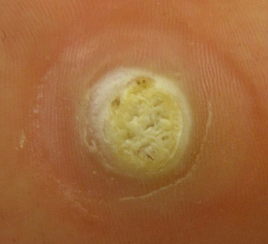
Verrucae causes (aetiology)1
Verrucae are caused by the human papillomavirus (HPV), particularly types 1, 2, 4, 27 and 57.2 They affect epithelial cells causing small rough papules. Replication of the virus within the epithelial cells causes a proliferative reaction and formation of plaque or papule. Incubation is very variable, ranging from one month to over a year.
HPV infection is acquired from direct contact with an affected individual or from the environment (for example, from contaminated floors in places such as communal showers and changing areas or swimming pools). Damaged or wet skin predisposes to infection. It appears the virus can survive outside the body for a significant length of time, probably months or even years.
They should not be used as a reason to stop children swimming, as learning to swim is important in the National Curriculum and helps to prevent death from drowning.3
How common are verrucae? (Epidemiology)1 4
Warts are very common and thought to affect 7-12% of the population. No large studies are available; however, small studies suggest up to 30% of children and young adults may have warts. There are no high-quality epidemiological studies on prevalence of verrucae specifically.
Verrucae are more common in young people regularly using swimming pools and communal washing/changing areas.
Verrucae symptoms (presentation)
Storia
They may cause pain, particularly with walking.
Occasionally leg or back pain may result from altered posture or gait disturbance.
They are more common in those who are immunosuppressed:
Long-term immunosuppressant usage.
Untreated HIV.
Transplant patients.
Lymphomas and leukaemias.
Esame
Firm, hyperkeratotic lesions.
May have minor pinpoint petechiae centrally within the lesions. These may appear as small black dots.
Usually found over pressure areas.
Flat because of pressure.
May fuse with surrounding warts (mosaic warts - below).
Debrided verruca
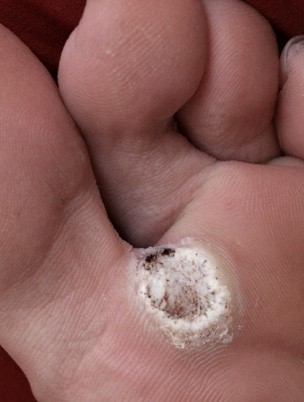
© Goatboy~commonswiki, via Wikimedia Commons
Diagnosi
Diagnosis is made by examination and observation of typical features.
Diagnosi differenziale5
Corns: these are inflamed and painful. Paring corns reveals pearly sections of keratin.
Calluses: these are thick and painless patches of hard skin.
Black heel: patches of hard skin with ruptured capillaries.
Verrucous squamous cell carcinoma: this should be considered if long-standing. They invade the dermis but are slow-growing and rarely metastasise.
Lichen nitidus.
Keratoderma.
Diagnosing verrucae (investigations)
None is usually required or appropriate. Distinguishing them from corns may require paring of the keratin. Blood tests to check for causes of immunodeficiency may be required in unusually widespread or resistant cases.
Management of verrucae1 4 6
Treatment is not necessarily required if the verruca is not painful. However, a wart on the sole of the foot is more likely to cause discomfort than warts in other areas such as the hands.
Topical salicylic acid has the best evidence base and is inexpensive.7 It is therefore normally first-line treatment. There is no evidence for one preparation being more effective than another. The wart should be pared down prior to application. Daily treatment for at least 12 weeks is required.
Crioterapia with liquid nitrogen every two weeks until the wart has gone (up to four months) may be effective. For plantar warts, there is evidence that this is more effective if the lesion is pared down first. Clinicians vary in how long they freeze the wart for; usually liquid nitrogen is applied until a ring of frozen tissue is visible around the wart, typically 5 to 30 seconds. There is no evidence that a spray or cotton bud application is more effective. Over-the-counter preparations do not reach such low temperatures and are probably not as effective. Reported cure rates vary hugely. Cryotherapy may be painful, may cause blistering and should be avoided in young children.
Cryotherapy may be used in combination with topical salicylic acid. The latter is applied in between episodes of cryotherapy, once the blistering has settled down.
Altri trattamenti with some evidence base recommended as options by the British Association of Dermatologists (BAD) guidelines include:
Dithranol.
5-fluorouracil (5-FU).
Formaldehyde.
Glutaraldehyde.
Laser.8
Microwave therapy
Photodynamic therapy.
Podophyllotoxin.
Topical immunotherapy.
These treatments would be carried out in secondary care.
Secondary care referral may be necessary in the following situations:5
Facial wart.
Diagnosis is uncertain.
Person is immunocompromised.
Areas of skin that are extensively affected - e.g. mosaic warts of the hands and feet.
Persistent warts that are unresponsive to both topical salicylic acid and cryotherapy.
Complications of verrucae
Secondary to condition or treatment:
Dolore.
Infezione.
Spread.
Scars and keloid formation.
Psicologico.
Malignant change: extremely rare, especially with normal immunity. Whilst it rarely occurs, be aware of the possibility in patients who are immunocompromised (for example, transplant patients).
Prognosi5
Cutaneous warts do not usually cause symptoms and in most cases resolve spontaneously within months (at the most, within two years). However, in adults resolution may take 5-10 years..
One study showed in school children, half resolved within one year and two thirds within two years.9 Those with immunosuppression may be resistant to treatment.
Prevention of verrucae5
Suggestions for reducing spread include:
Cover the verruca with a waterproof plaster when swimming. Swimming socks have no value other than in attracting attention and increasing stigma and should not be encouraged.10
Wear flip-flops in communal areas and showers.
Avoid sharing shoes, socks or towels.
Limit auto-inoculation by avoiding trauma (scratching and biting), keeping feet dry and changing socks or tights daily.
Aggiornamenti esclusivi per i professionisti sanitari
Rimani informato con gli ultimi aggiornamenti clinici, approfondimenti professionali e linee guida basate su evidenze. La newsletter Patient Pro seleziona contenuti essenziali per i professionisti sanitari—consegnati direttamente nella tua casella di posta.
Abbonandoti accetti i nostri Informativa sulla Privacy. Puoi annullare l'iscrizione in qualsiasi momento. Non vendiamo mai i tuoi dati.
Ulteriori letture e riferimenti
- Al Aboud AM, Nigam PK; Wart. StatPearls, 2021.
- Linee guida dell'Associazione Britannica dei Dermatologi per la gestione delle verruche cutanee; British Journal of Dermatology (2014)
- Witchey DJ, Witchey NB, Roth-Kauffman MM, et al; Plantar Warts: Epidemiology, Pathophysiology, and Clinical Management. J Am Osteopath Assoc. 2018 Feb 1;118(2):92-105. doi: 10.7556/jaoa.2018.024.
- Brenner RA, Taneja GS, Haynie DL, et al; Association between swimming lessons and drowning in childhood: a case-control Arch Pediatr Adolesc Med. 2009 Mar;163(3):203-10.
- Kwok CS, Gibbs S, Bennett C, et al; Trattamenti topici per verruche cutanee. Cochrane Database Syst Rev. 2012 Sep 12;9:CD001781. doi: 10.1002/14651858.CD001781.pub3.
- Verruche e verruche plantari; NICE CKS, ottobre 2024 (accesso solo Regno Unito)
- Loo SK, Tang WY; Warts (non-genital). BMJ Clin Evid. 2014 Jun 12;2014. pii: 1710.
- Becker BA, Childress MA; Common Foot Problems: Over-the-Counter Treatments and Home Care. Am Fam Physician. 2018 Sep 1;98(5):298-303.
- Nguyen J, Korta DZ, Chapman LW, et al; Laser Treatment of Nongenital Verrucae: A Systematic Review. JAMA Dermatol. 2016 Sep 1;152(9):1025-34. doi: 10.1001/jamadermatol.2016.0826.
- Bruggink SC, Eekhof JA, Egberts PF, et al; Corso naturale delle verruche cutanee tra i bambini delle scuole primarie: uno studio di coorte prospettico. Ann Fam Med. 2013 Set-Ott;11(5):437-41. doi: 10.1370/afm.1508.
- Comprendere le Verruche; Nuoto Britannico
Informazioni sull'autoreVisualizza il profilo completo

Dr Rosalyn Adleman, MRCGP
MRCGP
La Dott.ssa Rosalyn Adleman è un medico di base del NHS che lavora nel nord di Londra.
Informazioni sul recensoreVisualizza il profilo completo

Dr Toni Hazell, FRCGP
MBBS, BSc, FRCGP, DFSRH, Dip GU med, DRCOG, DCH (London, UK, 2000)
La Dott.ssa Toni Hazell si è laureata presso la St. Mary’s Hospital Medical School e ha completato il suo VTS al Northwick Park Hospital.
Storia dell'articolo
Le informazioni su questa pagina sono scritte e revisionate da clinici qualificati.
Articolo disponibile anche in Inglese, Tedesco, Spagnolo, Francese, Italiano, Portoghese, Hindi, Ebraico, Arabo, and Svedese.
Prossima revisione prevista: 5 Ago 2028
6 Ago 2025 | Ultima versione

Chiedi, condividi, connettiti.
Esplora le discussioni, fai domande e condividi esperienze su centinaia di argomenti di salute.

Non ti senti bene?
Valuta i tuoi sintomi online gratuitamente
Altro in dermatologia
- Acne conglobata e forme più rare di acne
- Condilomi anogenitali
- Sindrome di Birt-Hogg-Dubé
- Naevus blu
- Filariosi della cavità corporea
- Psoriasi cronica a placche
- Pemfigo cicatriziale
- Ecthyma
- Granuloma anulare
- Dermatite seborroica infantile
- Leucoplachia
- Dermatosi lineare da IgA
- Sindrome da lipodistrofia
- Fascite necrotizzante
- Eritema palmare
- Pitiriasi versicolor
- Iperpigmentazione post-infiammatoria della pelle
- Psoriasi di mani e piedi
- Manifestazioni cutanee di malattie sistemiche
- Sindrome di Stevens-Johnson