Isteroscopia
Revisione paritaria di Dr Colin Tidy, MRCGPUltimo aggiornamento di Dr Philippa Vincent, MRCGPUltimo aggiornamento 3 Ago 2023
Rispetta le linee guida editoriali
- ScaricaScarica
- Condividi
- Language
- Discussione
- Ask Patient
- Versione audio
- Aggiungi alle fonti preferite su Google
Hysteroscopy is a procedure which uses a thin tube-like telescope to see inside the womb (uterus). It can also allow doctors to do some minor operations to the uterus.
A colpo d'occhio
A hysteroscopy is a procedure to look inside the womb (uterus) using a slim instrument called a hysteroscope.
Può aiutare a diagnosticare problemi come sanguinamento abbondante, sanguinamento dopo la menopausa, infertilità e aborti ricorrenti.
It can also be used to remove polyps, scar tissue, or lost contraceptive devices.
Una isteroscopia può essere eseguita con o senza anestesia e di solito richiede dai 5 ai 30 minuti.
Dopo la procedura, è comune avere crampi simili a quelli mestruali e un lieve sanguinamento per un massimo di sette giorni.
Consultare un medico se si sviluppa febbre, dolore crescente, secrezione maleodorante o sanguinamento abbondante successivamente.
Scelte video per EndoscopiaVideo library
What is a hysteroscopy?
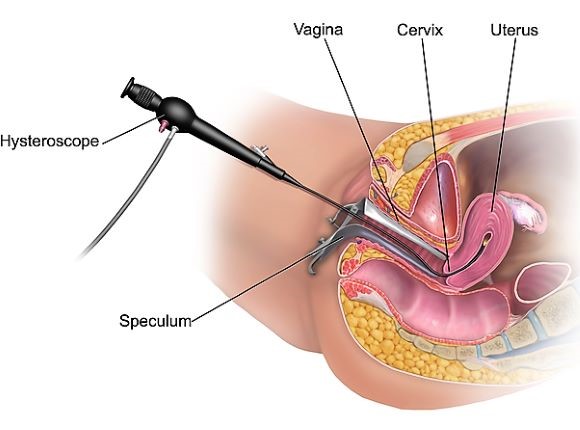
Hysteroscopy allows a doctor to look inside the womb (uterus). This is done using an instrument called a hysteroscope. The hysteroscope is very slim (about 3 to 5 millimetres in diameter). It's carefully passed through the vagina and neck of the womb (cervix) and into the uterus.
What happens during a hysteroscopy?
The hysteroscope is connected to a camera and a TV monitor which show the inside of the uterus. Some gas or fluid may be pumped into the uterus to make it swell a little. This makes it easier to see the lining of the uterus.
After this, the doctor may take a tiny piece of tissue (biopsy) from the uterus. This will be sent to the laboratory for examination under the microscope. Sometimes small fleshy lumps (polyps) are found. It may be possible to remove these during the test. After the procedure is completed the hysteroscope is gently removed.
A hysteroscopy takes between 5 and 30 minutes.
In some hospitals an ultrasound scan may be arranged before a hysteroscopy. See the separate leaflet called Ultrasound Scan for more details.
What anaesthesia is used for hysteroscopy?
A hysteroscopy can be done under general or with local anaesthetic. A general anaesthetic means being put to sleep. Some women will not have either a general or a local anaesthetic. Occasionally, a sedative may be used, which won't cause sleep but may help to feel more relaxed.
A non-steroidal anti-inflammatory painkiller (for example, ibuprofene) might be advised around one hour before the appointment to help reduce pain immediately after the procedure. If no general anaesthetic is used, women may be asked if they wish to see the pictures coming from the hysteroscope. Some people do not wish to do this but others find it helpful.
The doctor may use a speculum (the same instrument used in a cervical screening test) so that they can see the neck of the womb. They then pass the hysteroscope through the cervix into the uterus. Sometimes the hysteroscope will be passed into the vagina without having to use a speculum.
Are there any preparations I should consider?
Local hospitals will give guidance on what to do before a hysteroscopy. If having a hysteroscopy with local anaesthetic, there will not usually be a need for any special preparation.
If having a general anaesthetic, it will be a requirement not to eat or drink for a number of hours before the procedure.
Isteroscopia
What can be found during a hysteroscopy?
A hysteroscopy may be used to find the cause of various problems such as:
Heavy or irregular bleeding that has not improved with medication.
Bleeding in between periods.
Bleeding after the menopausa.
Irregular bleeding whilst taking hormone replacement therapy (HRT).
These are called diagnostic hysteroscopies.
As well as being used to investigate the cause of various problems, a hysteroscopy can also be used to:
Remove polyps - small lumps of tissue growing on the lining of the womb (uterus).
Remove scar tissue in the uterus.
Perform endometrial ablation - a procedure where the lining of the womb is made thinner in order to prevent heavy periods.
Remove adhesions (areas where the walls of the uterus are sticking together).
Locate a 'lost' or stuck contraceptive device, such as an intrauterine contraceptive device (IUCD) - also known as a 'coil'.
Perform certain types of sterilisation procedures.
Before having the procedure the gynaecologist will discuss the test. A number of different treatment options might be discussed. This is because it may be possible to treat the cause of symptoms immediately, using the hysteroscope. In order for this, agreement (consent) to the treatment will be needed in advance.
Is a hysteroscopy painful?
If awake, there may be a feeling like period cramps at some stages. A lot of women feel no discomfort or only minimal discomfort. For other women it is very painful and the procedure has to be stopped. In this case a hysteroscopy under general anaesthetic will be likely to be offered on another day. Many different things may influence how painful the procedure is. This includes:
Whether an anaesthetic is used.
Whether local or general anaesthetic is used and, if local, which type of local anaesthetic. (There are a number of options.)
Whether pain relief is used.
The size of hysteroscope used (the thinner ones tend to be less painful).
The type of hysteroscope used (flexible or rigid).
Whether a speculum is used.
The reason for having the test.
Whether babies have been delivered vaginally (vaginal delivery) in the past.
Whether the menopause has been reached/passed.
When asked to give consent to the procedure, these sorts of issues should be discussed. It is not possible to safely have a hysteroscopy whilst you are pregnant.
What can I expect after a hysteroscopy?
After a general anaesthetic or sedation, it is necessary to rest until the effects of these have passed. Driving is not permitted for the first 24 hours and it is usual to advise that a friend or relative should stay with the person for the first 24 hours.
After a local anaesthetic, it is usual to be able to go home as normal (walking, driving or travelling by public transport) after a short rest.
Period-like cramps and mild bleeding afterwards is common. The bleeding is usually mild and should settle within seven days. To reduce the risk of infection whilst bleeding it is best to:
Use sanitary towels rather than tampons.
Avoid vaginal sex for one week after the hysteroscopy and until the bleeding has stopped.
Take it easy for the first one or two days and take painkillers as needed.
Hysteroscopy side-effects
The most common side-effects after the procedure are bleeding and pain. Very rarely it is possible that a small hole may be made in the womb (uterus) by the hysteroscope. It is also possible, although not common, to develop an infection of the uterus as a result of hysteroscopy. Some women feel faint during the procedure, when the hysteroscope is passed through the cervix, but this is usually short-lived.
Medical advice should be sought if any problems develop, such as:
A temperature.
Increased unexplained pain not relieved with painkillers.
Increased scarico, which is smelly and unpleasant.
Sanguinamento abbondante.
Scelte del paziente per Endoscopia

Chirurgia e procedure
Colonscopia
Una colonscopia è un esame per valutare il tuo colon (intestino crasso). Nota: le informazioni di seguito sono solo una guida generale. Le modalità di organizzazione e di esecuzione degli esami possono variare tra diversi ospedali. Segui sempre le istruzioni fornite dal tuo medico o dall'ospedale locale.
da Dott.ssa Claudia Berty, MRCGP

Chirurgia e procedure
Gastroscopia
La gastroscopia è un esame per osservare l'interno dell'esofago, dello stomaco e della prima parte dell'intestino tenue, chiamata duodeno. Nota: le informazioni di seguito sono solo una guida generale. Le modalità di organizzazione e di esecuzione degli esami possono variare tra diversi ospedali e aree. Seguire sempre le istruzioni fornite dal proprio medico o dall'ospedale locale.
di Dr Philippa Vincent, MRCGP
Domande frequenti
Posso fare una isteroscopia se ho il ciclo mestruale?
L'articolo non specifica se una isteroscopia può o non può essere eseguita durante il ciclo mestruale. Si concentra sulla procedura stessa, l'anestesia e i potenziali risultati. È meglio discuterne con il tuo ginecologo, poiché fornirà indicazioni basate sulle tue circostanze individuali.
Posso avere rapporti sessuali prima di una isteroscopia?
L'articolo non fornisce istruzioni specifiche riguardo all'attività sessuale prima di una isteroscopia. Consiglia di evitare rapporti vaginali per una settimana dopo l'isteroscopia e fino a quando il sanguinamento non si è fermato per ridurre il rischio di infezione. Per le linee guida pre-procedura, gli ospedali locali forniranno generalmente istruzioni specifiche.
Ci sono motivi per cui potrei non essere in grado di sottopormi a una isteroscopia?
La principale controindicazione menzionata nell'articolo è la gravidanza. Si afferma: "Non è possibile eseguire una isteroscopia in sicurezza mentre si è in gravidanza." Altri fattori potenziali non sono discussi, ma il tuo ginecologo esaminerà la tua storia medica e discuterà con te l'idoneità della procedura.
Posso rifiutare di sottopormi a un'isteroscopia?
L'articolo implica la scelta del paziente nelle procedure mediche menzionando che è necessario il consenso e che potrebbero essere discusse opzioni di trattamento alternative. Anche se non esplicitamente dichiarato, i pazienti generalmente hanno il diritto di rifiutare una procedura medica dopo aver compreso i rischi e i benefici. Se hai preoccupazioni, dovresti discuterne con il tuo medico.
Riceverò i miei risultati immediatamente dopo una isteroscopia?
L'articolo menziona che se viene prelevato un piccolo pezzo di tessuto (biopsia), verrà inviato al laboratorio per l'esame. Questo suggerisce che i risultati di una biopsia non sarebbero immediati. Per altri riscontri, come i polipi che vengono rimossi, il ginecologo potrebbe discuterne con te durante o poco dopo la procedura.
Ulteriori letture e riferimenti
- Tangsiriwatthana T, Sangkomkamhang US, Lumbiganon P, et al; Paracervical local anaesthesia for cervical dilatation and uterine intervention. Cochrane Database Syst Rev. 2013 Sep 30;9:CD005056. doi: 10.1002/14651858.CD005056.pub3.
- Ahmad G, Attarbashi S, O'Flynn H, et al; Pain relief in office gynaecology: a systematic review and meta-analysis. Eur J Obstet Gynecol Reprod Biol. 2011 Mar;155(1):3-13. doi: 10.1016/j.ejogrb.2010.11.018. Epub 2011 Jan 20.
- Centini G, Troia L, Lazzeri L, et al; Modern operative hysteroscopy. Minerva Ginecol. 2016 Apr;68(2):126-32. Epub 2016 Mar 1.
- Ahmad G, Saluja S, O'Flynn H, et al; Pain relief for outpatient hysteroscopy. Cochrane Database Syst Rev. 2017 Oct 5;(10)(10):CD007710. doi: 10.1002/14651858.CD007710.pub3.
Informazioni sull'autoreVisualizza il profilo completo
Aggiornato da

Dr Philippa Vincent, MRCGP
Medico di base, Autore medico
MB BS, Bsc, MRCGP (2000), DCH, DFSRH, DRCOG
Dr Philippa Vincent è un medico di base del NHS che lavora nel nord di Londra.
Informazioni sul recensoreVisualizza il profilo completo

Dr Colin Tidy, MRCGP
Medico di base, Autore medico
MBBS, MRCGP, MRCP (Paediatrics), DCH
Il Dr Colin Tidy è un medico del NHS, con sede nell'Oxfordshire.
Condividi i tuoi pensieri o esperienze con gli altri nel nostro comunità di pazienti.
Accesso semplice a trattamenti affidabili e servizi sanitari online.
Common conditions
Get help with common conditions through the NHS, without a GP appointment.
 Sinusite acuta
 Tonsillite batterica
 Impetigine
 Punture di insetti
 Fuoco di Sant'AntonioInfezioni delle vie urinarie (IVU)
Iscriviti alla newsletter di Patient
La tua dose settimanale di consigli sulla salute chiari e affidabili - scritti per aiutarti a sentirti informato, sicuro e in controllo.
Abbonandoti accetti i nostri Informativa sulla Privacy. Puoi annullare l'iscrizione in qualsiasi momento. Non vendiamo mai i tuoi dati.