Ganglion
Peer reviewed by Dr Toni Hazell, FRCGPLast updated by Dr Philippa Vincent, MRCGPLast updated 11 Aug 2025
Meets Patient’s editorial guidelines
- DownloadDownload
- Share
- Language
- Discussion
- Audio Version
- Add to preferred sources on Google
A ganglion cyst is a harmless fluid-filled lump which can occur near joints or tendons. They are most commonly found on the wrists or hands. They are harmless but can cause discomfort, pain and weakness. Some people find them unsightly. Usually, no treatment is needed. Sometimes a ganglion can be removed by a small operation.
At a glance
A ganglion cyst is a lump under the skin containing jelly-like fluid.
It often appears on the back or front of the wrist, foot or fingers.
Ganglion cysts vary in size and can sometimes be painful.
They are not cancerous and do not spread to other parts of the body.
Some ganglion cysts disappear over time without any treatment.
Treatment options include aspiration (sucking out fluid) or surgical removal.
What is a ganglion cyst?
Wrist ganglion cyst
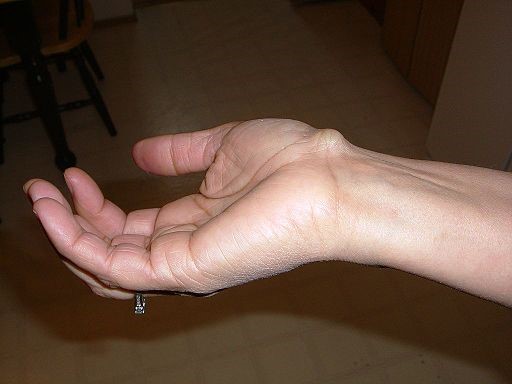
© GEMalone, CC BY 3.0, via Wikimedia Commons
A ganglion cyst is a small swelling that contains a thick jelly-like material. It looks and feels like a smooth lump under the skin. It is not fully understood how it occurs but most experts think that they occur due to multiple micro-traumas to the area of the body.
A ganglion is usually attached to a joint or tendon, and the fluid inside is a thicker version of the fluid which 'lubricates' the joint and tendon sheaths (synovial fluid).
Where are ganglion cysts found?
Back of the wrist. The most common site for a ganglion to be found is on the back of the wrist. 7 out of 10 ganglion cysts are found here.
Front of the wrist (the same side as the palm). It can also occur on the other side of the wrist. 2 out of 10 ganglion cysts are found here.
Top of foot, ankle, top parts of the fingers. 1 out of 10 ganglion cysts are found here.
Other sites of the body are affected less commonly.
Ganglion cyst symptoms
Swelling. The main symptom is a lump, which is usually very smooth and round.
Size. Their size can vary from being very small (pea-sized) to being larger (plum-sized).
Painful. They can sometimes be painful or tender, particularly if they lie next to a nerve.
Never spread. They never spread to other areas of the body.
Usually when a ganglion cyst is present it is there all the time but sometimes they come and go. 5 out of 10 ganglion cysts disappear completely over time without any treatment.
Your doctor will usually be able to tell if the lump is a ganglion just by examining it. Very occasionally, if the diagnosis is not clear, a scan such as an ultrasound scan or MRI scan may be needed.
Ganglion cyst treatment
If a ganglion cyst does not cause symptoms it can be best just to leave it alone. However, many people prefer to get rid of them.
Many people have heard of the traditional cure, which is to smash them with a heavy book (tradition holds it to be the family bible). This bursts the cyst under the skin. The fluid is then absorbed into the bloodstream. In some people this works well, but there is a high chance of it coming back (recurring), as the walls of the cyst can reform. It is not usually recommended as there is a risk of injury to the area around the ganglion cyst.
Medical treatment is not always available on the NHS.
Aspiration
In some cases it is possible to suck out (aspirate) the fluid with a needle and syringe. If the jelly-like fluid is very thick this may not work. Also, if it does work, there is a chance that the cyst will recur, as the wall of the cyst is not removed, and the fluid may form again to refill the ganglion. However, in some people it cures the problem. As it is quite easy for a doctor (usually an orthopaedic surgeon) to do, this is often attempted first.
Surgery
Surgical removal of the ganglion cyst is the most successful cure. This is a relatively minor operation. This is the treatment that is most likely to be permanent but still around 3 cases in 20 will come back.
Patient picks for Lumps and bumps

Signs and symptoms
Neck lumps and bumps
Neck lumps and bumps are common and they have many possible causes. They may arise from the skin or from structures underneath.
by Dr Doug McKechnie, MRCGP

Signs and symptoms
Lumps
Most lumps are harmless and do not need any treatment. However, it is very important to see your GP if you have any concerns about the lump, or if the lump doesn't disappear within two weeks.
by Dr Hayley Willacy, FRCGP
Frequently asked questions
What is the fluid inside a ganglion cyst made of?
The fluid inside a ganglion cyst is a thicker version of synovial fluid. Synovial fluid is what normally lubricates joints and the sheaths surrounding tendons in the body.
Do ganglion cysts always stay the same size?
No, the size of a ganglion cyst can change. They can vary from very small, like a pea, to larger, like a plum. Their size can also fluctuate, and sometimes they may even disappear on their own.
Are ganglion cysts a sign of a more serious condition, like cancer?
No, ganglion cysts are not cancerous or malignant, and they never spread to other areas of the body. They are a benign condition.
How can a doctor determine if a lump is a ganglion cyst?
Most of the time, a doctor can identify a ganglion cyst just by examining the lump. In rare cases where the diagnosis isn't clear, further imaging like an ultrasound or MRI scan might be used to confirm it.
If I have a ganglion cyst that doesn't bother me, do I need to treat it?
If a ganglion cyst isn't causing you any symptoms or pain, it can often be left alone. Many people choose not to treat them if they aren't causing problems.
Further reading and references
- Gude W, Morelli V; Ganglion cysts of the wrist: pathophysiology, clinical picture, and management. Curr Rev Musculoskelet Med. 2008 Dec;1(3-4):205-11. doi: 10.1007/s12178-008-9033-4. Epub 2008 Aug 26.
- Ganglion - Clinical guidance; Primary Care Dermatology Society. November 2021.
- Ganglion cysts; British Society for Surgery of the Hand (BSSH)
- BSSH Evidence for Surgical Treatment - Wrist Ganglion; British Society for Surgery of the hand
About the authorView full bio

Dr Philippa Vincent, MRCGP
General Practitioner, Medical Author
MB BS, Bsc, MRCGP (2000), DCH, DFSRH, DRCOG
Dr Philippa Vincent is an NHS GP working in North London.
About the reviewerView full bio

Dr Toni Hazell, FRCGP
MBBS, BSc, FRCGP, DFSRH, Dip GU med, DRCOG, DCH (London, UK, 2000)
Dr. Toni Hazell qualified from St. Mary’s Hospital Medical School and did her VTS at Northwick Park Hospital.
Article history
The information on this page is written and peer reviewed by qualified clinicians.
Article also available in English, German, Spanish, French, Italian, Portuguese, Hindi, Hebrew, Arabic, and Swedish.
Next review due: 10 Aug 2025
11 Aug 2025 | Latest version
Join the conversation
Share your thoughts or experiences with others in our patient communities.

Ask, share, connect.
Browse discussions, ask questions, and share experiences across hundreds of health topics.

Feeling unwell?
Assess your symptoms online for free
Sign up to the Patient newsletter
Your weekly dose of clear, trustworthy health advice - written to help you feel informed, confident and in control.
By subscribing you accept our Privacy Policy. You can unsubscribe at any time. We never sell your data.