Che cos'è l'esfoliazione e perché è importante?
Revisione paritaria di Dr Colin Tidy, MRCGPUltimo aggiornamento di Lynn StephenUltimo aggiornamento 24 Ago 2026
Rispetta le linee guida editoriali
- ScaricaScarica
- Condividi
- Language
- Discussione
- Versione audio
- Aggiungi alle fonti preferite su Google
Al giorno d'oggi, una routine di cura della pelle può contenere molti passaggi, ma i guru della pelle considerano ancora 'detergere, esfoliare, idratare' il mantra essenziale se si cerca una carnagione sana. Cos'è esattamente l'esfoliazione e tutti dovrebbero farla?
What does exfoliating do?
Dr Osman Bashir Tahir, Medical Director at Halcyon Aesthetics, London, explains that exfoliation means removing dead skin cells from the surface of your skin, using either a chemical, granular substance, or exfoliation tool.
"Your skin does shed dead skin cells," he says. "But it doesn't always get rid of them all."
No matter your skin type, shedding these cells can improve the appearance and health of your skin. According to Tahir, exfoliating will help your skin to look brighter, but it also helps absorption of topical skin care products - ones you apply directly on to your skin - which will make them more effective.
Dull-looking skin is something that we're all more susceptible to as we age. Exfoliating can help your skin look younger for longer.
Is exfoliating good for acne?
"Yes, it can be," says Tahir. "Exfoliating can help prevent breakouts by unclogging pores. However, it can also exacerbate cicatrici da acne if performed too vigorously or with incorrect methods."
He advises choosing a product that is gentle but also effective if you have acne-prone skin.
Physical versus chemical exfoliation
Not all products that exfoliate are created equal, and it's helpful to know which are more gentle, particularly if you have acne-prone skin. This is where physical versus chemical exfoliation comes in.
A physical exfoliant - also known as mechanically exfoliating products. Many face and body scrubs contain exfoliating particles that give them a grainy texture. These 'grains' physically slough off dead skin cells on your skin's outermost surface (epidermis). Likewise, brushes and sponges designed with rough bristles work in a similar way, manually lifting off dead skin cells as you rub.
A chemical exfoliant - relies on chemicals to break the bonds between dead skin cells in order to loosen and remove them. Chemical ingredients can be included in facial cleansers, toners, gels, peels, and masks.
If you have acne or sensitive skin, Tahir recommends using a chemical exfoliant.
"Physical exfoliants may do more harm than good as they may irritate your skin," he says.
Topical exfoliants
Massaging an exfoliant in a circular motion directly on to your skin is by far the most common and budget-friendly option. If cost is a factor, many affordable high street brands offer physical exfoliators in the form of scrubs, brushes, and sponges.
In contrast, topical chemical products are smooth in texture and come in a range of price tags. But you needn't pay an arm and a leg for a good product. The key is to check the label for the star exfoliating ingredients - alpha hydroxy acids (AHAs) and beta hydroxy acids (BHAs). These aren't as scary as they sound.
AHAs - is glycolic acid an exfoliant?
AHAs are water-soluble acids derived from plants and work well as natural exfoliants. Glycolic acid is the most popular AHA in skincare, gently dissolving bonds between cells while allowing your skin to stay moisturised. It also boosts la produzione di collagene production, creating a smoother surface, and reducing signs of ageing.
BHAs - is salicylic acid an exfoliant?
Also extracted from plants, BHAs are oil-soluble acids that exfoliate the skin in a similar way to AHAs. They also unclog dirt and oil (sebum) from pores, making them great for tackling oily skin and acne. Salicylic acid is a BHA that's used in many skincare products. Its antibacterial and anti-inflammatory properties make it an ideal choice for acne-prone skin.
Facial peels
Exfoliating your skin needn't break the bank, but facial peels may be a good choice if you have certain skin issues and if you have the money to spend.
Peeling chimici
Chemical peeling is usually carried out by a skincare professional (dermatologist) who applies a chemical solution to remove the top layer of skin cells. This penetrates deeper than topical products, making it a super exfoliant that can address a number of skin imperfections.
"Face peels can be used to offer very light rejuvenation right through to effectively treating acne scarring and patches of darker skin (pigmentation)," says Tahir. It all depends on the level of depth you choose:
Which depth is right for you?
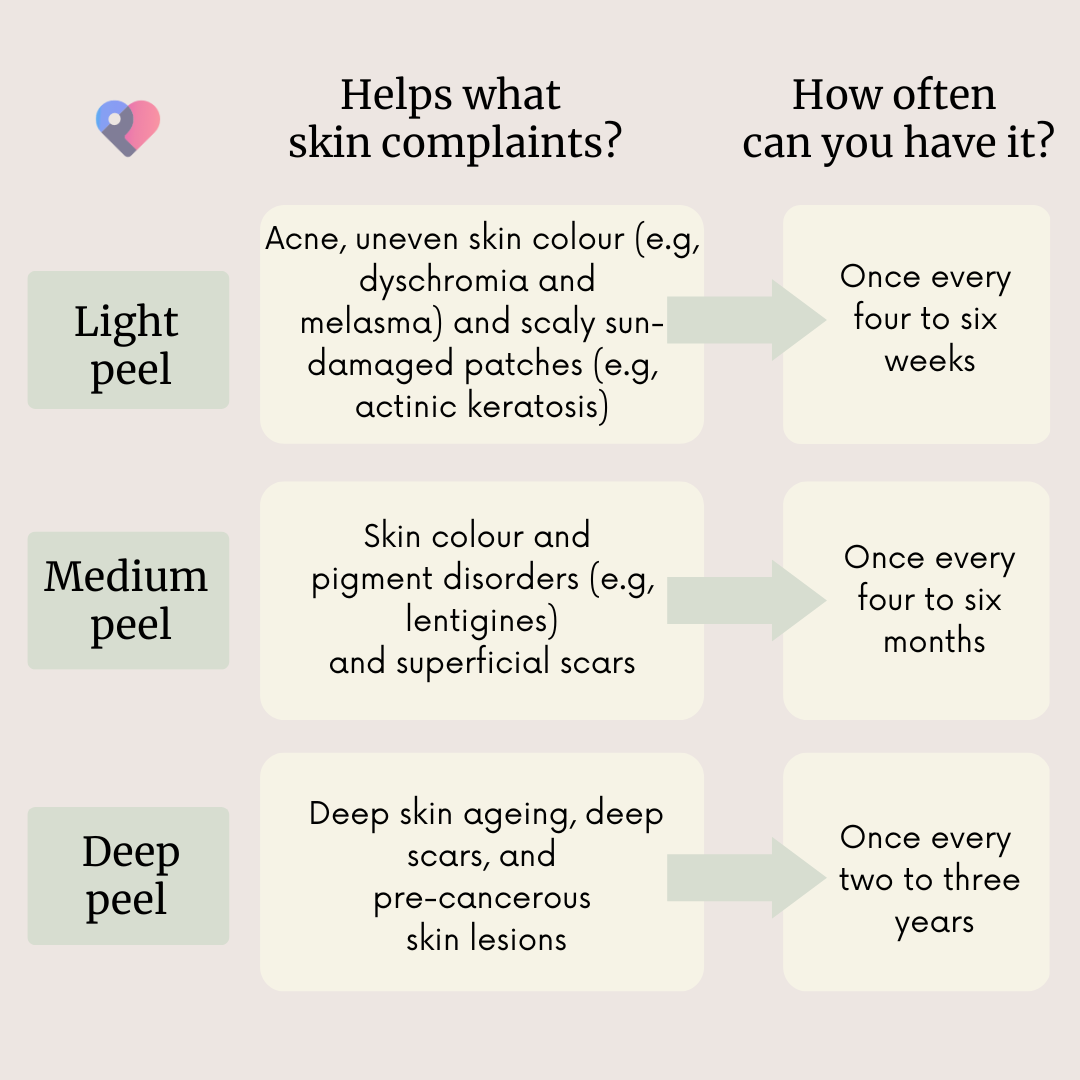
According to Tahir, depending on the type and strength of each chemical peel, you can expect to experience redness and swelling which can last anywhere from just a couple of hours to two weeks.
As chemical peels can irritate your skin, it's important that your dermatologist finds the right peel for you. There are many factors they should consider, including your medical history and skin tone. For example, if you have a dark skin tone you are more likely to experience inflammation and should avoid deep chemical peels.
Laser peels
Tahir says that there is some degree of overlap between laser and chemical peels but there are also major differences. For example, recovery following laser peels is often quicker because there is no chance of adverse chemical reactions.
"Technological advancements with laser peel treatments can now leave people with no downtime and no pain," he notes.
This said, the decision to have a laser or chemical peel will ultimately come down to the skin issues you want to address. Chemical peels may be more appropriate for uneven skin colour and other surface-level issues. Tahir explains that laser peels are better at improving your overall skin texture as well as treating deeper skin damage - such as wrinkles, scars, redness, melasma, spider veins, acne, and acne scarring.
Facial peel side effects
A word of caution - because they expose new skin, all facial peels leave you more vulnerable to sun damage from ultraviolet (UV) rays. Be sure to apply a high sun protection factor (SPF) sunscreen when out and about.
Peels that are tailored to your skin are generally considered safe. However, there can sometimes be complications.
Questi includono:
Infezione.
Patches of darker skin (hyperpigmentation).
Patches of lighter skin (hypopigmentation).
Cicatrici.
How to exfoliate - Tahir's tips
How often should I exfoliate?
If you exfoliate with topical products such as scrubs, Tahir does not recommend exfoliating more than once or twice a week. You should use facial peels even less frequently, as noted in the table above.
How to exfoliate your face
Tahir says: "For your face, I do recommend chemical and laser peels as the best option, but these are of course not always affordable.
"If you're using a scrub at home, the key is not to rub it in too harshly. You want to massage your skin gently in small circular motions, otherwise it will hurt. Scrubs have the potential to create small tears in the skin."
How to exfoliate legs with ingrown hairs
Tahir says: "Keeping skin exfoliated can help prevent ingrown hairs by ensuring hair doesn't grow sideways into your skin. For legs, I would recommend using an exfoliating glove to wash away dead skin and clear out pores before you shave."
How to exfoliate your scalp
Tahir says: "If you want to exfoliate your scalp, I recommend doing it on wet, shampooed hair. However, you shouldn't exfoliate your scalp more than once or twice a week as it removes oil, and it may lead to an overproduction of oil."
Scelte del paziente per Cura della pelle
Salute della pelle, delle unghie e dei capelli
Retinolo: benefici per la cura della pelle, effetti collaterali e altro
Qualunque sia la tua età, se hai mai pensato alla cura della pelle, probabilmente hai sentito parlare di retinolo. Ma se non sei sicuro di cosa sia esattamente - o perché potresti aver bisogno di saperlo - non sei solo. Per complicare le cose, il termine 'retinolo' è usato in contesti simili a 'retinoide' e 'acido retinoico' tra gli altri. Ecco una panoramica del retinolo, dei suoi benefici per la pelle e delle cose da considerare prima di aggiungerlo alla tua routine di cura della pelle.
di Lynn Stephen
Salute della pelle, delle unghie e dei capelli
Cosa fa il siero alla vitamina C?
Un siero di vitamina C di buona qualità può essere un'ottima aggiunta alla tua routine di cura della pelle. Con così tanti sul mercato, ecco come scegliere uno con gli ingredienti più efficaci e supportati scientificamente.
di Victoria Raw
Informazioni sull'autoreVisualizza il profilo completo
Aggiornato da

Lynn Stephen
Sviluppatore di contenuti
MA (Hons)
Lynn si è unita a Patient nel 2023 e il suo ruolo include il controllo di tutti i volantini professionali, i foglietti informativi per i pazienti e i foglietti illustrativi dei medicinali, per garantire la coerenza dell'ortografia, della grammatica, del materiale di riferimento e dello stile del marchio, lavorando con gli autori medici e il direttore clinico per coordinare la redazione e la revisione tra pari dei volantini.
Autore

Amberley Davis
Scrittore senior
BA (Hons), CPD
Amberley è una scrittrice senior presso Patient e ha scritto ampiamente su una gamma di argomenti relativi alla salute e al benessere.
Informazioni sul recensoreVisualizza il profilo completo

Dr Colin Tidy, MRCGP
Medico di base, Autore medico
MBBS, MRCGP, MRCP (Paediatrics), DCH
Il Dr Colin Tidy è un medico del NHS, con sede nell'Oxfordshire.
Storia dell'articolo
Articolo disponibile anche in Inglese, Tedesco, Spagnolo, Francese, Italiano, Portoghese, Hindi, Ebraico, Arabo, and Svedese.
Next review due: 24 Aug 2027
24 Ago 2026 | Ultima versione
9 Aug 2022 | Pubblicato originariamente
Autore:
Amberley Davis
Partecipa alla conversazione
Condividi i tuoi pensieri o esperienze con gli altri nel nostro comunità di pazienti.

Chiedi, condividi, connettiti.
Esplora le discussioni, fai domande e condividi esperienze su centinaia di argomenti di salute.

Non ti senti bene?
Valuta i tuoi sintomi online gratuitamente
Iscriviti alla newsletter di Patient
La tua dose settimanale di consigli sulla salute chiari e affidabili - scritti per aiutarti a sentirti informato, sicuro e in controllo.
Abbonandoti accetti i nostri Informativa sulla Privacy. Puoi annullare l'iscrizione in qualsiasi momento. Non vendiamo mai i tuoi dati.