Trigger finger
Peer reviewed by Dr Colin Tidy, MRCGPLast updated by Dr Hayley Willacy, FRCGP Last updated 10 Apr 2025
Meets Patient’s editorial guidelines
- DownloadDownload
- Share
- Language
- Discussion
- Audio Version
- Add to preferred sources on Google
A trigger finger does not straighten easily. The cause is not clear. Sometimes it settles and goes away without treatment. An injection of steroid will usually cure the problem. A small operation is needed in a small number of cases.
At a glance
Trigger finger is a condition causing your finger or thumb to lock or click when you try to straighten it.
It is caused by inflammation and thickening of a tendon or its sheath in the affected finger.
Symptoms include pain at the base of the finger, stiffness, and a snapping or locking sensation.
It's more common in women over 40 and can be linked to repetitive hand movements or other health conditions.
Treatment options include rest, splinting, steroid injections, or surgery if other treatments fail.
What is trigger finger?
Trigger finger (also known as stenosing tenosynovitis) is a condition that affects the tendons in your fingers or thumb, causing them to become inflamed and thickened. This can lead to difficulty in straightening or bending the affected finger, often resulting in it "locking" or "catching" in a bent position, like a trigger being pulled and released. It is difficult to straighten out without pulling on it by the other hand. When the finger "snaps" back into place, it can be painful.
You may hear a popping or clicking sound when it is pulled straight. This clicking may be worse in the morning. Sometimes there is mild pain and/or a small swelling at the base of the affected finger or thumb.
One or more fingers may be affected. Trigger finger most commonly affects your little finger, ring finger or thumb. It is actually more common in the right hand.
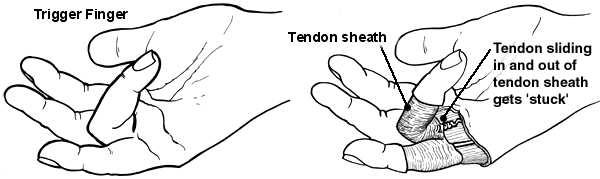
Diagram: trigger finger
What causes trigger finger?
The cause is often not clear. It is thought to be due to some inflammation which causes swelling of a tendon or the covering of the tendon (tendon sheath).
A tendon is a strong tissue that attaches a muscle to a bone. In this case the tendon comes from a muscle in the forearm. It passes through the palm and attaches to the finger bone. The muscle pulling on this tendon bends (flexes) the finger towards the palm.
A tendon sheath is like a tunnel that covers and protects parts of a tendon. Normally, the tendon slides easily in and out of the sheath as you bend and straighten the finger. In trigger finger the tendon can slide out of the sheath when you bend your finger. However, it cannot easily slide back in due to the swelling. The finger then remains bent (flexed) unless you pull it straight with your other hand.
Most cases occur for no apparent reason in healthy people. Around 2 in 100 people develop trigger finger. It is more common if you are aged over 40 and if you are female. It may also be more likely to develop if you have had a previous injury to your palm or finger.
In some cases it occurs after you have used your palm a lot - for example, it can happen:
After jobs which involve a lot of screwdriver use.
After working with tools that press on the palm.
These may cause some inflammation in the palm.
Sometimes trigger finger occurs as a feature of another disease. For example, trigger finger is more common in people with rheumatoid arthritis, amyloidosis, diabetes, underactive thyroid gland, Dupuytren's contracture and carpal tunnel syndrome and in people on dialysis. In these situations you will have other symptoms of the condition and the trigger finger is just one feature.
Note: most people with trigger finger do not have any of these conditions.
What are the symptoms of trigger finger?
Symptoms can vary from mild to severe and typically affect one finger or the thumb. They may include:
Pain or tenderness: Pain is often felt at the base of the finger or thumb, particularly when bending or straightening the finger.
Stiffness: The finger may feel stiff, especially in the morning.
Snapping or clicking sensation: The finger may make a snapping or clicking sound as it moves, particularly when it is being straightened after being bent.
Locking or catching: The finger may "lock" in a bent position and may need help to straighten it. This can be painful.
Swelling: The affected area may be swollen or appear thicker than usual.
How is trigger finger diagnosed?
Your doctor will diagnose trigger finger based on your medical history, symptoms, and a physical examination. During the exam, they may ask you to move your fingers in different ways to assess for pain, stiffness, or clicking. In some cases, your doctor may use an ultrasound or an X-ray to rule out other conditions.
What is the treatment for trigger finger?
Not treating is an option at first
Around one in five people will improve without any treatment. Simply resting the hand and fingers, allowing any inflammation to settle, may resolve the problem without the need for treatment. You may be advised to take a painkiller (for example, paracetamol or ibuprofen) to relieve the pain.
Splinting
Your symptoms may improve if your finger (or trigger thumb) is strapped to a plastic splint so that it is completely straight. Some people wear a splint just at night.
A steroid injection
A steroid injection into the tendon sheath is one treatment if the condition does not settle. The steroid is combined with a local anaesthetic to make the injection less painful.
Steroids work by reducing inflammation. A finger splint may be advised for a few days after the injection to rest the finger. This treatment works in about 9 in 10 cases. A second injection may be needed if the first does not work.
Surgery
An operation done under local anaesthetic may be advised if the above does not work. A small cut is usually made at the base of the finger and the tendon sheath is widened. The surgical treatment of trigger finger is usually very successful.
An alternative operation is a percutaneous trigger finger release. A needle is used to release the tight mouth of the tunnel so an open operation is avoided.
If you have rheumatoid arthritis, these types of surgery may not be suitable for you. If you do need surgery, you may be offered an operation to remove part of the tendon sheath instead.
However, with an operation there is a small risk of damaging the tiny finger nerve and causing some numbness to the finger. Also, as with any operation, there is a small risk of any wound becoming infected.
Preventing trigger finger
While trigger finger may not always be preventable, you can reduce your risk by:
Taking breaks from repetitive hand movements.
Stretching your fingers and wrists regularly if you do activities that involve gripping or bending.
Using ergonomic tools that reduce strain on your hands.
Maintaining a healthy lifestyle to reduce the risk of conditions such as diabetes and arthritis, which can contribute to trigger finger.
Outlook for trigger finger (prognosis)
In most cases, trigger finger improves with treatment. Non-surgical treatments, such as rest, splinting, and corticosteroid injections, are often effective in reducing symptoms. Surgery is rarely necessary and is typically only recommended if other treatments fail. Most people recover fully and regain normal hand function.
Patient picks for Connective tissue disorders

Bones, joints and muscles
Tendinopathy and tenosynovitis
Tendinopathy is a general term for disease of a tendon. Tendinosis is another name for this. Tenosynovitis is a general term for disease of the sheath surrounding a tendon.
by Dr Rachel Hudson, MRCGP

Bones, joints and muscles
Hypermobility spectrum disorders
Hypermobility spectrum disorders include all people with what used to be called joint hypermobility syndrome, and before that benign joint hypermobility syndrome. Anyone who has symptoms as a result of having hypermobile joints, but who does not have all the features of Ehlers-Danlos syndrome, has a hypermobility spectrum disorder. These problems mainly affect children and young adolescents with extra-flexible (hypermobile) joints who develop pain on exercise, which persists when they rest. These conditions can have a major impact on school and sporting life. Whilst they do not usually cause long-term harm, they can be associated with injuries and can sometimes persist into adulthood. Treatment is aimed at increasing muscle strength and joint resilience without causing injury.
by Dr Colin Tidy, MRCGP
Frequently asked questions
Can trigger finger affect more than one finger?
Yes, one or more fingers may be affected by trigger finger. It most commonly impacts the little finger, ring finger, or thumb, and is often seen in the right hand.
Does trigger finger cause swelling in the affected area?
Yes, swelling is a possible symptom of trigger finger. The affected area may appear swollen or thicker than usual at the base of the finger or thumb.
How is trigger finger diagnosed by a doctor?
Your doctor will diagnose trigger finger by reviewing your medical history, assessing your symptoms, and conducting a physical examination. During the exam, they might ask you to move your fingers to check for pain, stiffness, or clicking. Occasionally, an ultrasound or X-ray might be used to rule out other conditions.
Are there any risks associated with surgery for trigger finger?
Yes, there are small risks associated with surgery for trigger finger. These include a slight chance of damaging a tiny finger nerve, which could lead to some numbness in the finger. Additionally, as with any surgical procedure, there's a small risk of the wound becoming infected.
How can I reduce the risk of developing trigger finger?
You can reduce your risk of developing trigger finger by taking breaks from repetitive hand movements, regularly stretching your fingers and wrists if your activities involve gripping or bending, using ergonomic tools to lessen hand strain, and maintaining a healthy lifestyle to lower the risk of conditions like diabetes and arthritis which can contribute to trigger finger.
Further reading and references
- Peters-Veluthamaningal C, van der Windt DA, Winters JC, et al; Corticosteroid injection for trigger finger in adults. Cochrane Database Syst Rev. 2009 Jan 21;(1):CD005617. doi: 10.1002/14651858.CD005617.pub2.
- Jeanmonod R, Harberger S, Waseem M; Trigger Finger. StatPearls.
- Fiorini HJ, Tamaoki MJ, Lenza M, et al; Surgery for trigger finger. Cochrane Database Syst Rev. 2018 Feb 20;2:CD009860. doi: 10.1002/14651858.CD009860.pub2.
- Merry SP, O'Grady JS, Boswell CL; Trigger Finger? Just Shoot! J Prim Care Community Health. 2020 Jan-Dec;11:2150132720943345. doi: 10.1177/2150132720943345.
- Ferrara PE, Codazza S, Maccauro G, et al; Physical therapies for the conservative treatment of the trigger finger: a narrative review. Orthop Rev (Pavia). 2020 Jun 26;12(Suppl 1):8680. doi: 10.4081/or.2020.8680. eCollection 2020 Jun 29.
- Abdulsalam AJ, Mezian K, Ricci V, et al; Injecting the Trigger Finger: Target (With Ultrasound), Then Shoot! J Prim Care Community Health. 2021 Jan-Dec;12:21501327211000237. doi: 10.1177/21501327211000237.
About the authorView full bio

Dr Hayley Willacy, FRCGP
General Practitioner, Medical Author
MBChB (1992), DRCOG, DFFP, MRCOG (Part 1) MRCGP (2007), DFSRH (2013), MSc - medical education (2020)
Dr Hayley Willacy was an NHS GP working in northwest England, who retired from clinical practice in 2022 after 30 years.
About the reviewerView full bio

Dr Colin Tidy, MRCGP
General Practitioner, Medical Author
MBBS, MRCGP, MRCP (Paediatrics), DCH
Dr Colin Tidy is an NHS Doctor, based in Oxfordshire.
Article history
Article also available in English, German, Spanish, French, Italian, Portuguese, Hindi, Hebrew, Arabic, and Swedish.
Next review due: 9 Apr 2028
10 Apr 2025 | Latest version
Join the conversation
Share your thoughts or experiences with others in our patient communities.

Ask, share, connect.
Browse discussions, ask questions, and share experiences across hundreds of health topics.

Feeling unwell?
Assess your symptoms online for free
Sign up to the Patient newsletter
Your weekly dose of clear, trustworthy health advice - written to help you feel informed, confident and in control.
By subscribing you accept our Privacy Policy. You can unsubscribe at any time. We never sell your data.
More in bones, joints and muscles
- Ankle injury
- Baker's cyst
- Bisphosphonates
- Broken toe
- Dupuytren's contracture
- Ehlers-Danlos syndrome
- Hamstring injury
- Hip fracture
- Knee replacement
- Mallet finger
- Multiple sclerosis
- Osteoarthritis
- Pelvic fractures
- Pins and needles
- Primary bone cancer
- Scoliosis and kyphosis
- Shin splints
- Shoulder pain
- Sprains and strains
- Temporomandibular Joint Disorder (TMD)