Milia
Revisione paritaria di Dr Hayley Willacy, FRCGP Ultimo aggiornamento di Dr Philippa Vincent, MRCGPUltimo aggiornamento 18 Apr 2023
Rispetta le linee guida editoriali
- ScaricaScarica
- Condividi
- Language
- Discussione
- Versione audio
- Add to preferred sources on Google
Milia sono piccole protuberanze molto piccole, sollevate, di colore bianco perla o giallastro sulla pelle. Si trovano più spesso sulla pelle intorno alle guance, al naso, agli occhi e alle palpebre, alla fronte e al petto. Tuttavia, possono comparire ovunque sul corpo. Le milia sono molto comuni nei neonati, ma possono colpire persone di qualsiasi età. Nei neonati, le milia scompaiono da sole e non è necessario alcun trattamento. In altre persone, possono richiedere più tempo per scomparire. In casi persistenti, può essere consigliato un trattamento.
At a glance
Milia are small, raised, pearly-white or yellowish bumps on the skin.
They are tiny skin cysts filled with a protein called keratin.
Milia are common in newborn babies, usually disappearing by 12 weeks.
In children and adults, milia often clear by themselves without treatment.
You should not try to squeeze or treat milia yourself, as this can cause scarring or infection.
If persistent or widespread, a skin specialist can offer removal treatments.
Preventing sun damage and correctly using steroid creams may reduce some types of milia.
In questo articolo:
Video picks for Eruzioni cutanee
Continua a leggere sotto
Cosa sono i milia?
A milium is a small, raised bump on the skin. It is a type of tiny skin cyst filled with a protein called keratin.
Many are usually found together and so they are called milia (the plural of milium).
What do milia look like?
Torna ai contenutiMilia in un neonato
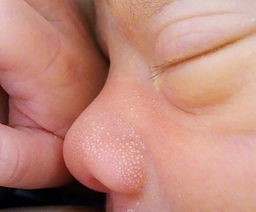
© Serephine, CC0, via Wikimedia Commons
As can be seen in the picture, milia are usually each about 1 or 2 millimetres across and are pearly-white or yellowish. They appear to be small white bumps on the face.
They are most often seen on the skin around the cheeks, nose, eyes and eyelids, forehead and chest but they can occur anywhere on the body.
Continua a leggere sotto
Types and causes of milia
Torna ai contenutiThere are different types of milia.
Neonatal milia
These are milia that are seen in young babies soon after they are born. They are very common and are usually found around the nose area but may also occur on the scalp, cheeks, upper body and inside the mouth. They are thought to arise from sweat glands that aren't fully developed or mature. Around half of all babies develop neonatal milia. In fact, because they are so common, they are actually considered as normal in newborn babies - often they are called "milk spots" although they are nothing to do with milk. They usually disappear by 12 weeks of age.
Milia primarie
These are milia that can occur in both children and adults. They occur in an area of skin that has otherwise been normal without any previous damage or injury.
Milia secondaria
These are milia that develop in an area of skin, anywhere on the body, that has previously been damaged or injured. For example, after a burn or a blistering rash. The milia develop as the skin heals and it is thought that damage to the sweat glands may be an underlying cause. Secondary milia also sometimes develop after some skin creams have been used.
Milia en plaque
Milia of this type are extremely rare. The milia develop on an inflamed, raised patch of skin known as a plaque which may be several centimetres across. The cause of milia en plaque is not fully understood. It usually occurs behind the ears, on an eyelid or on the cheeks or jaw area. This type of milia tends to particularly affect middle-aged women.
Milia eruttiva multipla
The milia appear in crops, or patches, of milia that develop over a period of weeks or months. The crops usually appear on the face, the upper arms and the upper trunk. Milia of this type are also extremely rare.
Sintomi delle milia
Torna ai contenutiMilia do not usually cause any symptoms but,they can occasionally become itchy.
Continua a leggere sotto
How are milia diagnosed?
Torna ai contenutiMilia are usually diagnosed by their typical appearance and generally no investigations are needed. However, occasionally, if the diagnosis is uncertain or if milia en plaque are suspected, a skin biopsy might be recommended.
During a skin biopsy, a small piece of skin is removed so that it can be examined under a microscope. There are different ways that a skin biopsy can be carried out. For example, by shaving away a small piece of skin or by using a special instrument to punch a tiny hole in the skin.
How long do milia last?
Torna ai contenutiMilia are harmless and, in most cases, they will eventually clear by themselves. In babies, they clear after a few weeks. However, in some people, milia can persist for months or longer. Secondary milia are sometimes permanent.
Trattamento delle milia
Torna ai contenutiBecause they normally clear by themselves, milia do not usually need any treatment. However, some people find them unsightly and so opt for treatment to remove milia.
Milia removal
Milia may be removed using a fine needle and then squeezing, or pricking, out the contents. No anaesthetic is needed. However, it is not recommended to squeeze or try to treat milia yourself. This can lead to skin damage and scarring or infection.
If milia become very widespread and persistent, various other treatments may be suggested, usually by a skin specialist (a dermatologist). They include:
Crioterapia: a type of treatment that freezes skin lesions. Where a patch of skin has changed in appearance, it is known as a skin lesion.
Trattamento laser.
Dermabrasion: a procedure that removes the topmost layers of the affected skin.
Chemical peeling: a treatment where a chemical is applied to the face to burn off skin lesions.
In the rare type of milia called milia en plaque, certain creams such as isotretinoin or tretinoin are sometimes suggested as treatment, or the antibiotic tablet, minocycline.
Can milia be prevented?
Torna ai contenutiMost milia cannot be avoided, particularly neonatal milia. The risk of developing secondary milia development can be reduced by avoiding excessive sun exposure, only using steroid creams for the length of time they are prescribed and regularly exfoliating and cleansing the skin to remove dead skin cells.
Patient picks for Eruzioni cutanee

Salute della pelle, delle unghie e dei capelli
Cisti epidermoidali e pilari
Le cisti epidermiche e pilari sono comunemente chiamate "cisti sebacee" (pronunciato "seb-ay-shuss"). Sono proliferazioni di cellule della pelle (chiamate cheratina) racchiuse in una piccola capsula o sacchetto. Sono escrescenze lisce e innocue appena sotto la superficie della pelle. Non sono cancerose e non richiedono rimozione a meno che non ti infastidiscano per l'aspetto o la sensazione. Possono verificarsi praticamente ovunque nel corpo, ma sono comunemente trovate sulla schiena o sul cuoio capelluto.
di Dr Doug McKechnie, MRCGP

Salute della pelle, delle unghie e dei capelli
Lupus discoide
Il lupus discoide è una condizione cutanea rara, ma molto duratura. È generalmente sensibile alla luce solare e provoca cicatrici quando le lesioni guariscono.
di Dr Colin Tidy, MRCGP
Domande frequenti
Can I remove milia at home?
It is not recommended to squeeze or try to treat milia yourself, as this can lead to skin damage, scarring, or infection. While a fine needle can be used to remove them in a clinical setting, self-removal is not advised.
Are milia contagious?
No, milia are not contagious. They are small skin cysts filled with keratin and are not spread from person to person.
What is the difference between primary and secondary milia?
Primary milia develop on skin that has not been previously damaged or injured, and can occur in both children and adults. Secondary milia, on the other hand, develop in an area of skin that has been damaged, for example, after a burn, blistering rash, or use of certain skin creams, as the skin heals.
If milia are usually harmless, why would anyone want to remove them?
While milia do not usually cause any physical symptoms and often clear by themselves, some people find them unsightly and therefore choose to have them removed for cosmetic reasons.
What kind of specialist would treat persistent milia?
If milia become very widespread and persistent, a skin specialist, known as a dermatologist, may suggest various treatments.
Can certain creams cause milia?
Yes, secondary milia can sometimes develop after some skin creams have been used.
What are the long-term effects of milia?
Milia are harmless and generally clear by themselves, often within a few weeks for babies. In some cases, milia can persist for months or longer. Secondary milia can sometimes be permanent.
Ulteriori letture e riferimenti
- O'Connor NR, McLaughlin MR, Ham P; Pelle del neonato: Parte I. Eruzioni cutanee comuni. Am Fam Physician. 1 Gen 2008;77(1):47-52.
- Milium, milia; DermNet NZ
Continua a leggere sotto
About the authorView full bio

Dr Michelle Wright, MRCGP
Medico di base, Autore medico
MB, ChB, MRCGP, DCH, DRCOG
Dr Michelle Wright qualified in 1997 in the UK and worked as a GP in London before moving to Switzerland. She has been an author with EMIS since 2007.
About the reviewerView full bio

Dr Hayley Willacy, FRCGP
Medico di base, Autore medico
MBChB (1992), DRCOG, DFFP, MRCOG (Part 1) MRCGP (2007), DFSRH (2013), MSc - medical education (2020)
Dr Hayley Willacy was an NHS GP working in northwest England, who retired from clinical practice in 2022 after 30 years.
Storia dell'articolo
Le informazioni su questa pagina sono scritte e revisionate da clinici qualificati.
Next review due: 16 Apr 2028
18 Apr 2023 | Ultima versione
15 Mar 2012 | Pubblicato originariamente
Autore:
Dr Michelle Wright, MRCGP

Chiedi, condividi, connettiti.
Esplora le discussioni, fai domande e condividi esperienze su centinaia di argomenti di salute.

Non ti senti bene?
Valuta i tuoi sintomi online gratuitamente
Iscriviti alla newsletter di Patient
La tua dose settimanale di consigli sulla salute chiari e affidabili - scritti per aiutarti a sentirti informato, sicuro e in controllo.
By subscribing you accept our Informativa sulla Privacy. Puoi annullare l'iscrizione in qualsiasi momento. Non vendiamo mai i tuoi dati.