When to worry about a mole
Peer reviewed by Dr Krishna Vakharia, MRCGPLast updated by Amberley DavisLast updated 23 Apr 2024
Meets Patient’s editorial guidelines
- DownloadDownload
- Share
- Language
- Discussion
- Audio Version
- Add to preferred sources on Google
Generally, moles are harmless features of your skin, which rarely cause any issues. But in some cases, UV exposure from the sun can cause a mole to change shape, size or colour and become cancerous. We explore what you need to look out for.
We're growing more aware of the dangers of the sun's rays and how important covering up and applying sun cream is, but melanoma skin cancer rates are still increasing. So it's important we all get into the habit of checking our skin regularly.
"If you've ever had a love of sunbathing or sunbeds, you need to be especially aware of the warning signs of skin cancer. But even if this doesn't describe you, you still need to look out for the signs," says Dr Sarah Jarvis, GP and clinical consultant for Patient.Info.
What are moles?
Moles form when pigment-producing cells in the skin grow in a cluster instead of being spread throughout the skin. Most moles are flat, but sometimes they can be raised, and can range from pink, brown to black.
"Most moles will develop on the body during the first 30 years of someone's life, and they can often change due to hormonal fluctuations. Moles are more common and prominent in fairer-skinned people, and may darken after exposure to the sun, during the teen years, and during pregnancy," explains dermatologist Dr Sharon Wong from the London Bridge Hospital, which is part of HCA Healthcare UK.
Sponsored
Concerned about a mole?
Get your mole checked by a specialist - Peace of mind within 24 hours
If you have a mole that changes, or if new ones appear, this in-app mole assessment helps identify the need for further investigation - all from the comfort of your home.

How can a mole lead to cancer?
UV light from the sun or using sunbeds can change the structure of a mole and increase the chance of it becoming cancerous. This is known as melanoma.
"Melanoma is one of the most aggressive forms of skin cancer, which can spread to other organs in the body. The most common sign of melanoma is a change in an existing or new mole. The mole may also be larger than normal and can sometimes be itchy or bleed," reveals Wong.
Of course, not all new, enlarged or changing moles will mean skin cancer. But you should keep an eye on them just in case.
"Making a habit of examining your own skin on a monthly basis will help to detect any abnormal growths quickly. I always advise my patients to check their skin after they have had a bath or a shower, in a well-lit room with a full-length mirror," Wong adds.
Jarvis says: "Malignant melanoma can affect adults of all ages, and accounts for around 90% of skin cancer deaths despite being about 20 times less common than other skin cancers. The biggest risk factor is skin damage, particularly from burning and especially in childhood. A combination of pale skin and a hot climate is particularly risky. Most moles are nothing to worry about, but see your doctor immediately if a mole changes or you don't pass the ABCDE test."
What to look for when checking a mole
Wong also recommends the ABCDE test, which is a handy guide to remembering what to spot.
ABCDE melanoma
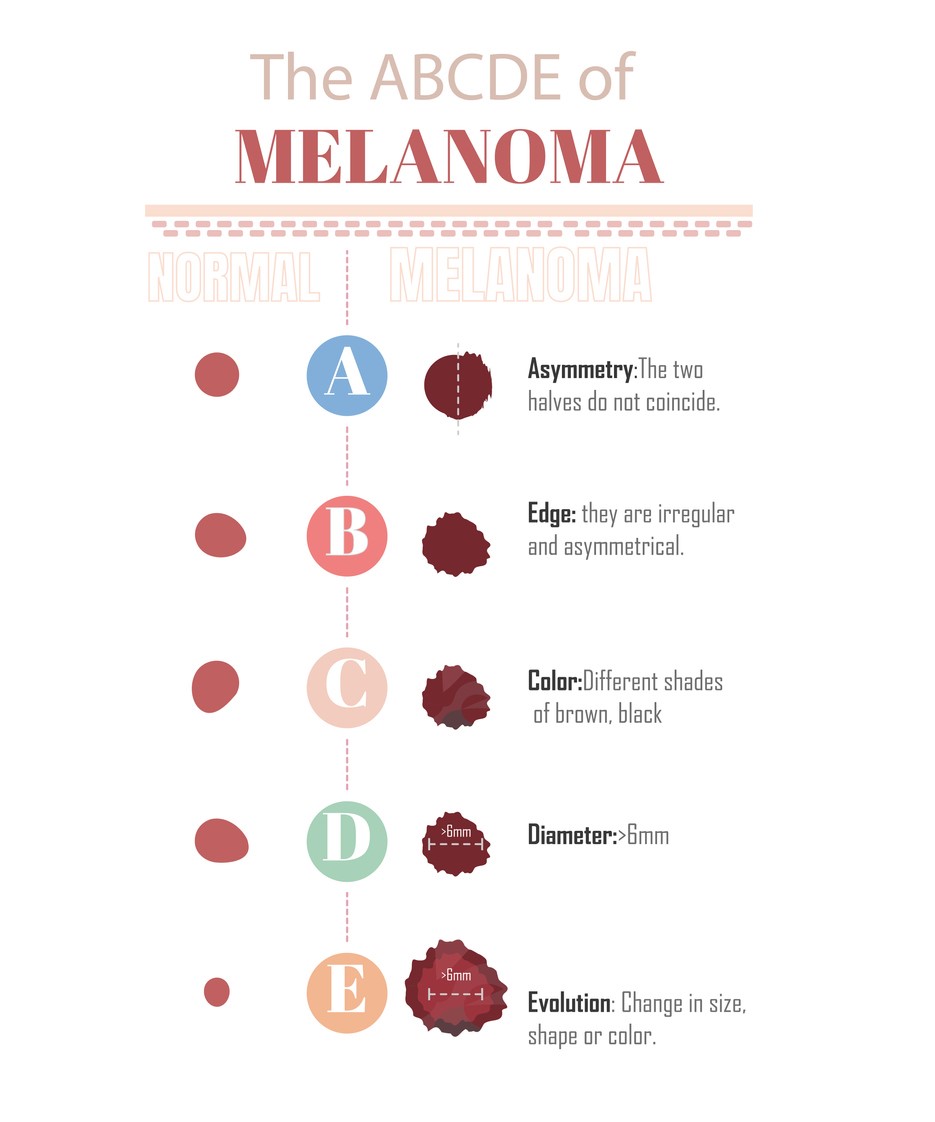
Asymmetry
Is the mole symmetrical? Look out for changes in pigment, texture or shape from one half of the mole to the other.
Border
A non-cancerous mole will usually have smooth, even borders, and you can see clearly where the mole ends and normal skin begins. You should look out for uneven formations and rough edges or lack of clarity between the edge of the mole and the skin that surrounds it.
Colour
Most non-cancerous moles are a single shade of brown, so if a mole is showing a number of colours this could be a warning sign.
Diameter
Melanomas are usually larger than 6 mm. If a mole is bigger than this you may want to consider having it checked out.
Evolving
Non-cancerous moles don't usually change shape or appearance, so if one of your moles is starting to evolve you should definitely book to seek your GP. Also, be aware of any new symptoms such as bleeding, itching or crusting.
But don't fret if you find the self-checking process tricky, or you've found some irregular moles or patches of skin. Book an appointment with your GP who will be able to review your moles and determine if any should be removed or investigated further.
How to reduce your skin cancer risk
Stay safe this year and don't skimp on sun cream. Wong says you need to find one with good UVA and UVB protection. Both types of ray can cause damage to the skin and increase the risk of skin cancer. And cosmetically, UVA can age the skin, resulting in deep wrinkling and dark spots.
And remember, there's no such thing as a healthy tan.
"Unfortunately, there is still a perception within our society that having a tan looks healthy. Due to this, many people apply low-factor sun cream when out in the sun, or don't apply any at all, in order to bronze their skin. I always advise my patients to use between factor 30-50 sun creams with 5* UVA cover, and to apply large amounts every two hours," says Wong.
"I also advise that people should avoid sunbeds at all costs. The UV rays from sunbeds can damage the DNA in your skin cells, and over time this damage can build up to cause skin cancer. Fake tan products are a great option for people who want a darker skin tone, without the long-lasting damage," she concludes.
Patient picks for Moles

Skin, nail and hair health
Concerned about a mole? Get peace of mind with online mole checking
Many of us have moles - small, often harmless marks on the skin that may change slowly over time. But sometimes, a new mole or changes in an existing one can cause worry. While most changes are harmless, it’s important to know when to get a professional opinion, as early detection is key in spotting skin cancer.
by Thomas Andrew Porteus, MBCS
Skin, nail and hair health
Whole body 3D mole mapping: the future of skin health?
Noticing changes in your moles is one of the best defences against skin cancer. But if you're someone who has moles in different places, it can be hard to keep track. Mole mapping is a way to look out for changes over time. The most technologically advanced form is whole body 3D imaging. Here's what you need to know.
by Amberley Davis
About the authorView full bio
Updated by

Amberley Davis
Senior writer
BA (Hons), CPD
Amberley is a senior writer with Patient and has written extensively on a range of health and wellbeing topics.
Authored by

Natalie Healey
Freelance journalist
BSc (Hons) Biomedical Science
She is a London-based health journalist who has been writing about science and medicine for several years. She is the former head of editorial at Patient.
About the reviewerView full bio

Dr Krishna Vakharia, MRCGP
Chief Medical Officer for Health, Optum UK
MBChB, MRCGP(2013), BMedSci (hons), DFSRH, DRCOG, PGDipDerm (Distn)
Dr Krishna Vakharia is an NHS GP. She is also a regular examiner for the postgraduate Diploma in Practical Dermatology at Cardiff University as well as being the Chief Medical Officer for health at Optum UK.
Article history
Article also available in English, German, Spanish, French, Italian, Portuguese, Hindi, Hebrew, Arabic, and Swedish.
Next review due: 23 Apr 2027
23 Apr 2024 | Latest version
22 Jun 2018 | Originally published
Authored by:
Natalie Healey
Join the conversation
Share your thoughts or experiences with others in our patient communities.

Ask, share, connect.
Browse discussions, ask questions, and share experiences across hundreds of health topics.

Feeling unwell?
Assess your symptoms online for free
Sign up to the Patient newsletter
Your weekly dose of clear, trustworthy health advice - written to help you feel informed, confident and in control.
By subscribing you accept our Privacy Policy. You can unsubscribe at any time. We never sell your data.