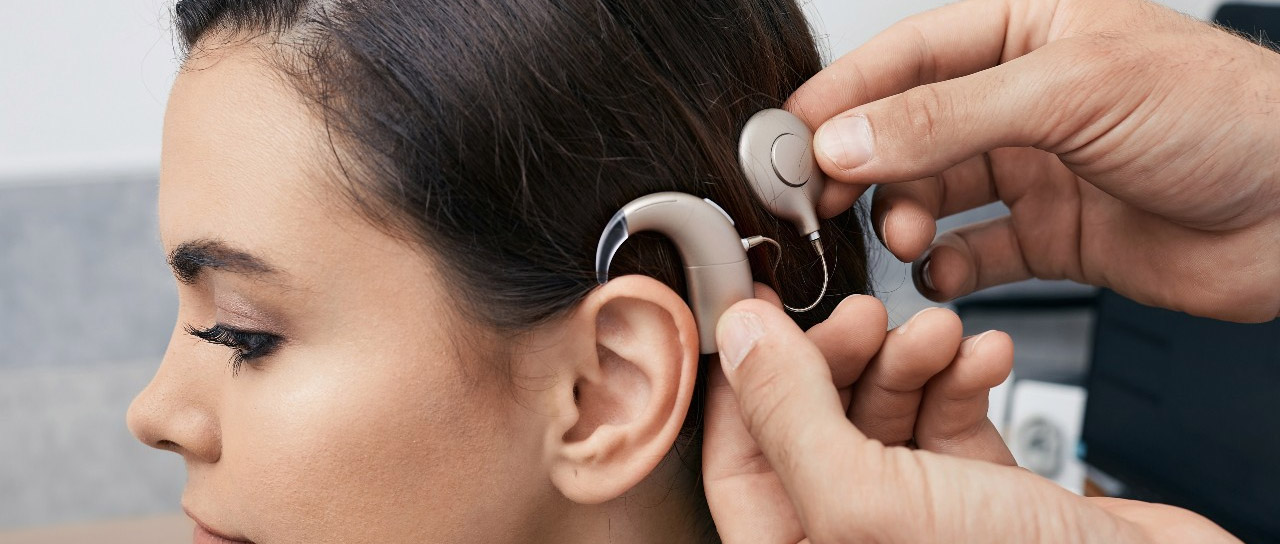
Che cos'è un impianto cocleare e quale effetto ha sull'udito?
Revisione paritaria di Dr Krishna Vakharia, MRCGPUltimo aggiornamento di Emily Jane BashforthUltimo aggiornamento 9 Jul 2022
Rispetta le linee guida editoriali
- ScaricaScarica
- Condividi
- Language
- Discussione
- Versione audio
- Aggiungi alle fonti preferite su Google
Le opportunità e la rappresentanza per la comunità dei non udenti sono notevolmente migliorate negli ultimi anni. Nel 2022, un disegno di legge è stato approvato dal Parlamento per rendere la Lingua dei Segni Britannica (BSL) una lingua legalmente riconosciuta e protetta. Nonostante queste conversazioni siano sotto i riflettori, potrebbero esserci alcuni aspetti della sordità che non conosci e di cui vuoi sapere di più.
The first single-channel cochlear implant was introduced in 1972. As of December 2019, approximately 736,900 registered devices have been implanted worldwide1.
Not all Deaf people have a cochlear implant. Over 5% of the world's population - or 430 million people - require rehabilitation to address their 'disabling' perdita dell'udito, according to the World Health Organization (WHO). But there has been more awareness in recent years over what the implants do2. For example, in 2022, a Love Island contestant named Tasha Ghouri became the villa's first Deaf Islander. She also wears a cochlear implant.
What is a cochlear implant?
A cochlear implant is a small yet complex electronic device that aims to provide those who are profoundly Deaf or severely hard of hearing with a sense of sound. The implant consists of an external portion that sits behind the ear and a second portion that is surgically placed under the skin.
There's a misconception that cochlear implants restore 'normal' hearing levels when this is not the case. What they do provide, however, is to offer a Deaf person a useful representation of the sounds in their environment. They can also help them to understand speech.
How do cochlear implants work?
Cochlear implants work via the following components:
Microphone
The microphone of a cochlear implant picks up sounds from the environment and transforms those sound into electrical signals.
Speech processor
After being picked up by the microphone, incoming sounds are taken to the processor, which is usually worn behind the ear. The processor contains batteries which power the entire cochlear implant. Its job is to select and arrange sounds picked up by the microphone.
Transmitter and receiver/stimulator
Signals from the processor then make their way to the transmitter and receiver/stimulator, where they are converted into electric impulses.
Electrode array
A group of electrodes then collects the impulses from the stimulator and delivers them to different regions of the hearing (auditory) nerve. Ultimately, this allows a person's brain to recognise signals as sound. But hearing with a cochlear implant is different from normal hearing and takes time to relearn.
Seashell Trust is a national learning disability charity that supports children and young people who have complex learning difficulties, disabilities, and additional communication needs. Their principal audiologist, Verity Langlands, works with people with cochlear implants. She explains that implant surgery is a big decision for families to go ahead with.
"A cochlear implant has two parts - an internal implant which is fed through the cochlea during surgery and an external part which collects the sounds and transmits them through the internal implant. The two parts connect via a magnet. The implant system bypasses the damaged cells by directly stimulating the cochlea, and the nerves send this signal to the brain to be interpreted."
How does a cochlear implant attach to the head?
A magnet attaches the cochlear implant to the head, but retention devices can also be used to help keep the external parts of the implant in place.
"I work with students who, for either medical or behavioural reasons, cannot wear the device over their ear. In these instances, we have used some creative ways to keep the implant in place with our students, such as using hair clips to place the speech processor on to the head," explains Langlands.
What is surgery like for cochlear implants?
Children tend to be around one year of age when they get their cochlear implant. There are certain eligibility criteria a child must meet before being fitted with their cochlear implant, including whether they have severe to profound deafness.
New criteria were introduced in 2019 following a review of the definition of severe to profound deafness, meaning those who would benefit from them the most can access cochlear implants via the NHS3.
National Institute for Health and Care Excellence (NICE) guidance states that severe to profound deafness is recognised as only hearing sounds louder than 80 dB HL at 2 or more frequencies without hearing aids (the equivalent of a busy downtown street). Langlands adds that children identified with complex needs in their early years may experience a delay in being implanted.
"The reasons for this delay are many: the young person needs to be well enough for surgery, gathering all the necessary information around hearing may be more challenging, and families may need a little more time to consider the best communication methods and outcomes for their child."
For families with children who have additional needs, she says it is important they access early years intervention, which supports the individual needs of the child and enables families to make informed decisions going forwards.
"The decision to implant is made within a multidisciplinary team (MDT), typically including specialist consultants, audiologists, speech and language therapists and teachers of the Deaf - the individual and their family are also important members of this MDT."
Can you take off a cochlear implant?
A cochlear implant can be removed at any time. Children are generally encouraged to wear their implant during all waking hours and remove it before going to bed. However, a flexible and caring approach to cochlear implant use is important, as with all care for people with learning disabilities.
Langlands says there are a myriad of different reasons why a child or young person might wish to remove their implant and, since their ability to communicate can be limited, it isn't always easy to ascertain their reason for removing the device.
One reason could be that they are experiencing sensory overload. This occurs when a person's five senses - sight, hearing, smell, touch and taste - take in more information than their brain can process, overwhelming it and sending them into a panic.
Langlands explains that it is often very difficult to establish implant use with children and young people with CHARGE syndrome. CHARGE syndrome (CS) refers to a pattern of birth defects and includes a wide range of conditions, which can differ from child to child. It is a complex syndrome and is rare.
She says her work suggests that these young people are mono-modal processors (they process one sense at a time), and they are unable to attend to sound in a multi-sensory environment.
"Similarly, it is likely that children and young people with autistic spectrum disorder (ASD) have under-developed skills to ignore some stimuli and cope with overload by shutting down, hence why they might remove their implant."
Another pattern of behaviour exhibited around cochlear implant use is compartmentalisation, where a person might only accept the use of their cochlear implant in certain environments or in specific time frames.
Children might also remove their implant if they become tired, experience pain, or just want a break from listening.
"Ultimately, flexibility and an open mind are key to exploring the reasons a young person is removing their device during the day," Langlands says.
Ulteriori letture
Cochlear implant criteria NICE guidance.
Scelte del paziente per Problemi di udito

Orecchio, naso e gola
Qual è la causa della mia perdita dell'udito?
Spesso diamo per scontato il nostro udito, ma man mano che invecchiamo non dovremmo fare supposizioni. La perdita dell'udito influisce molto più che sul semplice ascolto - se non trattata, può portare a isolamento sociale, ansia, depressione e persino cadute o ridotta indipendenza. Spieghiamo cosa influisce sul tuo udito e cosa puoi fare per proteggerlo.
di Dr Sarah Jarvis

Orecchio, naso e gola
Il cerume può causare perdita dell'udito?
L'accumulo di cerume è una delle principali cause di perdita dell'udito. Tuttavia, è anche una condizione altamente reversibile. Come può l'accumulo di cerume causare la perdita dell'udito e quali sono le potenziali conseguenze?
di Amberley Davis
Informazioni sull'autoreVisualizza il profilo completo

Emily Jane Bashforth
Scrittore di Articoli
NCTJ
Emily è una scrittrice di articoli per Patient, scrivendo articoli su una varietà di argomenti relativi alla salute e al benessere.
Informazioni sul recensoreVisualizza il profilo completo

Dr Krishna Vakharia, MRCGP
Direttore Sanitario per la Salute, Optum UK
MBChB, MRCGP(2013), BMedSci (hons), DFSRH, DRCOG, PGDipDerm (Distn)
La Dott.ssa Krishna Vakharia è un medico di base del NHS. È anche un'esaminatrice regolare per il Diploma post-laurea in Dermatologia Pratica presso l'Università di Cardiff, oltre ad essere il Direttore Medico per la salute presso Optum UK.
Storia dell'articolo
Le informazioni su questa pagina sono revisionate da clinici qualificati.
Articolo disponibile anche in Inglese, Tedesco, Spagnolo, Francese, Italiano, Portoghese, Hindi, Ebraico, Arabo, and Svedese.
9 Jul 2022 | Ultima versione
9 Jul 2022 | Pubblicato originariamente

Chiedi, condividi, connettiti.
Esplora le discussioni, fai domande e condividi esperienze su centinaia di argomenti di salute.

Non ti senti bene?
Valuta i tuoi sintomi online gratuitamente
Iscriviti alla newsletter di Patient
La tua dose settimanale di consigli sulla salute chiari e affidabili - scritti per aiutarti a sentirti informato, sicuro e in controllo.
Abbonandoti accetti i nostri Informativa sulla Privacy. Puoi annullare l'iscrizione in qualsiasi momento. Non vendiamo mai i tuoi dati.
Di più su orecchio, naso e gola
- 10 domande comuni sui calcoli tonsillari
- 9 rimedi casalinghi per l'tonsillite
- Il cerume può causare perdita dell'udito?
- Tosse, raffreddore e mal di gola: il miele è migliore dei trattamenti da banco?
- La tinnitus porta alla perdita dell'udito?
- Rimedi per il mal d'orecchio: medicine e trattamenti
- Trova il tuo equilibrio: 10 rimedi naturali per trattare la labirintite a casa
- Come gestire la tonsillite nei bambini
- Come proteggerti dalla perdita dell'udito questa notte dei falò
- Come usare le gocce nasali
- La Lingua dei Segni Britannica è riconosciuta legalmente come lingua?
- Vivere con l'acufene: sintomi e soluzioni
- Segni di acufene da osservare nei bambini
- Cosa fanno le tonsille?
- Cosa dice il tuo muco sulla tua salute?
- NuovoCos'è l'otite del nuotatore - e perché non dovresti ignorarla
- Cosa dovresti mangiare se hai la tonsillite?
- Qual è la causa della mia perdita dell'udito?
- Quando sembra che qualcosa sia bloccato in gola
- Perché un GCSE in Lingua dei Segni Britannica potrebbe rivelarsi rivoluzionario