Ascaris lumbricoides
Peer reviewed by Dr Adrian Bonsall, MBBSLast updated by Dr Nick Imm, MRCGPLast updated 10 Nov 2016
Meets Patient’s editorial guidelines
- DownloadDownload
- Share
- Language
- Discussion
- Audio Version
- Add to preferred sources on Google
Content notice
This page hasn’t been reviewed recently, so some information or external links may have changed.
Medical Professionals
Professional Reference articles are designed for health professionals to use. They are written by UK doctors and based on research evidence, UK and European Guidelines. You may find the Roundworms article more useful, or one of our other health articles.
Ascaris lumbricoides is a nematode (roundworm) which inhabits the intestines of humans. It measures 13-35 cm in length and may live in the gut for 6-24 months. Infection is normally from food contaminated by soil containing faeces from the worm. It is prevalent in deprived areas where there is often a combination of poor sanitation and a host made vulnerable by malnutrition, iron-deficiency anaemia or impairment of growth.
Roundworm ascaris lumbricoides
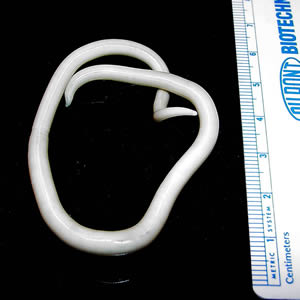
If only a few worms are present there may be no symptoms initially; however, during the migratory phase the larvae may penetrate into the tissues and circulate around the body via the blood and lymphatic systems, commonly to the lungs. In the lungs, the larvae penetrate the pulmonary capillaries to enter the alveoli, from where they ascend into the throat and descend back into the gut where they may grow as large as 35 cm in length1.
Epidemiology
Incidence
Infection with the nematode A. lumbricoides is endemic throughout the world. It is estimated that approximately 1 billion people are infected worldwide2.
The highest rates of infection with A. lumbricoides occur in China and Southeast Asia and in Africa in coastal regions of the West and in Central Africa3.
Risk factors
Large numbers of A. lumbricoides eggs may be found in municipal domestic sewage and individuals eating unwashed fruit and vegetables, particularly those grown in, or near, soil fertilised with sewage are more likely to become infected. Low socio-economic class and poor sanitation are also risk factors for infection.
Presentation1
Adult worms usually cause no symptoms if localised to the intestinal lumen.
Infestation may cause impaired growth in children.
Heavy infestations may cause abdominal pain, nausea, vomiting, anorexia, diarrhoea, malabsorption, weight loss, anal itching and intestinal obstruction.
Migrating adult worms may cause symptomatic occlusion of the biliary tract or oral expulsion.
Larval migration may cause cough, dyspnoea, haemoptysis and eosinophilic pneumonitis (Löffler's syndrome).
Differential diagnosis
The differential diagnosis will depend on the symptoms displayed but will also include infection with Trichuris trichiura, another roundworm causing similar problems.
Investigations
Diagnosis is usually made by identifying eggs in a stool sample.
FBC may reveal eosinophilia or anaemia.
LFTs may reveal liver damage or low protein state.
Specific investigations such as ultrasound, X-ray, amylase level, lung function tests and exploratory surgery may be required depending on the site of infestation.
Endoscopic retrograde cholangiopancreatography may be useful if biliary tree involvement is suspected4.
Management
Advise the patient to wash his or her hands thoroughly after using the toilet or changing nappies and before eating or preparing food5.
Drug treatment6:
Mebendazole is effective and generally considered to be the drug of choice for children aged 12 months and older and for adults.
Levamisole (unlicensed) or piperazine may be used as an alternative when mebendazole cannot be used.
Surgical intervention may be required to treat abdominal complications7.
Complications
Chronic infestation with A. lumbricoides may be associated with a poor nutritional state, anaemia, failure to thrive and impaired cognition, particularly in children. Nutritional deficiencies and anaemia may be caused by heavy worm loads, especially in people in developing countries where nutritional status is often marginal5.
Other possible complications include:
Intestinal: intussusception, perforation, appendicitis, peritonitis, volvulus.
Pancreatitis, cholangitis, jaundice, liver abscesses.
Respiratory tract obstruction.
Prognosis5
Uncomplicated infections respond well to treatment with anthelmintics.
Left untreated, some infections will resolve spontaneously and adult worms usually cause little pathology if they remain in the small intestine.
However, migration to other locations such as the liver, lungs, heart, or genitourinary tract may cause severe acute problems and death.
Re-infections can occur rapidly after treatment and so there is a need for frequent anthelmintic drug administrations to maximise the benefit of preventative chemotherapy in developing countries8.
Prevention
Infection can be avoided by scrupulous attention to personal hygiene and the careful washing of all fruit and vegetables.
Improved sanitation in developing countries is associated with a reduced risk of transmission of helminthiases to humans9.
Exclusive updates for healthcare professionals
Stay informed with the latest clinical updates, professional insights, and evidence-based guidance. The Patient Pro newsletter curates essential content for healthcare professionals—delivered straight to your inbox.
By subscribing you accept our Privacy Policy. You can unsubscribe at any time. We never sell your data.
Further reading and references
- Keiser J, Utzinger J; Efficacy of current drugs against soil-transmitted helminth infections: systematic review and meta-analysis. JAMA. 2008 Apr 23;299(16):1937-48.
- Khuroo MS, Rather AA, Khuroo NS, et al; Hepatobiliary and pancreatic ascariasis. World J Gastroenterol. 2016 Sep 7;22(33):7507-17. doi: 10.3748/wjg.v22.i33.7507.
- Ascariasis; DPDx, Centers for Disease Control and Prevention
- Dold C, Holland CV; Ascaris and ascariasis. Microbes Infect. 2011 Jul;13(7):632-7. doi: 10.1016/j.micinf.2010.09.012. Epub 2010 Oct 8.
- de Silva N, Brooker S, Hotez P; Soil-Transmitted Helminthic Infection: Updating the Global Picture Disease Control Priorities Project Working Paper No.12 July 2003
- Khandelwal N, Shaw J, Jain MK; Biliary parasites: diagnostic and therapeutic strategies. Curr Treat Options Gastroenterol. 2008 Mar;11(2):85-95.
- Roundworm; NICE CKS, January 2015 (UK access only)
- British National Formulary (BNF); NICE Evidence Services (UK access only)
- Hesse AA, Nouri A, Hassan HS, et al; Parasitic infestations requiring surgical interventions. Semin Pediatr Surg. 2012 May;21(2):142-50. doi: 10.1053/j.sempedsurg.2012.01.009.
- Jia TW, Melville S, Utzinger J, et al; Soil-transmitted helminth reinfection after drug treatment: a systematic review and meta-analysis. PLoS Negl Trop Dis. 2012;6(5):e1621. doi: 10.1371/journal.pntd.0001621. Epub 2012 May 8.
- Ziegelbauer K, Speich B, Mausezahl D, et al; Effect of sanitation on soil-transmitted helminth infection: systematic review and meta-analysis. PLoS Med. 2012 Jan;9(1):e1001162. doi: 10.1371/journal.pmed.1001162. Epub 2012 Jan 24.
About the authorView full bio
Updated by

Dr Nick Imm, MRCGP
Surgeon Commander, Medical Author
BM, MRCGP, DRCOG, DFFP, DTMH
Nick Imm qualified in 1993 and joined EMIS as a clinical author for Patient.info in 2013.
About the reviewerView full bio

Dr Adrian Bonsall, MBBS
Medical Author
MA (Chemistry), MBBS (Hons), DCH
Since 2000 Adrian has been employed in emergency and critical care paediatrics based in Sydney, with particular interests in toxicology, trauma and resuscitation.

Ask, share, connect.
Browse discussions, ask questions, and share experiences across hundreds of health topics.

Feeling unwell?
Assess your symptoms online for free
More in infectious disease
- Amoebiasis
- Antenatal infections and their consequences
- Babesiosis
- Bartonellosis
- Body cavity filariasis
- Encephalitis and meningoencephalitis
- FeverPAIN score
- Hepatitis C
- HIV and skin disorders
- HIV counselling
- Laryngitis
- Long COVID
- Malaria prophylaxis
- Psittacosis
- PVL-positive Staphylococcus aureus
- Shigellosis
- Tinea capitis
- Tonsillitis
- Treating infections
- Zika virus