Necrobiosi lipoidica
Revisione paritaria di Dr Rachel Hudson, MRCGPUltimo aggiornamento di Dr Colin Tidy, MRCGPUltimo aggiornamento 15 giu 2023
Rispetta le linee guida editoriali
- ScaricaScarica
- Condividi
- Language
- Discussione
- Versione audio
- Aggiungi alle fonti preferite su Google
Professionisti Medici
Gli articoli di riferimento professionale sono progettati per essere utilizzati dai professionisti della salute. Sono scritti da medici del Regno Unito e basati su prove di ricerca, linee guida del Regno Unito ed europee. Potresti trovare uno dei nostri articoli sulla salute più utile.
What is necrobiosis lipoidica?1
Necrobiosis lipoidica is a rare inflammatory granulomatous skin disorder occurring as a result of collagen degeneration. It is characterised by irregularly shaped, callous lesions with reddish-brown pigmentation and central atrophy.
It was originally described in conjunction with diabetes. As it occurs in the absence of diabetes as well, it is now known as necrobiosis lipoidica, a term applied to all cases, whether occurring in those with diabetes or not.
The pathology is collagen degeneration with granulomatous response, associated with thickened blood vessels and fat deposition. The underlying cause is unknown but is believed to involve microangiopathy.2
For people with diabetes, prevention includes optimising glucose control. Improved glycaemic control can even lead to abatement in further progression to microvascular complications and improved long-term outcomes.3
How common is necrobiosis lipoidica? (Epidemiology)4
It is a rare skin condition. Whilst there is a high prevalence of diabetes mellitus in patients with necrobiosis lipoidica (one third of cases have diabetes, and two thirds have glucose tolerance abnormalities), the reported prevalence of necrobiosis lipoidica in patients with diabetes is 1-2%.
It most commonly presents in the 30s but can present at any age, including infancy. It tends to appear earlier in those with diabetes than in others: in one study, approximately 2% of young people with diabetes (aged up to 22 years) had a necrobiosis lipoidica lesion compared with none of the control subjects.5
It is three times as common in women as it is in men. Non-diabetic familial clustering of necrobiosis lipoidica does occur but extremely rarely.
Smoking is more prevalent in patients with diabetes with necrobiosis lipoidica than in those without it, as are diabetic complications (retinopathy and nephropathy), although the presence of necrobiosis lipoidica does not correlate with diabetic control.
Symptoms of necrobiosis lipoidica (presentation)
Necrobiosi lipoidica
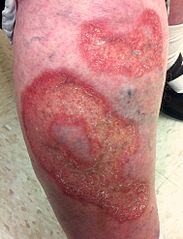
Shiny patches slowly enlarge over months or years. They are initially a reddish brown and 1-3 mm in diameter but progress to yellow and become depressed and atrophic plaques.
The most common site is the pretibial area but they can occur on the face, scalp, trunk and upper arms where they are less likely to be correctly diagnosed.
There is often no pain (due to associated neuropathy) but it can be very painful.
Trauma produces ulceration.
Köbner's phenomenon may be demonstrated, in which lesions occur in areas of trauma. (This phenomenon is more typically associated with psoriasis and lichen planus.)
Diagnosi differenziale
Usually the appearance is fairly typical but variations can be difficult to diagnose. Consider as a cause of atypical leg ulcers in diabetic patients.6
Superficial annular lesions may look like granuloma anulare. However, granuloma annulare do not exhibit the typical yellow fatty appearance of necrobiosis lipoidica plaques.
Yellow, fatty lesions may resemble xanthoma.
Sarcoidosi can appear very similar, even on histology.
Eritema nodoso. These lesions do not ulcerate.
Rheumatoid nodules are similar histologically but tend to be raised rather than atrophic. Ulcerated necrobiotic areas have been described in artrite reumatoide.
Eczema varicoso produces a scaly rash and is usually near the malleoli.
Indagini
If the patient is not known to have diabetes this must be checked. Biopsy of the lesion may be helpful but be aware of poor wound healing.
Management of necrobiosis lipoidica4 7
Management is impaired by lack of understanding of the aetiology of the condition. No treatment to date is completely effective and, whilst numerous treatments have been tried, none has proven effectiveness based on controlled trials.1
Trauma should be avoided, and strategies for prevention of ulcers employed. Wound care for established ulcers is as for other diabetic ulcers.
Potent topical steroids are usually considered first-line treatment. This may reduce inflammation but it does not benefit burned-out lesions and may aggravate atrophy, so careful monitoring for this is required.
Intralesional injections of steroids are also sometimes helpful, but increase the risk of ulceration.
Immunomodulating drugs have also been used, including:
Studies demonstrate spontaneous healing of necrobiosis lipoidica following pancreas and kidney transplantation and the immunosuppressive regime is thought to have played a significant role in this.11 12Antiplatelet treatment seems logical but controlled trials have had different results. Aspirin and dipyridamole have been used. Pentoxifylline decreases blood viscosity and increases fibrinolysis and erythrocyte deformity and it may be helpful. Ticlopidine and perilesional injections of heparin have been used in uncontrolled trials.
Excision and grafting are occasionally used but poor healing and recurrence are common.
Phototherapy. Photodynamic therapy has been used, as have topical retinoids and topical psoralens with ultraviolet A (PUVA).
Laser treatment has been used to stabilise lesions and reduce erythema and telangiectasias.
Prognosi3
The lesions often do not heal well and it becomes a chronic, relapsing condition. However, lesions are known to remit spontaneously and even resolve. The most common complication is ulceration, but occasionally carcinoma a cellule squamose can arise in areas of long-standing necrobiosis lipoidica.2 13
Aggiornamenti esclusivi per i professionisti sanitari
Rimani informato con gli ultimi aggiornamenti clinici, approfondimenti professionali e linee guida basate su evidenze. La newsletter Patient Pro seleziona contenuti essenziali per i professionisti sanitari—consegnati direttamente nella tua casella di posta.
Abbonandoti accetti i nostri Informativa sulla Privacy. Puoi annullare l'iscrizione in qualsiasi momento. Non vendiamo mai i tuoi dati.
Ulteriori letture e riferimenti
- Related conditions - Necrobiosis lipoidica; Diabetes UK
- Dissemond J; Images in clinical medicine. Necrobiosis lipoidica diabeticorum. N Engl J Med. 2012 Jun 28;366(26):2502. doi: 10.1056/NEJMicm1109700.
- Necrobiosi lipoidica; DermNet NZ
- Lause M, Kamboj A, Fernandez Faith E; Dermatologic manifestations of endocrine disorders. Transl Pediatr. 2017 Oct;6(4):300-312. doi: 10.21037/tp.2017.09.08.
- Necrobiosi lipoidica; Primary Care Dermatology Society (PCDS).
- Feily A, Mehraban S; Treatment Modalities of Necrobiosis Lipoidica: A Concise Systematic Review. Dermatol Reports. 2015 Jun 8;7(2):5749. doi: 10.4081/dr.2015.5749. eCollection 2015 May 21.
- Reid SD, Ladizinski B, Lee K, et al; Update on necrobiosis lipoidica: a review of etiology, diagnosis, and treatment options. J Am Acad Dermatol. 2013 Nov;69(5):783-91. doi: 10.1016/j.jaad.2013.05.034. Epub 2013 Aug 19.
- Naik PP, Farrukh SN; Clinical Significance of Diabetic Dermatopathy. Diabetes Metab Syndr Obes. 2020 Dec 8;13:4823-4827. doi: 10.2147/DMSO.S286887. eCollection 2020.
- Grillo E, Rodriguez-Munoz D, Gonzalez-Garcia A, et al; Necrobiosis lipoidica. Aust Fam Physician. 2014 Mar;43(3):129-30.
- Pavlovic MD, Milenkovic T, Dinic M, et al; The prevalence of cutaneous manifestations in young patients with type 1 diabetes. Diabetes Care. 2007 Aug;30(8):1964-7. Epub 2007 May 22.
- Gottrup F, Karlsmark T; Leg ulcers: uncommon presentations. Clin Dermatol. 2005 Nov-Dec;23(6):601-11.
- Erfurt-Berge C, Seitz AT, Rehse C, et al; Update on clinical and laboratory features in necrobiosis lipoidica: a retrospective multicentre study of 52 patients. Eur J Dermatol. 2012 Nov-Dec;22(6):770-5. doi: 10.1684/ejd.2012.1839.
- Stanway A, Rademaker M, Newman P; Healing of severe ulcerative necrobiosis lipoidica with cyclosporin. Australas J Dermatol. 2004 May;45(2):119-22.
- Rallis E, Korfitis C, Gregoriou S, et al; Assigning new roles to topical tacrolimus. Expert Opin Investig Drugs. 2007 Aug;16(8):1267-76.
- Suarez-Amor O, Perez-Bustillo A, Ruiz-Gonzalez I, et al; Necrobiosis lipoidica therapy with biologicals: an ulcerated case responding to etanercept and a review of the literature. Dermatology. 2010;221(2):117-21. doi: 10.1159/000314694. Epub 2010 Jun 25.
- Gullo D, Latina A, Tomaselli L, et al; Healing of chronic necrobiosis lipoidica lesions in a type 1 diabetic patient after pancreas-kidney transplantation: a case report. J Endocrinol Invest. 2007 Mar;30(3):259-62.
- Souza AD, El-Azhary RA, Gibson LE; Does pancreas transplant in diabetic patients affect the evolution of necrobiosis Int J Dermatol. 2009 Sep;48(9):964-70.
- Lim C, Tschuchnigg M, Lim J; Squamous cell carcinoma arising in an area of long-standing necrobiosis lipoidica. J Cutan Pathol. 2006 Aug;33(8):581-3.
Informazioni sull'autoreVisualizza il profilo completo
Aggiornato da

Dr Colin Tidy, MRCGP
Medico di base, Autore medico
MBBS, MRCGP, MRCP (Paediatrics), DCH
Il Dr Colin Tidy è un medico del NHS, con sede nell'Oxfordshire.
Informazioni sul recensoreVisualizza il profilo completo

Dr Rachel Hudson, MRCGP
Medico Generico e Autore Medico
MBChB, MRCGP (2008), BSc (Medical Science), DFSRH, DRCOG, DCH
La Dott.ssa Rachel Hudson è un medico di base del NHS che lavora nel nord-ovest dell'Inghilterra.
Storia dell'articolo
Articolo disponibile anche in Inglese, Tedesco, Spagnolo, Francese, Italiano, Portoghese, Hindi, Ebraico, Arabo, and Svedese.
Prossima revisione prevista: 12 maggio 2028
15 giu 2023 | Ultima versione

Chiedi, condividi, connettiti.
Esplora le discussioni, fai domande e condividi esperienze su centinaia di argomenti di salute.

Non ti senti bene?
Valuta i tuoi sintomi online gratuitamente
Altro in dermatologia
- Acne conglobata e forme più rare di acne
- Balanite
- Trattamento alla cieca dell'infezione batterica
- Foruncoli e carbonchi
- Malattia di Bowen
- ulcera di Buruli
- Campbell de Morgan spot
- Cellulite ed erisipela
- Sindrome di Chediak-Higashi
- Varicella
- Larva migrans cutanea
- Dermatite artefattiva
- Eczema su mani e piedi
- Cheratosi pilare
- Dermatosi lineare da IgA
- Melanoma maligno della pelle
- Disturbi e anomalie delle unghie
- Fascite necrotizzante
- Pemfigo
- Malattia di Schamberg