Rimozione dei peli con laser
Revisione paritaria di L'Associazione Britannica dei Chirurghi Plastici (BAAPS)Autore L'Associazione Britannica dei Chirurghi Plastici (BAAPS)Pubblicato originariamente 23 Mar 2016
Rispetta le linee guida editoriali
- ScaricaScarica
- Condividi
- Language
- Discussione
- Versione audio
Questa pagina è stata archiviata.
Non è stato rivisto di recente e non è aggiornato. I link esterni e i riferimenti potrebbero non funzionare più.
Questo opuscolo è fornito da Associazione Britannica di Chirurghi Plastici Estetici, l'organismo professionale responsabile del progresso dell'educazione e della sicurezza nella chirurgia plastica estetica.
In questo articolo:
Video consigliati per Chirurgia estetica
Traditional methods for removing unwanted body hair include shaving, waxing, the application of depilatory cream and electrolysis. Depilation by laser is a relatively new technique. It helps not only those with normal hair growth, but also those with excessive hairiness of the body or face, a condition called hirsutism which causes considerable psychological distress.
Hirsutism affects approximately 10% of women between the ages of 18 and 35. In most cases there is no obvious cause but some patients may have a hormonal disturbance. Hirsutism may also be a feature of the menopause. Unwanted hair is a significant problem for transsexuals and transvestites, and many males with hair on their back dislike it intensely. Children with hairy moles of the face or lumbar spine area are often teased.
Continua a leggere sotto
Hair biology
Hair biology
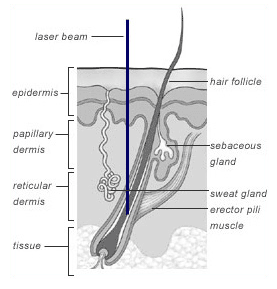
The hair grows in cycles, alternating between a growing phase (anagen) and a quiescent phase (telogen); catagen is the period of transition between the two.
Cells half way up the hair follicle are thought to be responsible for hair growth. The depilation laser delivers a particular wavelength of laser light which targets the pigment in the hair. This light penetrates up to a millimetre beneath the skin where it is absorbed by the pigment in the part of the hair root which is important for growth.
Hairs come in a variety of thicknesses and colours according to the pigment they contain. Black and laser light penetrates through the skin and is preferentially absorbed by the hair.
The stem cells responsible for hair growth are thought to be located at the attachment of the erector pili muscle to the follicle. The brown hairs contain most pigment and are easiest to treat. Grey or blonde hair has little pigment and is unlikely to respond to treatment.
Trattamento
Torna ai contenutiTreatment may be a little uncomfortable - it feels a little like an elastic band snapping against the skin - but some patients prefer to use local anaesthetic cream to numb the area first. Aloe vera gel may also be used during or after treatment for its cooling effect. Some lasers have a cooling system which reduces the discomfort of the treatment.
After treatment, the treated area may look red and feel warm and tender. This feeling goes after a couple of hours, but in a few patients, particularly those with dark skin, blistering and crusting of the skin sometimes occur after laser treatment. Some hairs disappear at the treatment session; others, which initially look curled up or "frazzled" may take a few days to fall out.
Continua a leggere sotto
Types of laser
Torna ai contenutiA variety of laser systems are now available. Ruby lasers, Alexandrite lasers, Nd-YAG lasers and white light machines can all be used to remove hair with varying degrees of success. The size of the area covered by each pulse of laser energy varies with the machine used.
Risultati
Torna ai contenutiInitial reports of laser hair removal were extremely promising, and some research went so far as to claim that it may be permanent, but this is generally not the case. A few patients do not respond to the laser treatment at all but many will have good results. Regrowth is not only less dense but also less coarse. In the ideal patient, with dark hair and pale skin, the hair usually disappears for two to three months and then slowly regrows. Repeat treatment is usually required several times a year.
Continua a leggere sotto
Sicurezza
Torna ai contenutiWhen laser treatment is carried out it is essential that all those within the treatment room, you and the staff, should wear protective goggles or glasses. Entry to the room is strictly controlled whilst treatment is being given.
Complications and problems
Torna ai contenutiLaser light can damage the skin's pigment and sometimes the treatment area may become unusually pale or dark several months after treatment. For this reason, it is always wise to carry out a small trial of treatment in an unobtrusive area before proceeding to extensive treatment. The test patch is examined six to eight weeks later for unwanted side effects and to carefully assess success before proceeding to further treatment. Special care is needed when treating patients with black or brown skin. The Nd-YAG laser may be most suitable for dark skins as it causes less skin damage. After treatment you should stay out of the sun as exposure of recently laser treated skin to strong sunshine may increase the risk of pigmentation problems.
Il futuro
Torna ai contenutiAt present many patients derive great benefit from laser hair removal, achieving hair-free intervals of up to three months. Further research is likely to improve results in the future. Permanency, the gold standard of hair removal, seems to be some way off however.
Contenuto utilizzato con il permesso del sito web della British Association of Aesthetic Plastic Surgeons: Rimozione dei peli con laser. Il copyright di questo opuscolo è di BAAPS.
Avvertenza
Questo opuscolo è progettato per fornire informazioni utili ma non deve essere considerato come un consiglio specifico per alcun caso particolare. Non sostituisce la necessità di una consultazione approfondita e tutti i pazienti potenziali dovrebbero cercare il consiglio di un medico adeguatamente qualificato. La BAAPS non accetta alcuna responsabilità per qualsiasi decisione presa dal lettore riguardo al trattamento che decidono di intraprendere.
Scelte dei pazienti per Chirurgia estetica

Chirurgia e procedure
Lifting del viso
Questo opuscolo è fornito dalla British Association of Aesthetic Plastic Surgeons, l'organismo professionale responsabile dell'avanzamento dell'educazione e della sicurezza nella chirurgia plastica estetica.
da The British Association of Plastic Surgeons (BAAPS)
Chirurgia e procedure
Chirurgia oculare laser
La chirurgia oculare laser sta diventando sempre più popolare come alternativa permanente all'uso di occhiali o lenti a contatto.
di Dr Colin Tidy, MRCGP
Continua a leggere sotto
Storia dell'articolo
Le informazioni su questa pagina sono scritte e revisionate da clinici qualificati.
23 Mar 2016 | Pubblicato originariamente
Autore:
L'Associazione Britannica dei Chirurghi Plastici (BAAPS)Revisione paritaria di
L'Associazione Britannica dei Chirurghi Plastici (BAAPS)

Chiedi, condividi, connettiti.
Esplora le discussioni, fai domande e condividi esperienze su centinaia di argomenti di salute.

Non ti senti bene?
Valuta i tuoi sintomi online gratuitamente
Iscriviti alla newsletter di Patient
La tua dose settimanale di consigli sulla salute chiari e affidabili - scritti per aiutarti a sentirti informato, sicuro e in controllo.
Abbonandoti accetti il nostro Informativa sulla Privacy. Puoi annullare l'iscrizione in qualsiasi momento. Non vendiamo mai i tuoi dati.