Scaphoid wrist fracture
Peer reviewed by Dr Colin Tidy, MRCGPLast updated by Dr Toni Hazell, FRCGPLast updated 15 Sept 2023
Meets Patient’s editorial guidelines
- DownloadDownload
- Share
- Language
- Discussion
- Audio Version
- Add to preferred sources on Google
The scaphoid bone is one of the carpal bones in your hand around the area of your wrist. It is the most common carpal bone to break (fracture). A scaphoid fracture is usually caused by a fall on to an outstretched hand. Symptoms can include pain and swelling around the wrist. Diagnosis of a scaphoid fracture can sometimes be difficult, as not all show up on X-rays. Treatment is usually with a cast worn on your arm up to your elbow for 6-12 weeks. Sometimes surgery is advised. Correct diagnosis and prompt treatment of a scaphoid fracture can help to reduce complications.
At a glance
A scaphoid fracture is a break in a small bone in your wrist called the scaphoid.
It usually happens after a fall onto an outstretched hand.
Symptoms include wrist pain, bruising, or swelling after an injury.
Fractures may not show up on an initial X-ray, so a follow-up X-ray or scan might be needed.
Treatment for a confirmed or suspected fracture is often a cast for 6-12 weeks.
Untreated fractures can lead to complications such as ongoing pain and loss of function.
What is a scaphoid fracture?
A scaphoid fracture occurs when you break your scaphoid bone. It is the type of fracture that most commonly happens after a fall on to your outstretched hand. That is, when your palm is flat and stretched out and your wrist is bent backwards as you fall to the ground. Instinctively, you will usually put your hands out in this position for protection if you fall forwards.
What causes a scaphoid fracture?
Sometimes a direct blow to the palm of your hand can cause a scaphoid fracture. Rarely, repeated 'stress' on the scaphoid bone can lead to a fracture. This can occur, for example, in gymnasts and shot putters.
Commonly you will fracture only your scaphoid bone but sometimes other bones around the wrist area may be broken at the same time.
Scaphoid fractures may be non-displaced (the fragments of the broken bone haven't moved out of position) or displaced (there is some movement of the bone fragments).
How common is a scaphoid fracture?
The scaphoid bone is the most commonly broken (fractured) carpal bone. This is because of its size and position in the two rows of carpal bones in the wrist.
Scaphoid fracture symptoms
Usually, most people who break (fracture) a scaphoid bone will remember a specific injury or fall. Symptoms of a scaphoid fracture include:
Pain around the wrist area after the injury.
Bruising or swelling around the wrist on the affected side.
In some people, symptoms may be milder. Quite commonly, people with a scaphoid fracture just assume that they have a wrist sprain and don't seek medical attention for some time afterwards. The fracture may only be diagnosed when they see a doctor some weeks later because of pain that is not settling or reduced movement around their wrist.
How is a scaphoid fracture diagnosed?
A doctor will usually suspect a scaphoid break (fracture) by the mechanism of the injury that has happened - for example, a fall on to an outstretched hand. Also, when they examine your wrist and hand, there is a specific point where you are likely to be tender if you have a scaphoid fracture. This is known as the anatomic snuffbox. It is a depression in your skin on the back of your hand near to the base of your thumb. Movement of your wrist in certain directions may also be painful if you have fractured your scaphoid.
It can sometimes be quite difficult to diagnose a scaphoid fracture. However, it is important to recognise and treat a scaphoid fracture as soon as possible because the complication of non-union (see below) is more likely if treatment is delayed.
Wrist X-ray
Standard X-rays may not pick up all scaphoid fractures. This is because the scaphoid bone can 'hide' behind the other carpal bones on an X-ray. Special scaphoid view X-rays taken with your hand and wrist in a certain position may help to show up a scaphoid fracture. However, about 2 in every 10 scaphoid fractures may not be seen on X-ray at first.
In some cases, a scaphoid fracture will not show up on an X-ray until around 10-14 days after the initial injury. At this time, the healing process will have started in the bone, which will help the fracture site to show up. So, if a scaphoid fracture is suspected but not confirmed on an initial X-ray, you will usually be treated as if you have a scaphoid fracture (see below). A repeat X-ray may be suggested after 10-14 days.
Ultrasound, CT or MRI scan
Sometimes, at this time, it is still not clear whether you have had a scaphoid fracture. If this is the case, a CT scan or MRI scan may be suggested to look for the fracture. A radionuclide bone scan is occasionally used as an alternative but this is used less often, as MRI and CT scans are more widely available and expose you to less radiation.
There is currently some debate as to whether there is benefit of doing further investigations such as an ultrasound, CT or MRI scan earlier if a scaphoid fracture is suspected but has not shown up on the initial X-ray. You will usually be followed up by an orthopaedic surgeon in the outpatient clinic if a scaphoid fracture is diagnosed or suspected. They will be able to advise whether and when further investigations are needed.
Scaphoid fracture treatment
If a non-displaced scaphoid break (fracture) is confirmed on X-ray or is suspected, it is usually treated by putting your arm in a cast (commonly referred to as a plaster cast but actually made of fibreglass or another similar synthetic material) up to your elbow. This is not the same as wearing a splint - a splint can be removed and put back on, whereas a cast stays on for the whole time. The cast is usually worn for 6-12 weeks until the scaphoid bone heals. In some cases, it may be needed for longer.
If a scaphoid fracture is displaced, surgery may be advised. A small screw or a special pin is inserted into the scaphoid bone to hold the bone fragments together in the correct position. This can often be done via a small cut in your skin.
Sometimes surgery may be an option for some people even if a scaphoid fracture is non-displaced. The idea is that it avoids you having to wear a cast for a long period of time. In some cases it may remove the need for wearing a cast altogether.
Some also argue that it allows normal movement of your wrist to return more quickly than if you had just been treated with a cast. This means that you can return to your usual activities more quickly. For example, if you are an athlete, a musician, or if there is another reason why you have significant pressure to return to high-level activity quickly, this treatment option may be a consideration. However, this does mean going through a surgical procedure that does carry some small risks.
What happens if a scaphoid fracture is left untreated?
If the fracture is left untreated, there may be non-union and/or avascular necrosis - these are described in more detail below. Longer term consequences can include chronic pain and a loss of function.
Are there any complications?
A scaphoid break (fracture) will usually heal well if it is recognised and treated early. However, occasionally, complications can occur after a scaphoid fracture. These can include the following:
Delayed union or non-union
Delayed union occurs when the scaphoid bone has not healed completely after four months of being treated in a cast. Non-union occurs when the scaphoid fracture has not healed at all. In non-union, the bony fragments are still completely separated.
Delayed and non-union may be more likely if treatment of a scaphoid fracture is delayed for some reason. So, this is the main reason why a scaphoid fracture needs to be recognised and treated promptly. However, the exact position of the fracture in the scaphoid bone, whether the fracture is displaced of not, and whether or not there is avascular necrosis (see below), can also affect the healing of a scaphoid fracture.
If delayed or non-union occurs, various treatments may be suggested, including wearing a cast for a longer period or surgery to help join the bone fragments together. Surgery may involve a bone graft to help with fracture healing. This is a procedure where bone tissue is taken from another area of bone in the wrist and inserted into the fracture site.
Malunion
This occurs when the fragments of the scaphoid bone heal in an incorrect position - for example, at a slight angle. If this happens, it may affect the movement of the wrist and lead to pain and problems gripping and holding objects.
Malunion may be seen on an X-ray or scans of the scaphoid bone. Surgery is usually needed to correct this complication. The scaphoid bone is re-broken, aligned correctly and a bone graft used to correct the deformity and encourage healing.
Avascular necrosis
Most commonly, a fracture occurs at the narrowest part of the scaphoid (known as the waist). This is where the blood supply enters the scaphoid bone. So, there is a risk that if you have a fracture in this area, it can sometimes stop the blood supply to part of the scaphoid bone, leaving part of the bone without a blood supply. This means that the scaphoid will not be able to heal properly and part of the scaphoid bone 'dies', collapses and breaks up. ('Avascular' refers to having no blood supply and 'necrosis' means death.)
If it occurs, avascular necrosis can be seen on an X-ray of the scaphoid bone some months after the initial injury. However, avascular necrosis does not occur with all fractures around the waist of the scaphoid.
Osteoarthritis
Osteoarthritis can develop some time after a scaphoid fracture in some people. It is more likely if there have been complications of non-union, malunion or avascular necrosis.
Some anatomy around your wrist
Diagram showing scaphoid position
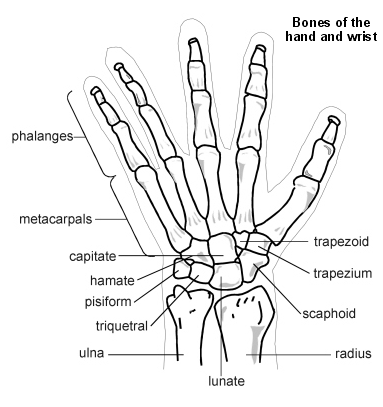
There are two bones in the part of the arm between the elbow and the wrist (the forearm). These bones are called the radius and the ulna.
The radius is on the thumb side of the wrist and the ulna is on the little finger side.
In the hand, there are eight small bones known as the carpal bones. They are arranged in two rows, one on top of the other.
The proximal row is the row that is closest to the arm. In the proximal row are the scaphoid, lunate, triquetrum and pisiform bones. The distal row is the row below this nearest to the hand. In the distal row are the hamate, capitate, trapezoid and trapezium bones.
The scaphoid bone is one of the largest of the carpal bones and is on the thumb side of the wrist. It looks a bit like a cashew nut and is roughly the same size. It links the two rows of carpal bones together and actually helps to stabilise them. The scaphoid bone and the lunate bone connect with the radius at the wrist joint.
Patient picks for Fractures

Bones, joints and muscles
Broken or bruised ribs
Broken or bruised ribs occur when there is a force to the chest such as from a fall, road accident or assault. The force from severe coughing, straining, or heavy sports can also cause rib injury. The symptoms may include pain when coughing, laughing or sneezing, and swelling around the ribs. A bruised rib usually heals itself in 2-3 weeks; pain killers may help with the symptoms. Complications can occur if internal organs are damaged by the sharp end of a broken rib. If you are feeling breathless or unable to catch your breath - call for an emergency ambulance immediately (999 in the UK).
by Dr Philippa Vincent, MRCGP
Bones, joints and muscles
Broken upper arm
Most of us will break a bone at some point in our lives. As a child it usually takes something major, like falling out of a tree, but we bounce back and usually recover quickly. As we get older though, more minor accidents such as tripping over from standing can result in a broken arm.
by Dr Colin Tidy, MRCGP
Frequently asked questions
What is the 'anatomic snuffbox' and why is it important in diagnosing a scaphoid fracture?
The anatomic snuffbox is a specific depression on the back of your hand near the base of your thumb. When a doctor examines your wrist and hand, tenderness in this area is a key indicator that you might have a scaphoid fracture. It helps them suspect a scaphoid break even if it doesn't immediately show up on an X-ray.
What is the difference between a displaced and non-displaced scaphoid fracture, and how does it affect treatment?
A non-displaced scaphoid fracture means the fragments of the broken bone have not moved out of position. These are typically treated by immobilising the arm in a cast. A displaced fracture, however, involves some movement of the bone fragments and may require surgery to insert a screw or pin to hold them together correctly.
If my initial X-ray doesn't show a fracture but it's still suspected, what happens next?
If a scaphoid fracture is suspected but not confirmed on an initial X-ray, you will usually be treated as if you have a fracture. A repeat X-ray may be suggested after 10-14 days. This is because the healing process will have started by then, which can make the fracture site more visible. If it's still unclear, a CT or MRI scan might be suggested later.
Why would someone choose surgery for a non-displaced scaphoid fracture instead of a cast?
While a cast is common for non-displaced fractures, surgery might be an option to avoid wearing a cast for a long period, or sometimes to remove the need for a cast entirely. Some believe it allows normal wrist movement to return more quickly, enabling a faster return to activities. This can be particularly relevant for athletes, musicians, or individuals who need to return to high-level activity quickly. However, surgery does involve small risks.
What does 'non-union' mean in the context of a scaphoid fracture?
Non-union means that the scaphoid fracture has not healed at all, and the bony fragments remain completely separated. This complication is more likely if treatment for a scaphoid fracture is delayed. If non-union occurs, treatments can include wearing a cast for a longer period or surgery, potentially with a bone graft to help the fragments join.
Further reading and references
- Mallee WH, Wang J, Poolman RW, et al; Computed tomography versus magnetic resonance imaging versus bone scintigraphy for clinically suspected scaphoid fractures in patients with negative plain radiographs. Cochrane Database Syst Rev. 2015 Jun 5;(6):CD010023. doi: 10.1002/14651858.CD010023.pub2.
- Clementson M, Bjorkman A, Thomsen NOB; Acute scaphoid fractures: guidelines for diagnosis and treatment. EFORT Open Rev. 2020 Feb 26;5(2):96-103. doi: 10.1302/2058-5241.5.190025. eCollection 2020 Feb.
- Mallee WH, Walenkamp MMJ, Mulders MAM, et al; Detecting scaphoid fractures in wrist injury: a clinical decision rule. Arch Orthop Trauma Surg. 2020 Apr;140(4):575-581. doi: 10.1007/s00402-020-03383-w. Epub 2020 Mar 3.
- Seltser A, Suh N, MacDermid JC, et al; The Natural History of Scaphoid Fracture Malunion: A Scoping Review. J Wrist Surg. 2020 Apr;9(2):170-176. doi: 10.1055/s-0039-1693658. Epub 2019 Jul 21.
- Backer HC, Wu CH, Strauch RJ; Systematic Review of Diagnosis of Clinically Suspected Scaphoid Fractures. J Wrist Surg. 2020 Feb;9(1):81-89. doi: 10.1055/s-0039-1693147. Epub 2019 Jul 21.
- Grewal R, Suh N, MacDermid JC; The Missed Scaphoid Fracture-Outcomes of Delayed Cast Treatment. J Wrist Surg. 2015 Nov;4(4):278-83. doi: 10.1055/s-0035-1564983.
- Jain R, Jain N, Sheikh T, et al; Early scaphoid fractures are better diagnosed with ultrasonography than X-rays: A prospective study over 114 patients. Chin J Traumatol. 2018 Aug;21(4):206-210. doi: 10.1016/j.cjtee.2017.09.004. Epub 2018 Jan 31.
About the authorView full bio
Updated by

Dr Toni Hazell, FRCGP
MBBS, BSc, FRCGP, DFSRH, Dip GU med, DRCOG, DCH (London, UK, 2000)
Dr. Toni Hazell qualified from St. Mary’s Hospital Medical School and did her VTS at Northwick Park Hospital.
About the reviewerView full bio

Dr Colin Tidy, MRCGP
General Practitioner, Medical Author
MBBS, MRCGP, MRCP (Paediatrics), DCH
Dr Colin Tidy is an NHS Doctor, based in Oxfordshire.
Join the conversation
Share your thoughts or experiences with others in our patient communities.

Ask, share, connect.
Browse discussions, ask questions, and share experiences across hundreds of health topics.

Feeling unwell?
Assess your symptoms online for free
Sign up to the Patient newsletter
Your weekly dose of clear, trustworthy health advice - written to help you feel informed, confident and in control.
By subscribing you accept our Privacy Policy. You can unsubscribe at any time. We never sell your data.